Last Updated on 15 Oct 2025
From Detection to Defense: How to Prevent Bot Attacks with Intelligent Threat Analysis
Share in

Key Notes
•
Bots often target high-value API endpoints, such as those handling login, pricing, inventory, checkout, and payouts, rendering simplistic defenses like IP blocks or broad rate limits ineffective.•
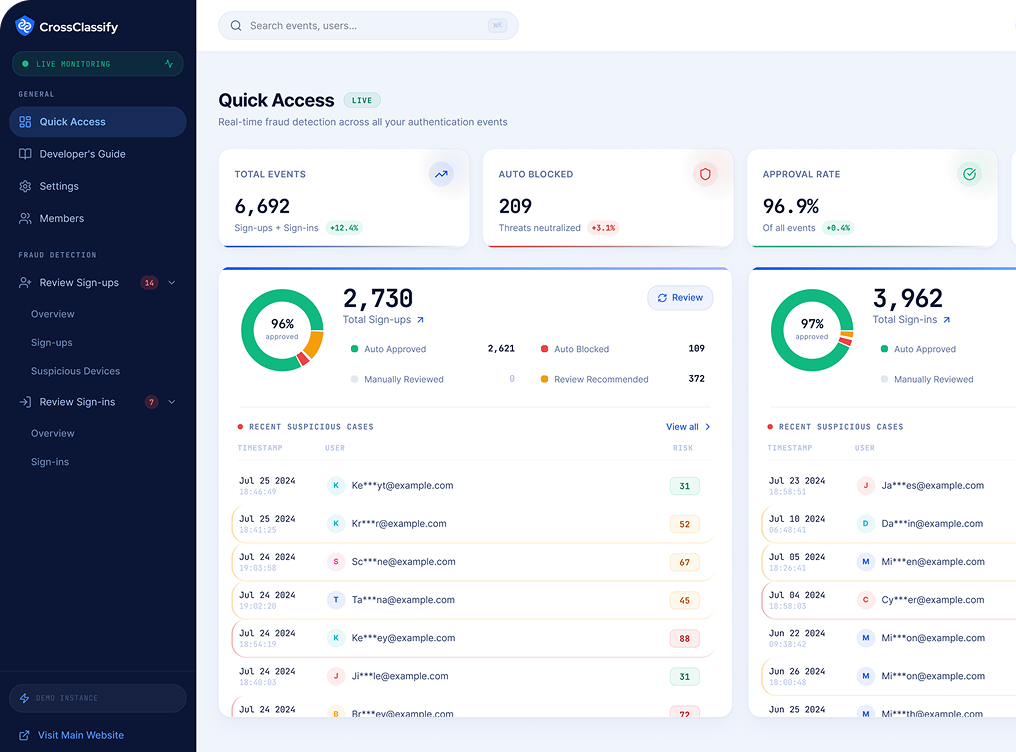
Intelligent threat analysis integrates behavioral patterns, device or identity verification, and network signals to assess risk in real time, enabling decisions to allow, escalate, or deny access while adhering to strict latency constraints.•
A hybrid architecture offers the optimal approach: begin with out-of-band monitoring for safe discovery and correlation, then elevate precise detections to inline enforcement at the edge or gateway, complete with emergency kill switches.•
Effective evaluations rely on phased proofs of concept with predefined acceptance criteria, measuring both attack mitigation and user experience impacts through verifiable, exportable data.•
Governance and key performance indicators (KPIs) should be embedded in the solution, emphasizing data minimization, explainable decisions, regional compliance, and monthly security scorecards linked to tangible business results.
Introduction
In today's digital landscape, APIs serve as the backbone of customer experiences, powering seamless interactions across platforms. However, attackers are increasingly leveraging emulator farms, residential proxies, and sophisticated automation tools that mimic human behavior to exploit these interfaces. Independent analyses reveal that automated traffic constitutes a substantial portion of internet activity, with a particular focus on APIs. For detailed trends and sector-specific insights, refer to the annual Bad Bot Report.
Traditional defenses include static signatures, IP blacklists, and uniform rate limits, yet these controls prove too rigid and easily circumvented. The more robust solution lies in intelligent threat analysis, which transforms raw data into actionable decisions under tight constraints of latency and privacy. This involves gathering multi-faceted telemetry, evaluating risk at both the request and session levels, implementing proportional responses, and iteratively refining models based on real-world outcomes.
To foster alignment across teams, adopting a common lexicon is essential. The OWASP Automated Threats (OAT) taxonomy outlines prevalent bot-driven tactics, including credential stuffing and scraping, while the OWASP API Security Top 10 (2023) highlights underlying logic vulnerabilities that bots frequently exploit.
Traditional defenses include static signatures, IP blacklists, and uniform rate limits, yet these controls prove too rigid and easily circumvented. The more robust solution lies in intelligent threat analysis, which transforms raw data into actionable decisions under tight constraints of latency and privacy. This involves gathering multi-faceted telemetry, evaluating risk at both the request and session levels, implementing proportional responses, and iteratively refining models based on real-world outcomes.
To foster alignment across teams, adopting a common lexicon is essential. The OWASP Automated Threats (OAT) taxonomy outlines prevalent bot-driven tactics, including credential stuffing and scraping, while the OWASP API Security Top 10 (2023) highlights underlying logic vulnerabilities that bots frequently exploit.
Understanding the Bot Threat: Why APIs Are Prime Targets
Imagine your APIs as the gateways to your business's most valuable assets including authentication, pricing queries, inventory checks, shopping carts, and financial payouts. These machine-readable interfaces are a goldmine for attackers, who deploy automated botsto probe, exploit, and profit. Campaigns often kick off with subtle reconnaissance to evade your defenses, then scale up by distributing attacks across varied identities, devices, and networks, making it nearly impossible to spot threats with isolated clues.
The fallout is multifaceted and costly: account takeovers fuel fraud and spike support tickets; competitive data scraping warps your analytics and erodes market edges; inventory manipulation frustrates genuine customers and skews demand forecasts; and automated refunds chip away at margins undetected. Since APIs drive core revenue, even fleeting disruptions or misclassifications can lead to significant financial hits. For a deeper dive into edge protection strategies, explore Cloudflare's guide on bot management.
Building a shared understanding starts with clear terminology. By leveraging the OWASP Automated Threats framework to categorize tactics like credential stuffing or denial of inventory, and pairing it with the API Security Top 10 to address vulnerabilities such as broken authorization, your teams can collaborate more effectively. This foundation sets the stage for the next step: crafting a sophisticated response through intelligent threat analysis.

The fallout is multifaceted and costly: account takeovers fuel fraud and spike support tickets; competitive data scraping warps your analytics and erodes market edges; inventory manipulation frustrates genuine customers and skews demand forecasts; and automated refunds chip away at margins undetected. Since APIs drive core revenue, even fleeting disruptions or misclassifications can lead to significant financial hits. For a deeper dive into edge protection strategies, explore Cloudflare's guide on bot management.
Building a shared understanding starts with clear terminology. By leveraging the OWASP Automated Threats framework to categorize tactics like credential stuffing or denial of inventory, and pairing it with the API Security Top 10 to address vulnerabilities such as broken authorization, your teams can collaborate more effectively. This foundation sets the stage for the next step: crafting a sophisticated response through intelligent threat analysis.
Building a Smarter Defense: The Power of Intelligent Threat Analysis
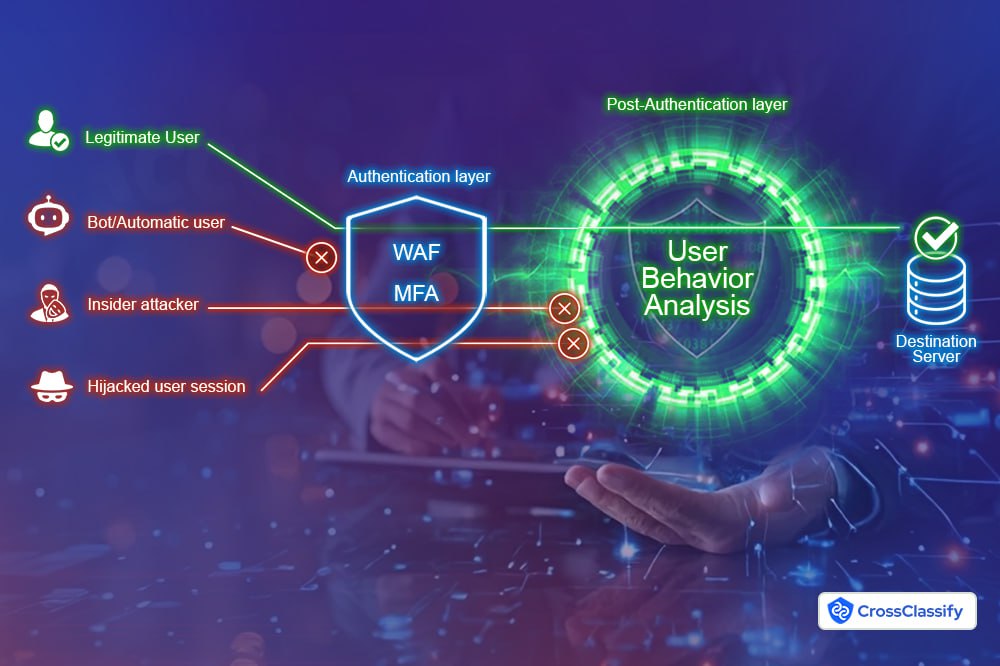
With the bot threat landscape in mind, how do you move beyond reactive fixes to proactive protection? Intelligent threat analysis is a dynamic approach that fuses diverse signals into real-time decisions. Drawing from behavioral cues like irregular navigation patterns, hesitation timing, and entropy in user journeys; device integrity checks for emulation or tampering; and network insights such as proxy fingerprints, geographic anomalies, and traffic bursts, allowing this method to paint a holistic picture of each interaction.
At its heart, risk scoring operates across requests and sessions: supervised models tackle familiar attacks, while unsupervised ones uncover novel clusters. Regular retraining combats model drift, ensuring adaptability to evolving threats. Crucially, decisions remain transparent, with key factors highlighted for quick analyst review, turning potential errors into learning opportunities.
Focusing on outcomes over alerts, this analysis tailors responses to context with minimal friction for low-risk browsing, escalated checks for high-stakes transactions like checkouts. By looping in feedback from confirmed incidents, your defenses refine over time, directly addressing the vulnerabilities outlined in the previous section. But to make this actionable, you need the right architecture to deploy it effectively.

At its heart, risk scoring operates across requests and sessions: supervised models tackle familiar attacks, while unsupervised ones uncover novel clusters. Regular retraining combats model drift, ensuring adaptability to evolving threats. Crucially, decisions remain transparent, with key factors highlighted for quick analyst review, turning potential errors into learning opportunities.
Focusing on outcomes over alerts, this analysis tailors responses to context with minimal friction for low-risk browsing, escalated checks for high-stakes transactions like checkouts. By looping in feedback from confirmed incidents, your defenses refine over time, directly addressing the vulnerabilities outlined in the previous section. But to make this actionable, you need the right architecture to deploy it effectively.
Choosing the Right Setup: Hybrid Architectures for Seamless Protection
Now that you've grasped how intelligent threat analysis transforms signals into safeguards, the question arises: where and how do you implement it without compromising speed or reliability? A hybrid architecture strikes the perfect balance, combining the immediacy of inline enforcement with the depth of out-of-bandprocessing.
Inline methods integrate directly into your traffic flow at the CDN edge or API gateway to enable instant actions like blocking a suspicious login burst before it escalates. This is ideal for high-value endpoints but demands ultra-low latency to avoid user frustration. For guidance on edge integrations, Cloudflare's bot management overview is invaluable.
Complementing this, out-of-band analysis works asynchronously, aggregating telemetry to reveal hidden patterns like cross-account device reuse or coordinated scraping that single requests miss. It enriches data with external intel and supports investigative tools, feeding refined rules back to the inline layer.
Starting out-of-band allows safe experimentation, as discussed in the analysis phase, before promoting proven detections inline. Incorporate client SDKs for richer signals and connect to SIEM systems for oversight, creating a feedback loop that evolves your defenses. With the architecture in place, the next challenge is validating its fit for your environment through structured evaluation.

Inline methods integrate directly into your traffic flow at the CDN edge or API gateway to enable instant actions like blocking a suspicious login burst before it escalates. This is ideal for high-value endpoints but demands ultra-low latency to avoid user frustration. For guidance on edge integrations, Cloudflare's bot management overview is invaluable.
Complementing this, out-of-band analysis works asynchronously, aggregating telemetry to reveal hidden patterns like cross-account device reuse or coordinated scraping that single requests miss. It enriches data with external intel and supports investigative tools, feeding refined rules back to the inline layer.
Starting out-of-band allows safe experimentation, as discussed in the analysis phase, before promoting proven detections inline. Incorporate client SDKs for richer signals and connect to SIEM systems for oversight, creating a feedback loop that evolves your defenses. With the architecture in place, the next challenge is validating its fit for your environment through structured evaluation.
Proving Value in Practice: Designing Evaluations and Proofs of Concept
Having selected a hybrid setup to operationalize your threat analysis, how can you confirm it delivers real results without risking your live traffic? A methodical evaluation process, centered on a phased proof of concept (PoC), provides the evidence you need while minimizing disruptions.
Begin by crafting a buyer's matrix that scrutinizes capabilities across signal layers, false positive controls, latency impacts, privacy features, and integration ease while building directly on the architectural choices from before. Align with standards like GDPR's Article 5 principles and the UK ICO's data minimization guidance.
The PoC unfolds in three stages: passive monitoring to baseline threats and risks; targeted inline testing on non-critical paths to assess performance; and a controlled production rollout with rollback safeguards. Each phase generates dashboards on metrics like suppression rates and conversion effects, tying back to OWASP taxonomies for context from Imperva's Bad Bot Report.
Predefine business-aligned gates such as fraud reduction targets or friction caps to ensure objectivity. This validation not only proves efficacy but also informs the smooth rollout and ongoing operations that follow.

Begin by crafting a buyer's matrix that scrutinizes capabilities across signal layers, false positive controls, latency impacts, privacy features, and integration ease while building directly on the architectural choices from before. Align with standards like GDPR's Article 5 principles and the UK ICO's data minimization guidance.
The PoC unfolds in three stages: passive monitoring to baseline threats and risks; targeted inline testing on non-critical paths to assess performance; and a controlled production rollout with rollback safeguards. Each phase generates dashboards on metrics like suppression rates and conversion effects, tying back to OWASP taxonomies for context from Imperva's Bad Bot Report.
Predefine business-aligned gates such as fraud reduction targets or friction caps to ensure objectivity. This validation not only proves efficacy but also informs the smooth rollout and ongoing operations that follow.
From Launch to Optimization: Implementing and Tuning Your Bot Defense
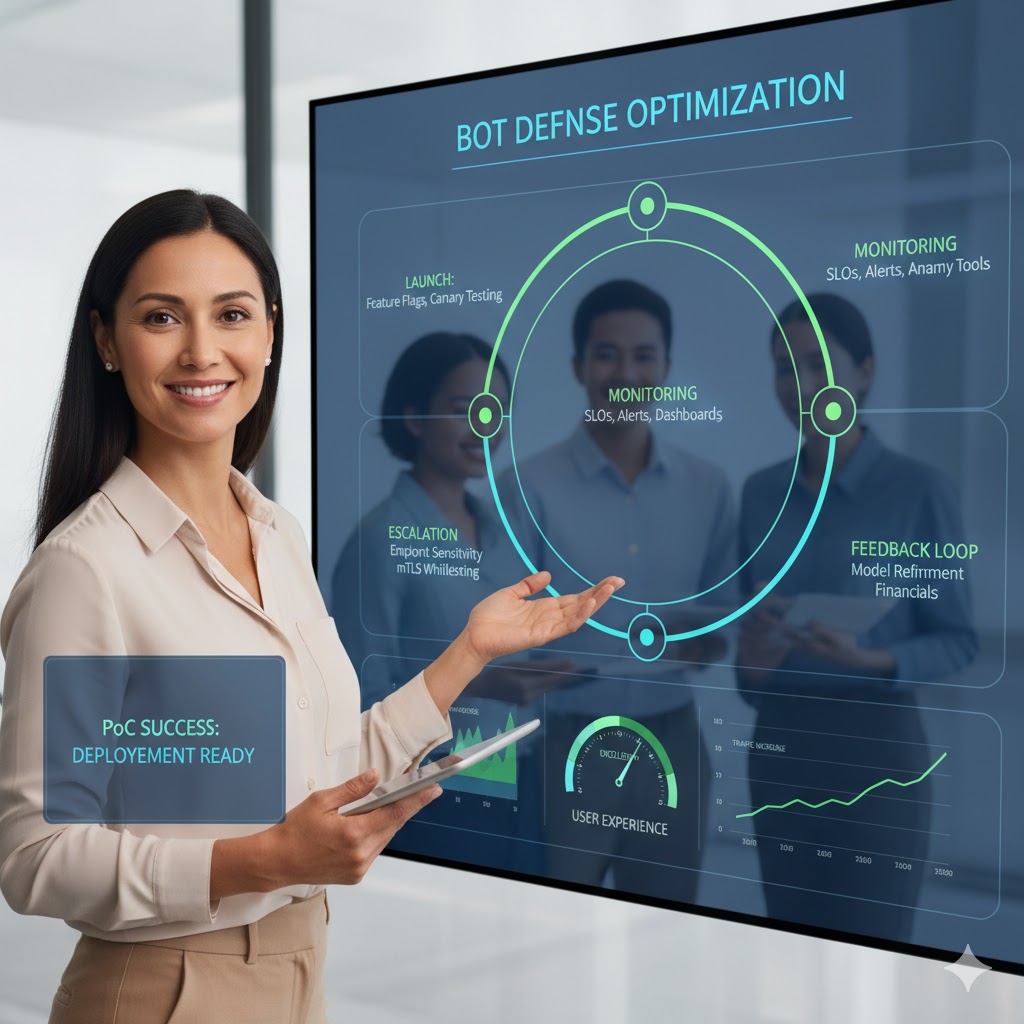
With a successful PoC under your belt, you're ready to deploy, but how do you ensure a flawless rollout and sustained performance? Implementation demands a cautious, iterative approach, starting with feature flags, canary testing on select endpoints, and gradual traffic increases to protect user experience.
Assign clear ownership and service level objectives (SLOs) to policies, monitoring them via dashboards that track changes and trigger alerts. Tuning evolves from there: calibrate thresholds by endpoint sensitivity, sequence escalations from subtle to overt, and whitelist legitimate bots using secure identifiers like mTLS, which extends the hybrid architecture's flexibility.
For high-pressure scenarios, predefined runbooks guide escalations and mode switches, while analyst tools enable deep dives into anomalies. Feeding insights back into models closes the loop, refining the defenses validated in your PoC. Yet, no strategy is complete without considering the full financial picture, from costs to returns.
Assign clear ownership and service level objectives (SLOs) to policies, monitoring them via dashboards that track changes and trigger alerts. Tuning evolves from there: calibrate thresholds by endpoint sensitivity, sequence escalations from subtle to overt, and whitelist legitimate bots using secure identifiers like mTLS, which extends the hybrid architecture's flexibility.
For high-pressure scenarios, predefined runbooks guide escalations and mode switches, while analyst tools enable deep dives into anomalies. Feeding insights back into models closes the loop, refining the defenses validated in your PoC. Yet, no strategy is complete without considering the full financial picture, from costs to returns.
Balancing Investment and Impact: Pricing, Total Cost of Ownership, and ROI
As your bot defense system goes live and tunes itself, it's essential to quantify its value so you can determine whether the protection justifies the expense. Total cost of ownership (TCO) goes beyond vendor fees, factoring in infrastructure for data flows, SDK maintenance, model operations, and privacy compliance, all layered atop your operational framework.
To build a compelling ROI case, baseline pre-deployment losses from threats like those in earlier sections, then measure improvements in monitoring mode and canaries. Annualize savings from reduced fraud, better conversions, and lower support loads, subtracting TCO for a net view. Transparent pricing and data exports enable independent verification.
Stay vigilant on emerging factors, such as AI crawler policies from Google's documentation and OpenAI's GPTBot, which could influence costs. This financial lens ensures accountability, but true sustainability requires robust governance to maintain trust.
To build a compelling ROI case, baseline pre-deployment losses from threats like those in earlier sections, then measure improvements in monitoring mode and canaries. Annualize savings from reduced fraud, better conversions, and lower support loads, subtracting TCO for a net view. Transparent pricing and data exports enable independent verification.
Stay vigilant on emerging factors, such as AI crawler policies from Google's documentation and OpenAI's GPTBot, which could influence costs. This financial lens ensures accountability, but true sustainability requires robust governance to maintain trust.
Safeguarding Trust: Governance and Privacy in Bot Defense
With ROI in focus, how do you ensure your defenses remain ethical and compliant as they scale? Strong governance embeds privacy from the start, adopting minimization by collecting only essential data for security purposes and purpose limitation, with transient retention and legal justifications per GDPR Article 5 and UK ICO guidance.
Log decisions transparently yet securely, with regional adaptations like EU-specific rules, and vet third-party data rigorously. This framework not only mitigates risks but also builds stakeholder confidence, directly supporting the operational tuning and financial evaluations discussed previously. Finally, to close the circle, track progress through meaningful metrics that drive continuous improvement.

Log decisions transparently yet securely, with regional adaptations like EU-specific rules, and vet third-party data rigorously. This framework not only mitigates risks but also builds stakeholder confidence, directly supporting the operational tuning and financial evaluations discussed previously. Finally, to close the circle, track progress through meaningful metrics that drive continuous improvement.
Tracking Progress and Driving Improvement: KPIs, Dashboards, and Continuous Evolution
How do you know your bot defense is truly succeeding over time? By measuring success through a balanced set of KPIs and dashboards that connect efficacy, user experience, and business outcomes by building on the governance foundation to inform future refinements.
Efficacy metrics include threat suppression by type, detectionspeed, and model drift rates; experience trackers cover false positive rates, challenge frequencies, and explainability; while business indicators reveal conversion lifts, fraud declines, and support savings. A monthly scorecard synthesizes these, highlighting incidents, trends, and experiments, each tied to hypotheses like new signal integrations.
This ongoing measurement not only validates your investment but also feeds back into every prior stage, from threat understanding to implementation, creating an engaging, adaptive cycle that keeps your APIs secure and your users satisfied.

Efficacy metrics include threat suppression by type, detectionspeed, and model drift rates; experience trackers cover false positive rates, challenge frequencies, and explainability; while business indicators reveal conversion lifts, fraud declines, and support savings. A monthly scorecard synthesizes these, highlighting incidents, trends, and experiments, each tied to hypotheses like new signal integrations.
This ongoing measurement not only validates your investment but also feeds back into every prior stage, from threat understanding to implementation, creating an engaging, adaptive cycle that keeps your APIs secure and your users satisfied.
Industry Playbooks
Dive into sector-specific strategies for combating bot attacks, drawing on proven tactics to protect critical APIs. Each playbook highlights unique challenges, recommended defenses, and how intelligent threat analysis can be tailored for maximum impact. For customized implementations, check out CrossClassify's specialized solutions designed to address these exact threats.
Fintech: Safeguarding Transactions Against Fraudulent Automation
In the fast-paced world of fintech, APIs handle everything from account onboarding to instant payouts, making them magnets for sophisticated bots engaging in synthetic identity fraud, account takeovers, and card testing rings. To counter this, implement device fingerprinting and behavioral biometrics at key touchpoints like login and transaction initiation, while using real-time risk scoringto flag anomalies such as unusual velocity in fund transfers. Out-of-band analytics can uncover hidden networks of mule accounts by correlating device reuse and session patterns across users. Maintain audit-ready logs to comply with regulations like PCI DSS, ensuring every decision is traceable and defensible. Explore CrossClassify's fintech defenses for seamless integration that minimizes false positives and preserves user trust.
Healthcare: Securing Patient Data and Claims Processing
Healthcare APIs manage sensitive operations like patient portals, claim submissions, and prescription refills, where bots exploit vulnerabilities for data breaches, insurance fraud, or unauthorized access to medical records. Prioritize privacy-centric signals, such as anonymized behavioral patterns and device attestation, to detectscripted interactions without compromising HIPAA compliance. Inline challenges on high-risk actions, like record exports, should be user-friendly to avoid disrupting care, while out-of-bandcorrelation identifies slow-drip scraping campaigns spanning multiple sessions. Short data retention policies and explainable AI decisions build confidence among providers and patients alike. For robust, compliant protection, consider CrossClassify's healthcare strategies that balance security with accessibility.
Crypto: Fortifying Exchanges and Wallet Security
Crypto platforms are battlegrounds for bots using virtual machines to automate trades, withdrawals, and KYC bypasses, often leading to wash trading or large-scale laundering schemes. Bolster defenses with advanced emulator detection and cryptographic token binding to ensure session integrity, enforcing multi-factor step-ups on withdrawals above thresholds. Keep trading APIs low-latency with edge-based inline filters, while leveraging out-of-band graph analysis to expose bot farms coordinating across wallets. This approach not only thwarts immediate threats but also adapts to emerging tactics in decentralized finance. Discover how CrossClassify's crypto solutions can enhance your exchange's resilience without slowing down market makers.
Travel: Defending Bookings and Inventory from Scrapers
Travel APIs face relentless scraping for pricing data and inventory hoarding that inflates operational costs and disrupts genuine bookings. Combat this with entropy-based behavioral checks on search queries to differentiate humans from scripts, applying dynamic rate limiting and CAPTCHA escalations at checkout. Out-of-band tools excel at detecting proxy networks rotating through fake sessions, allowing you to blacklist patterns while whitelisting loyal travelers for frictionless experiences. This preserves revenue by reducing no-shows and fake reservations. Tailor these tactics further with CrossClassify's travel protections, optimized for high-volume, seasonal traffic.
iGaming: Ensuring Fair Play and Blocking Bonus Abuse
iGaming sites contend with bots scripting gameplay, exploiting bonuses, and multi-accounting to skew odds and drain promotions. Continuous in-session monitoring of action patterns such as unnatural win rates or rapid bet placements combined with device correlation across accounts, helps isolate farms. Inline burst controls prevent overload during events, while out-of-band anomaly detection uncovers collusion rings. Focus on fair, engaging environments that comply with gambling regulations. Enhance your platform's integrity using CrossClassify's iGaming defenses, which integrate seamlessly with real-time odds systems.
Mining: Protecting Operational Interfaces from Unauthorized Access
Mining operations rely on APIs for telemetry, scheduling, and maintenance, where bots probe for credential stuffing to disrupt supply chains or steal proprietary data. Establish baseline behaviors for authorized devices and escalate on deviations, such as unexpected API calls to control systems. High-fidelity logging supports forensic investigations, ensuring quick recovery from incidents. This rugged approach withstands industrial environments. Strengthen your defenses with CrossClassify's mining solutions, built for reliability in remote operations.
Freight and Transportation: Halting Fake Carriers and Route Manipulation
Freight marketplaces are plagued by bots creating bogus carrier profiles and scraping load data to manipulate markets. Screen registrations with identity verification and device history checks, throttling bulk queries to prevent harvesting. Out-of-band cohort analysis reveals coordinated fraud across lanes, streamlining verification for trusted partners. This reduces downtime and fraud losses in logistics. Optimize your network via CrossClassify's freight and transportation tools, focused on secure B2B interactions.
Supply Chain and Logistics: Shielding B2B Platforms from Harvesting
Supply chain APIs expose pricing, inventory, and partner data to credential attacks and systematic scraping. Enforce mutual TLS authentication and per-partner rate controls, monitoring for anomalies like unusual data exports. Out-of-band detection curtails abuse while maintaining high throughput for legitimate integrations. This fosters secure collaborations. Bolster your ecosystem with CrossClassify's supply chain and logistics defenses, emphasizing trusted automation.
Recruitment: Combating Fake Profiles and Application Bots
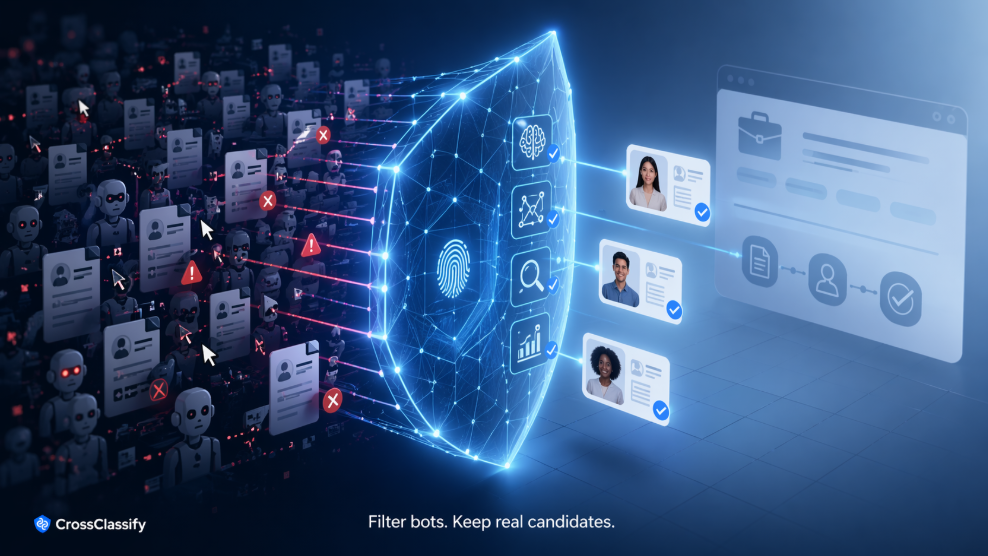
Recruitment platforms battle mass fake submissions and resumescraping that overwhelm systems and compromise candidate data. Correlate submission behaviors and devices to flag bot farms, deploying targeted challenges on suspicious batches. Protect contact reveals with risk-based policies. This ensures quality hires and data integrity. Refine your processes using CrossClassify's recruitment strategies, tailored for high-volume applicant flows.
Accounting: Securing Financial Workflows from Manipulation
Accounting systems face bots tampering with ledgers, automating fraudulent invoices, and exporting sensitive reports. Bind sessions to trusted devices and require escalations for mutations like payment changes. Out-of-band analytics spot entity-wide anomalies, with immutable logs for audits. This upholds financial accuracy. Secure your back-office with CrossClassify's accounting solutions, designed for precision and compliance.
Conclusion
Rigid, rule-based defenses falter against sophisticated automation. Intelligent threat analysis bridges signals to nuanced decisions, harmonizing accuracy with seamless experiences. A hybrid setup delivers both speed and insight, validated through structured PoCs with clear benchmarks. Tailored industry strategies target high-impact areas, while robust governance and KPIs ensure accountability and trust.
See How Protecting Customers from the Growing Threat of Account Takeover
Ensure Continuous Security with Real-Time Account Monitoring
Explore CrossClassify today
Detect and prevent fraud in real time
Protect your accounts with AI-driven security
Try CrossClassify for FREE—3 months
Share in
Related articles

Frequently asked questions
Bot detection merely identifies suspicious activity, whereas intelligent threat analysis integrates behavioral, device/identity, and network data to make real-time decisions on whether to allow, escalate, or block access.
Yes, numerous reports confirm automated traffic's dominance and API focus; consult Imperva's Bad Bot Report for the latest statistics.
Employ OWASP Automated Threats for bot behaviors and the OWASP API Security Top 10 for exploitable vulnerabilities.
Begin out-of-band for safe learning and risk assessment, then transition reliable detections to inline on priority endpoints. Explore Cloudflare's bot management summary for edge insights.
Deploy in monitor mode initially, use canaries, favor subtle escalations, and monitor false positives alongside conversion and latency metrics.
Adopt a phased model—monitor, partial inline, production canary—with predefined gates for suppression, false positives, friction, conversions, and alerts.
Edge tools are crucial for enforcement but require complementary intelligence for comprehensive defense; integrate both, as per Cloudflare's overview.
They introduce advanced, policy-evading traffic; adapt detection and reference evolving standards like AI crawlers and GPTBot.
Include suppression rates, false positive/friction levels, conversion impacts, detection times, policy changes, and ROI.
Permit via identity-based rules like keys or mTLS, with monitored per-partner limits.
Dive into OWASP Automated Threats, the API Security Top 10, Cloudflare's bot management primer, and the Bad Bot Report.
Let's Get Started
Create your free
account today
Discover how to secure your app against fraud using CrossClassify
No credit card required