Last Updated on 23 Aug 2026
How to Review High Volume Applications Without Losing Genuine Candidate Signal
Share in
Introduction
High volume recruitment creates a difficult balance. Recruiters need to review applications quickly enough to keep hiring moving, but they also need enough context to identify candidates who deserve meaningful attention. When application volume increases, teams often introduce more filters, additional screening questions, faster automation, or stricter rules. These measures can reduce some manual work, but poorly designed controls can also hide genuine candidates inside another layer of unexplained scoring.
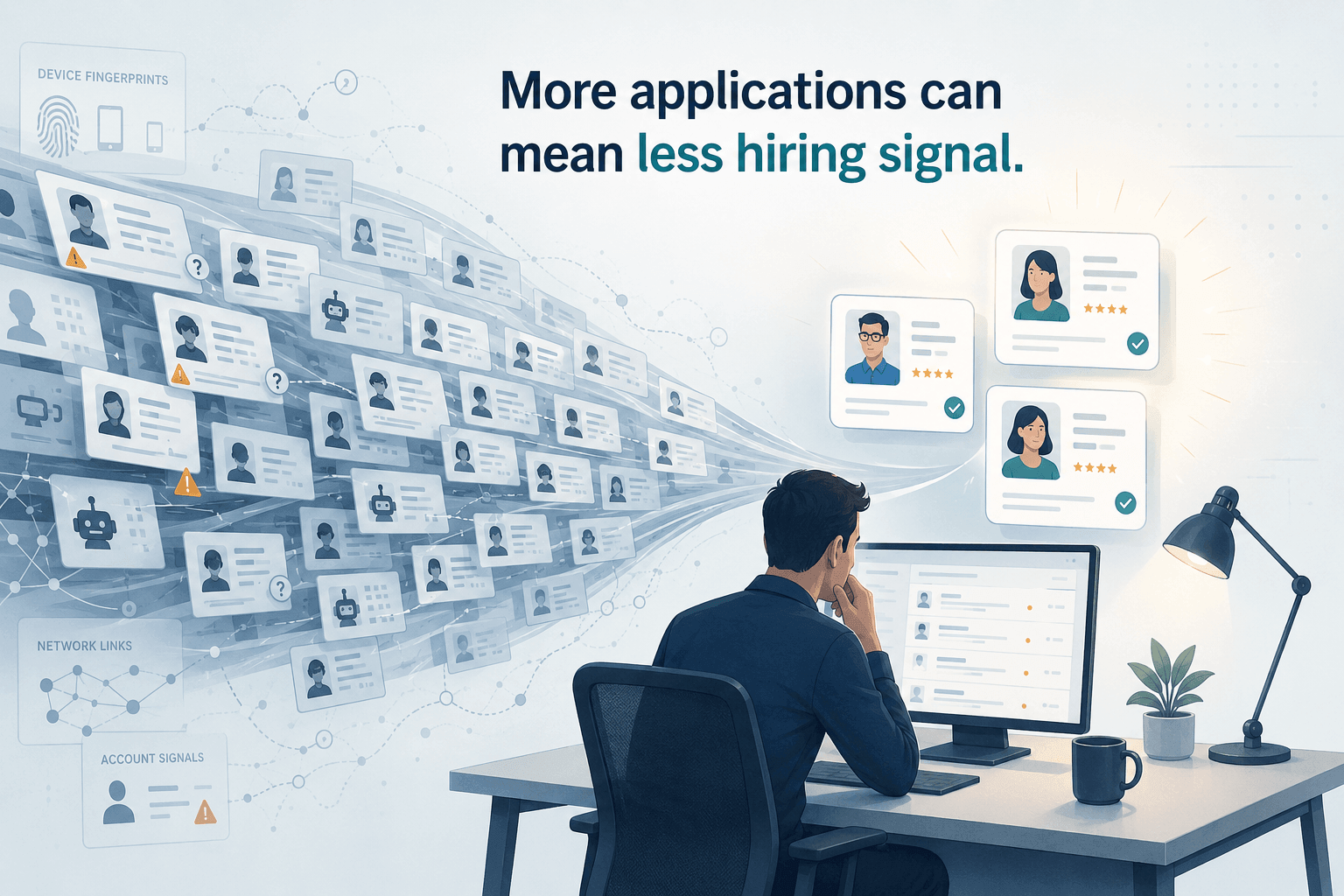
A large application pipeline does not necessarily represent a strong hiring pipeline. It may contain incomplete profiles, repeated submissions, automated application activity, candidates applying across unrelated roles, or coordinated accounts that appear separate on the surface. Every application still consumes some recruiter attention before its value can be understood. The operational challenge is therefore not only application volume. It is the loss of reliable candidate signal inside that volume.
Application relevance and application integrity are different questions. Relevance asks whether the candidate’s experience, skills, preferences, and availability relate to the role. Integrity asks whether the account and submission journey contain suspicious automation, identity inconsistencies, unusual device relationships, or coordinated activity. A recruitment platform should not merge these questions into one score because they belong to different teams and lead to different actions.
CrossClassify helps recruitment platforms evaluate the integrity layer through account history, device intelligence, behavioral biometrics, network context, submission velocity, and relationships between accounts. This context can help platform teams prioritize suspicious activity while recruiters remain responsible for evaluating candidate suitability. The objective is not to reject applicants automatically. It is to give each team a clearer and more manageable review queue.
What a practical high volume review workflow should achieve
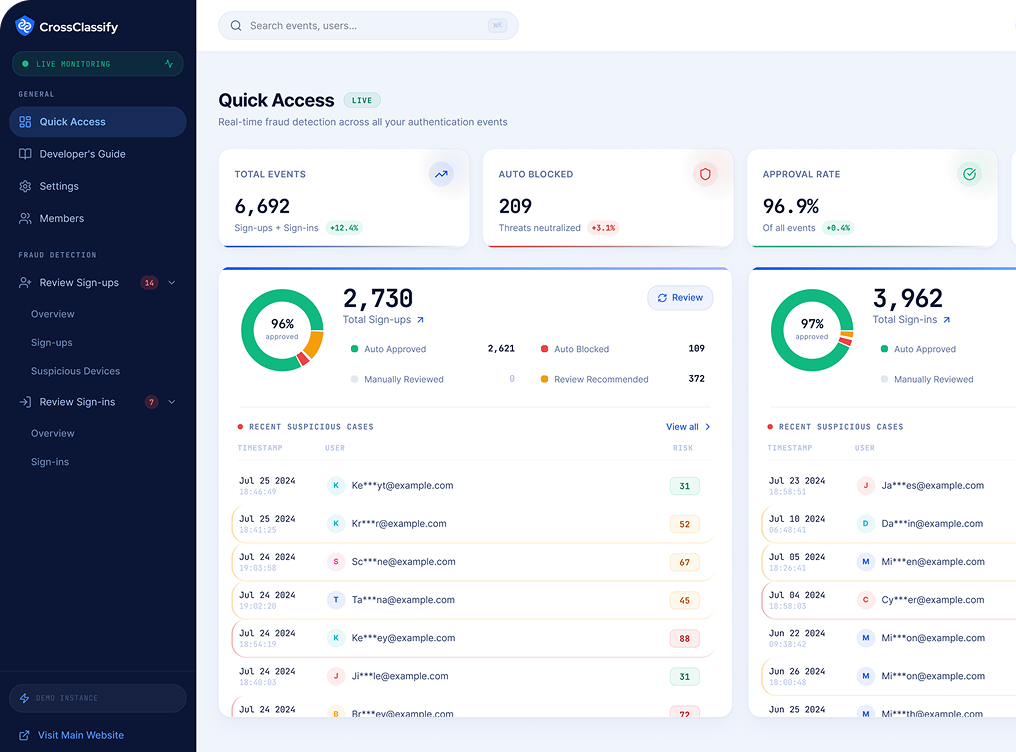
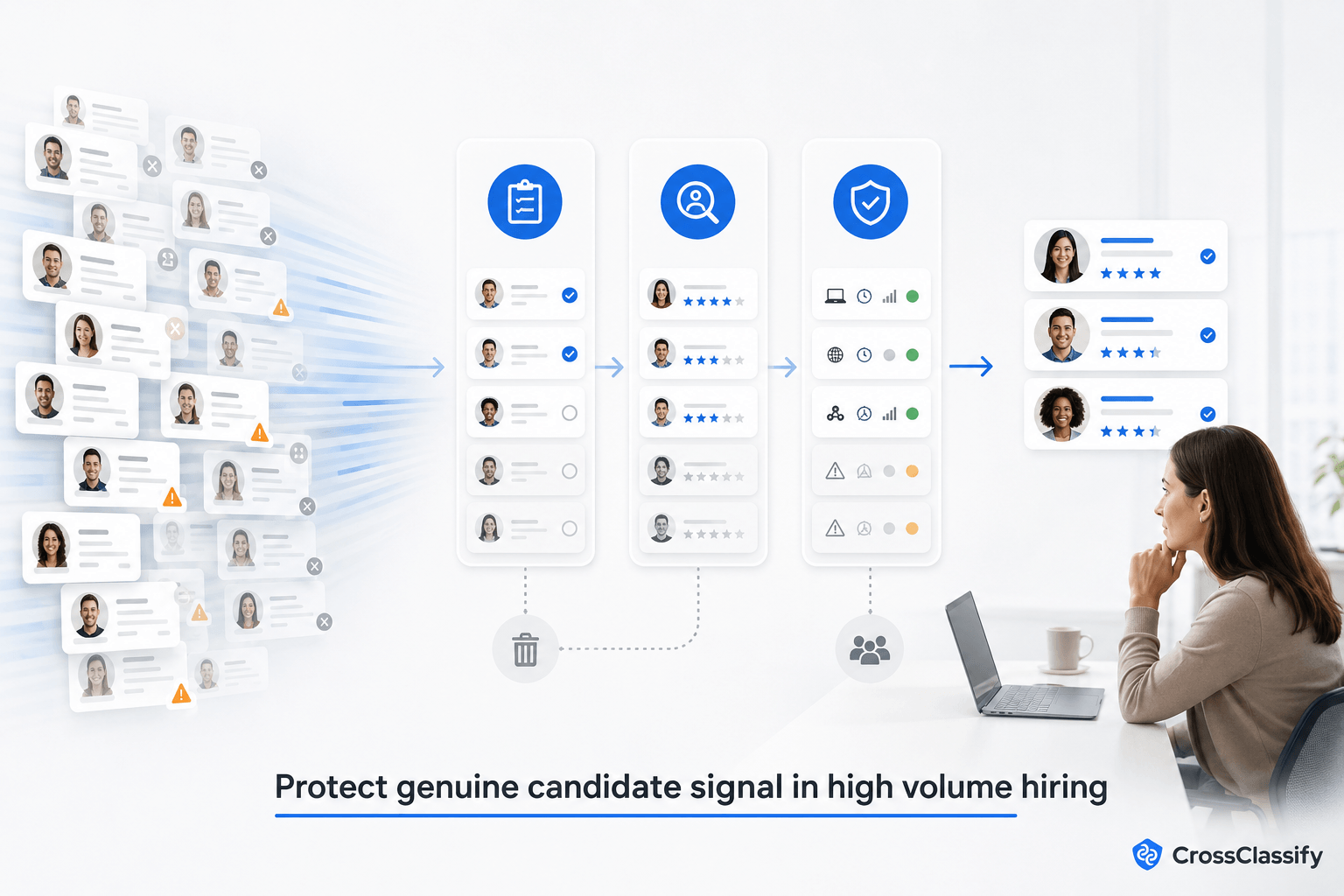
A practical workflow should reduce the number of unnecessary decisions recruiters must make before reaching credible candidates. Recruiters should not need to open every incomplete profile, investigate account relationships, interpret device information, or compare clusters of connected applications. The platform should organize submissions according to the next meaningful action and route each case to the team responsible for that action.
The workflow should also preserve candidate access. High activity does not automatically indicate abuse. Candidates may apply actively after graduation, redundancy, relocation, career change, or the completion of a contract. Popular roles may naturally receive large numbers of genuine submissions. A practical process must distinguish application volume from suspicious application patterns.
Every application should reach a clear operational status. It may be ready for recruiter review, require candidate clarification, enter platform integrity review, or remain incomplete. These statuses describe what should happen next. They should not label the candidate as trustworthy, fraudulent, qualified, or unqualified.
The final objective is to protect recruiter attention without creating a hidden hiring authority. Technology can organize information, identify repeated patterns, and route cases. Recruiters and employers should still evaluate professional experience, role relevance, communication, and hiring outcomes.
The practical application review workflow
A useful workflow begins with application intake and moves through completeness, professional relevance, integrity context, queue assignment, and human review. These stages should remain separate enough that teams understand what each decision means. One system may help organize the process, but the evidence and ownership behind each status should remain visible.
The recommended sequence is application received, completeness check, role information review, integrity signal review, queue assignment, and human decision. Missing information should not be treated as fraud. Professional relevance should not erase an account concern. An account concern should not become an automatic judgment about candidate quality.
The recruitment platform should record the outcome of every stage. This creates a timeline showing whether an application was incomplete, clarified, reviewed for platform integrity, or sent to a recruiter. It also allows product and operations teams to identify where delays, duplicated work, and unnecessary candidate friction occur.
A risk layer can be added around these stages without replacing the existing recruitment product. Teams can first define which application events matter and then review how CrossClassify connects with digital applications. This integration context allows account, device, behavior, and submission signals to enter existing review systems while the wider hiring workflow remains under platform control.
Do this now
Map the current application journey from submission to recruiter review. Mark every point where a recruiter must stop and investigate something that another team or system could resolve.
Best practice 1: Define what the first review stage must accomplish
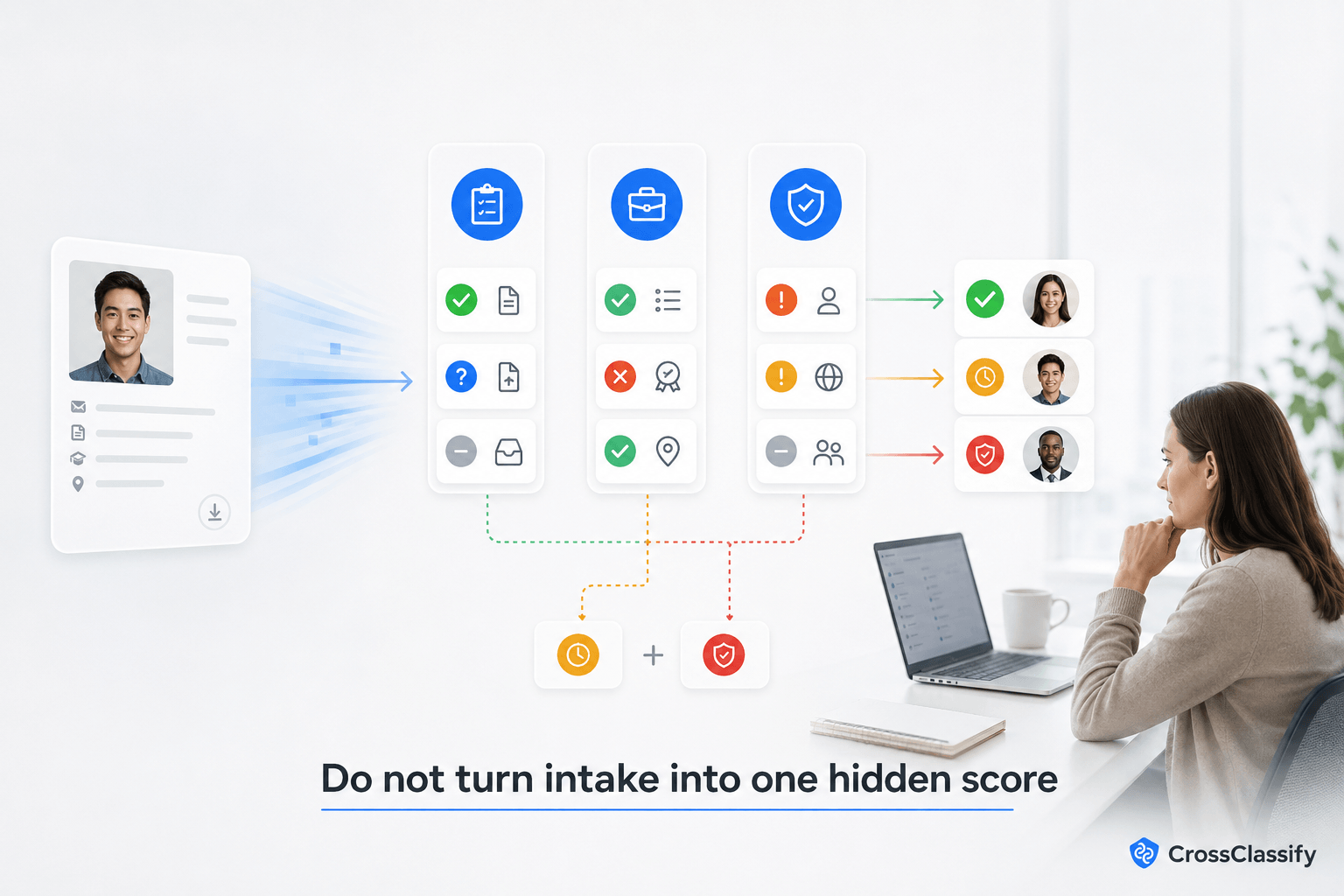
The first review stage should not attempt to make a final hiring decision. Its purpose is to confirm that the application contains enough information to enter the correct workflow. Trying to resolve qualification, fraud risk, identity, assessment readiness, and interview selection in one pass creates inconsistent decisions and excessive dependence on automation.
Define a small number of possible outcomes. An application can be complete and ready for recruiter review, incomplete and waiting for information, connected with a platform integrity concern, or outside a clearly stated role requirement. Each outcome should have an owner, a documented reason, and a defined next step.
Document what the first stage is not allowed to do. It should not infer personality from writing style, treat a new device as proof of fraud, or reject a candidate because a resume uses common language. It should not combine job relevance and fraud risk into one unexplained candidate score.
A narrow first stage makes the workflow easier to audit. Teams can see which checks protect data quality, which checks support recruiters, and which signals belong to fraud or trust operations. This prevents a technical convenience from gradually becoming an invisible hiring decision.
First stage responsibility table
| First stage question | Owner | Possible result | Next action |
|---|---|---|---|
| Is the application complete enough to review? | Platform or recruitment operations | Complete or incomplete | Continue or request missing information |
| Does the candidate answer a clear job requirement? | Recruiter or hiring team | Relevant information available | Begin professional review |
| Does the account or session require integrity review? | Fraud, trust, or security team | Normal, monitor, or review | Continue or open a specialist case |
| Should the candidate move forward? | Recruiter or employer | Hiring decision | Interview, hold, or decline according to hiring policy |
Practical scenario
A candidate submits a complete resume and answers all required role questions. The account also shows a recent identity change from a device connected with several other profiles.
The application can enter professional relevance review while the platform team investigates the account condition. The integrity concern should not disappear because the resume is relevant, and it should not automatically remove the candidate from consideration.
Do this now
Review every decision currently made during application intake. Remove any decision that cannot be clearly explained as data completeness, job relevance, or platform integrity.
Best practice 2: Clean the application intake
Begin by identifying the information genuinely needed during initial review. Long application forms often collect details that recruiters do not use until later. Every unnecessary field increases candidate effort, abandonment, and data variation. A shorter intake creates cleaner information and makes high volume review more manageable.
Validate basic completeness before the application enters a recruiter queue. Confirm that required contact information, resume files, work authorization answers, location details, and role specific questions are present. When information is missing, the candidate should receive a clear request rather than being silently removed from the process.
Normalize presentation where possible. Dates, locations, job titles, file formats, and skill names can be displayed consistently without changing the candidate’s meaning. Standardization reduces the time recruiters spend interpreting avoidable formatting differences. It should not rewrite the resume or generate claims the candidate did not provide.
Keep technical errors separate from integrity concerns. A damaged file, failed upload, or missing field may result from a device, browser, or connection problem. The platform should provide a correction path. Fraud review should begin only when account, device, behavior, network, or relationship evidence creates an additional concern.
Application intake checklist
| Intake area | Practical check | Candidate facing response | Internal response |
|---|---|---|---|
| Resume file | Confirm that the file opens and is readable | Request a replacement if necessary | Do not treat a file failure as fraud |
| Contact details | Confirm that required fields are complete | Ask the candidate to correct missing details | Compare major changes with account history |
| Role questions | Confirm that required answers are present | Request only the missing answer | Keep job relevance separate from account risk |
| Profile information | Compare the application with current profile fields | Ask for clarification where appropriate | Review recent identity changes internally |
| Submission event | Record the time, account, device, and session context | No visible action for normal activity | Use the context for platform integrity review |
Practical example
A candidate uploads a resume that cannot be opened. The account has a normal history, the device is familiar, and the candidate completed the application through a natural session.
Recommended response: Ask the candidate to upload a readable copy. Do not place the account into fraud review because of a technical document problem.
A second application contains an unreadable file, but the account also replaced its identity information shortly before submission and shares a device with several newly created profiles.
Recommended response: Request a readable document while the platform team separately reviews the account and device context.
Do this now
Remove one application field that recruiters do not use during the first review stage. Measure whether application completion improves without reducing decision quality.
Best practice 3: Use role specific screening questions carefully
Screening questions work best when they address clear and defensible role requirements. Examples include legal work authorization, a required professional certification, willingness to work in a defined location, availability for a specific schedule, or experience with a genuinely essential tool. Questions should relate directly to the role and affect a real next step.
Limit the number of questions. Every additional field increases candidate effort and creates more information for recruiters to interpret. A question that never changes the review outcome should be removed. The application should not become a long assessment before the candidate has received meaningful consideration.
Automatic outcomes must remain understandable. When a role legally requires a certification, the platform can identify candidates who did not confirm it. Recruiters should be able to see which requirement created the status. Hidden rules make it difficult to detect poor question design and can create unexplained candidate rejection.
Avoid questions that attempt to measure personality, honesty, or motivation through indirect signals. These assessments can be difficult to interpret and may introduce unfair assumptions. Fraud and integrity concerns should be evaluated through the account and submission journey rather than speculative personality questions.
Screening question quality table
| Question type | Good use | Poor use | Recommended action |
|---|---|---|---|
| Work authorization | Confirming a genuine legal requirement | Using broad assumptions about nationality or location | Ask only what is required for the role |
| Certification | Confirming a mandatory qualification | Requesting unrelated credentials | Explain why the certification matters |
| Location | Confirming onsite or regional requirements | Rejecting remote candidates without a clear need | State the working arrangement clearly |
| Experience | Asking about a critical capability | Using vague years of experience as the only signal | Allow context and practical examples |
| Integrity | Evaluating account and session evidence separately | Attempting to detect honesty through abstract questions | Keep fraud review in a separate workflow |
Practical test for every screening question
- Before adding a question, ask whether the answer affects a real decision. If the answer does not change the next stage, the question is probably unnecessary.
- Ask whether the recruiter can explain why the question matters. A rule that cannot be explained clearly should not create an automatic outcome.
- Ask whether the candidate has a reasonable opportunity to provide context. Some requirements are absolute, but others need interpretation.
- Ask whether the same concern belongs in a different workflow. Account integrity, bot activity, and device relationships should not be tested through candidate facing personality questions.
Turn CV Red Flags Into a
Documented Risk Score
A checklist tells you what to look for. CV Risk Checker scans any resume in seconds and shows you exactly where the fraud signals are — before you book the interview.
Best practice 4: Create separate relevance and integrity lanes
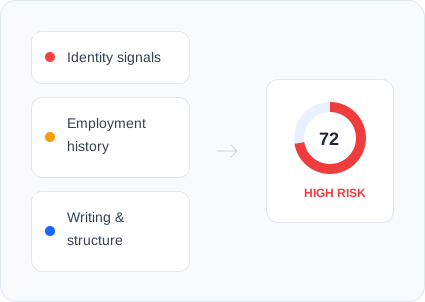
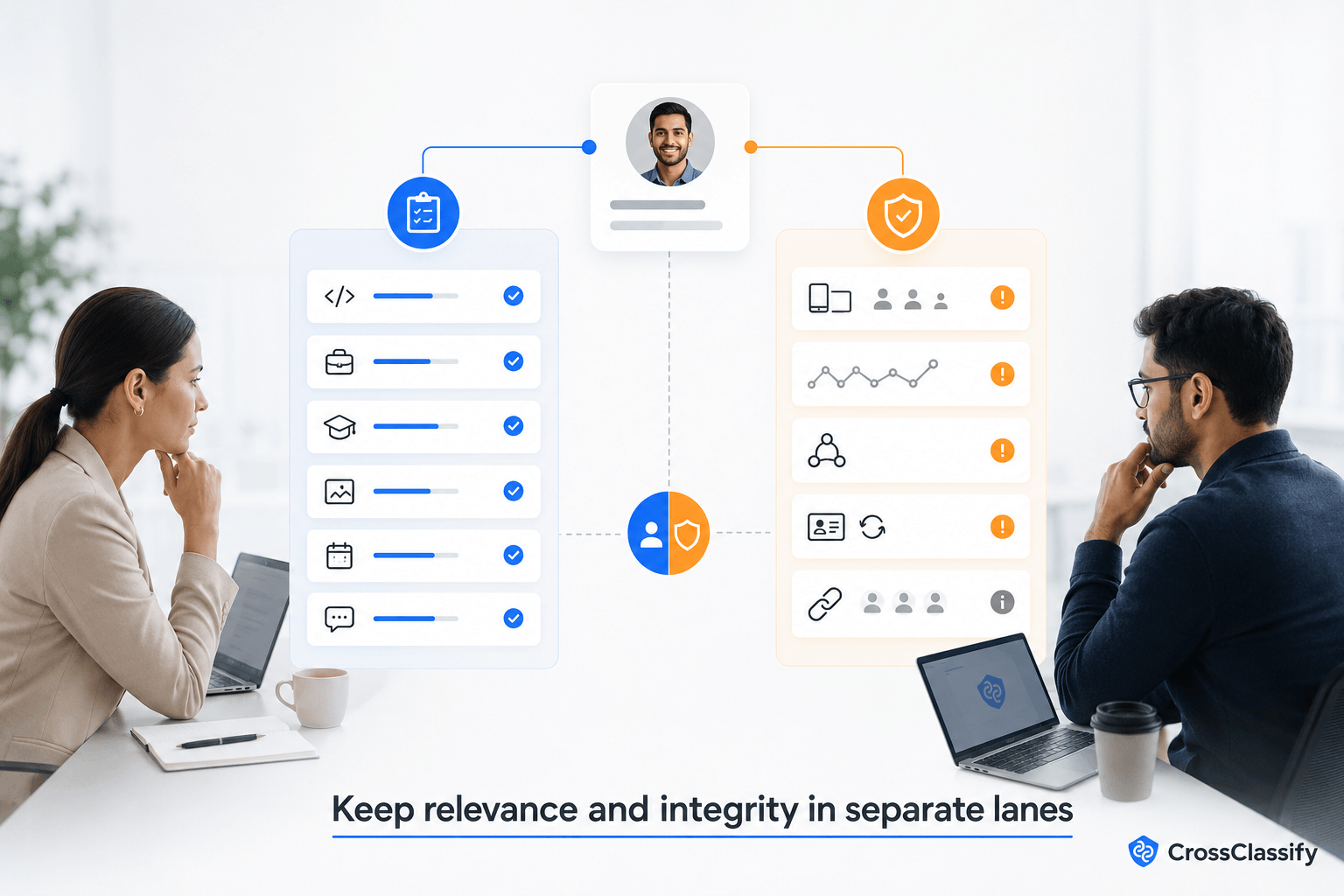
The relevance lane contains the information recruiters need to evaluate the role. This includes skills, experience, education where appropriate, portfolio information, availability, and answers to role specific questions. Technology may organize this information, but the recruiter should understand what is being shown and remain responsible for interpretation.
The integrity lane contains account and submission context. This may include unusual application velocity, repeated device relationships, mechanical interaction, recent identity changes, connected accounts, and suspicious network patterns. These signals should be reviewed by platform specialists according to a documented policy.
An application can exist in both lanes at the same time. A professionally relevant candidate may have an account condition that requires clarification. The platform can mark the account as under review without turning the integrity signal into a judgment about skills or professional value.
CrossClassify supports this separation by acting as a fraud signal and risk intelligence layer. Teams can evaluate suspicious interaction through behavioral biometrics for continuous session context. This evidence helps fraud and trust teams assess automation or abnormal behavior while recruiters continue focusing on candidate relevance.
Two lane review table
| Review lane | Main question | Typical evidence | Owner |
|---|---|---|---|
| Candidate relevance | Does the candidate appear related to the role? | Experience, skills, education, portfolio, and answers | Recruiter or employer |
| Platform integrity | Does the account or submission journey deserve review? | Device, behavior, network, velocity, account history, and relationships | Fraud, trust, or security team |
| Candidate clarification | Can a specific inconsistency be explained? | Dates, location, title, contact details, or missing information | Recruitment operations or recruiter |
| Platform action | Does completed review justify a platform response? | Documented evidence and policy outcome | Authorized platform reviewer |
Practical scenario
A candidate appears highly relevant to a data engineering role. The submission also came from a device connected with several recent profiles and followed the same mechanical sequence seen in those accounts.
The recruiter can continue evaluating the professional information while the integrity lane investigates the account relationship. The recruiter should see a neutral platform review status rather than an unexplained fraud label.
Do this now
Review the information shown in the recruiter interface. Remove technical fraud evidence that recruiters do not need and replace it with a neutral workflow status.
Best practice 5: Build three application queues
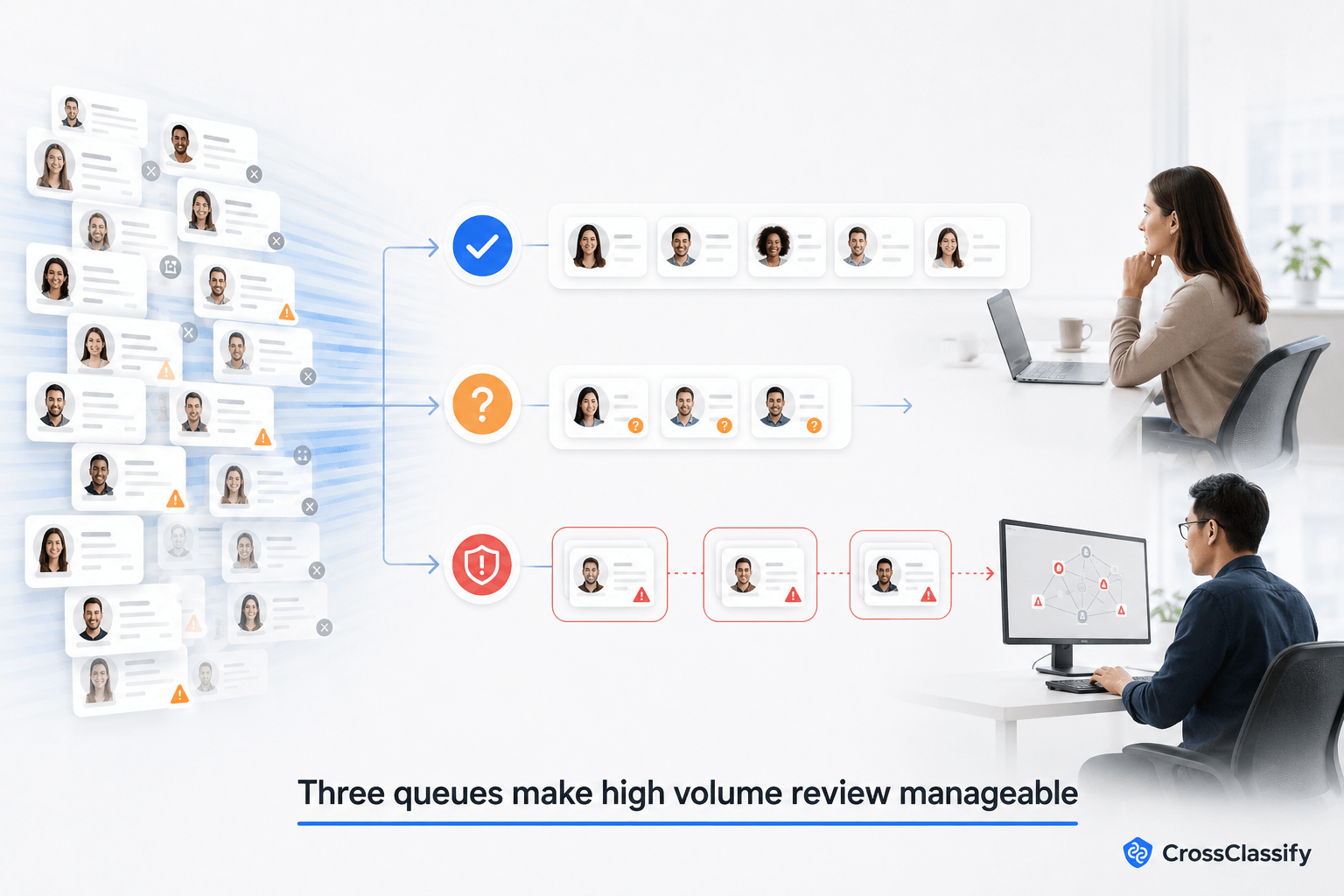
The first queue should contain applications ready for recruiter review. These submissions contain the required information and have no unresolved platform condition preventing normal processing. The queue can be organized by role, submission time, or recruiter workflow, but its order should remain understandable.
The second queue should contain applications requiring clarification. Missing information, conflicting dates, unreadable documents, or recent profile changes may be resolved by asking a specific question. Candidates should understand what they need to provide and how the process will continue.
The third queue should contain applications under platform integrity review. These cases involve account, device, behavior, automation, network, or relationship evidence that requires a specialist team. Recruiters may see a neutral status but should not be expected to interpret technical reasons.
Queue ownership and response time should be documented. Applications should not remain in an unexplained state because no team understands who must act. Service levels also allow product and operations teams to identify where high volume creates delay.
Three queue operating model
| Queue | What belongs here | Owner | Expected action |
|---|---|---|---|
| Ready for recruiter review | Complete submissions with no unresolved platform condition | Recruiter or hiring team | Evaluate professional relevance |
| Clarification needed | Missing or inconsistent candidate information | Recruitment operations or support | Ask one specific question |
| Platform integrity review | Connected accounts, suspicious devices, automation, or identity concerns | Fraud, trust, or security team | Review the evidence and determine a platform action |
Practical scenario
A role receives four hundred applications. Three hundred are complete and enter recruiter review. Sixty need missing information. Forty are grouped into six connected platform cases because several submissions share devices and mechanical behavior.
Without queue separation, recruiters would encounter all four hundred applications independently. With grouping and routing, specialist teams investigate the connected patterns while recruiters focus on complete candidate information.
Queue service level example
| Queue | Suggested first response | Candidate communication |
|---|---|---|
| Ready for recruiter review | According to normal recruiter workflow | Standard application status |
| Clarification needed | Within one business day where possible | Explain the exact missing or conflicting information |
| Platform integrity review | Prioritized according to evidence and impact | Use a neutral review status when communication is necessary |
Best practice 6: Detect automation without using volume alone
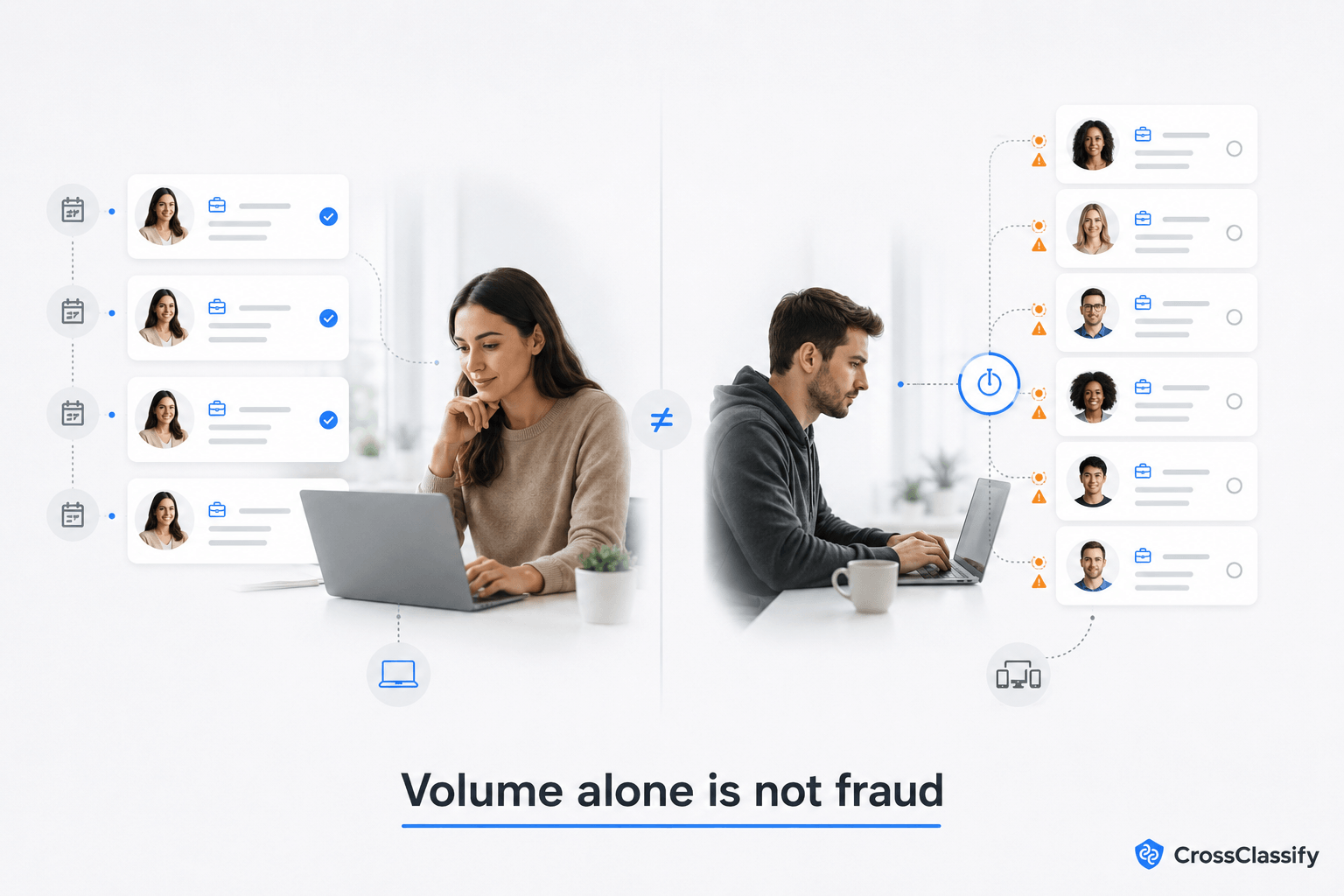
High application activity can be legitimate. Candidates may apply actively after graduation, redundancy, relocation, or contract completion. Some roles also attract large numbers of applicants because they are remote, widely advertised, or open to several experience levels. A fixed application limit can affect genuine users without stopping more advanced automation.
Examine the complete submission pattern. Relevant evidence includes role diversity, navigation variation, account age, device relationships, session timing, network changes, and repeated form behavior. A candidate applying quickly to related roles presents a different journey from many connected accounts submitting mechanically across unrelated categories.
Behavioral biometrics can help identify repeated timing and scripted interaction. Device fingerprinting can connect accounts that rotate visible information or network addresses. Neither signal proves automation alone. The practical value comes from combining several independent conditions.
A recruitment platform can strengthen this analysis with bot and automated abuse detection. Device, behavior, velocity, and relationship signals can support monitoring or specialist review. The platform still determines which responses are appropriate and how genuine candidates can resolve uncertainty.
Automation review matrix
| Observed pattern | Likely interpretation | Additional context needed | Recommended response |
|---|---|---|---|
| Several related applications over two days | Normal active candidate | Role relevance and natural session variation | Continue normal review |
| Fast application using a saved profile | Possibly normal efficiency | Device history and wider account behavior | Do not escalate based on speed alone |
| Many unrelated applications with repeated timing | Possible automation | Device, behavior, and account relationships | Open platform review when the signals align |
| Several accounts share a device and submission sequence | Possible coordinated activity | Organization, household, or public device context | Group the accounts into one specialist case |
| Human review confirms coordinated automation | Confirmed policy concern | Documented evidence and impact | Apply the platform response |
Contrasting scenarios
Normal high activity
A candidate applies to eight related engineering roles over three days. The person reads each job description, adjusts several answers, and uses one familiar device.
Recommended response: Continue normal recruiter review.
Potential automated activity
Ten recently created accounts apply to hundreds of unrelated roles. The accounts use two connected devices and repeat the same navigation sequence with nearly identical timing.
Recommended response: Group the activity into one platform integrity investigation. Do not ask individual recruiters to resolve the pattern.
Do this now
Review the last fifty applicants flagged for high volume. Determine how many were flagged only because of application count and how many showed additional independent signals.
Best practice 7: Show recruiters only actionable context
Recruiters should not receive a dashboard filled with device attributes, network identifiers, behavior models, and unexplained risk values. Their interface should explain whether the application is ready, needs candidate information, or is undergoing platform review. This protects recruiter attention and reduces unsupported interpretation.
When limited context is necessary, describe observable activity. The platform may state that the account is undergoing review after unusual changes or that additional confirmation is required. Avoid labels such as fake candidate or fraudulent applicant before the platform has completed an appropriate review.
Recruiters should have a simple reporting path. They may notice conflicting interview answers, repeated resumes, suspicious communication, or identity inconsistencies. Reporting should create a specialist case without requiring the recruiter to investigate devices or account graphs.
The workflow must close the loop. When the case is resolved, the recruiter status should update automatically. Recruiters should not need to contact several internal teams to learn whether they can continue reviewing an application.
Recruiter status language
| Avoid | Use instead | Why |
|---|---|---|
| Suspicious candidate | Platform review in progress | Describes the workflow without accusing the person |
| Fraud score | Account activity review | Keeps technical risk separate from candidate quality |
| Invalid application | Clarification required | Provides a resolution path |
| Verified candidate | Normal recruiter review | Avoids implying that every professional claim was confirmed |
Recruiter reporting form
| Field | Purpose |
|---|---|
| Application or profile | Identify the affected candidate record |
| Observed concern | Record the specific inconsistency or event |
| Hiring impact | Explain whether the recruiter requires an immediate status |
| Supporting information | Add relevant messages, interview notes, or repeated content |
| Urgency | Indicate whether candidates, employers, or data may be exposed |
Best practice 8: Group connected applications into one case
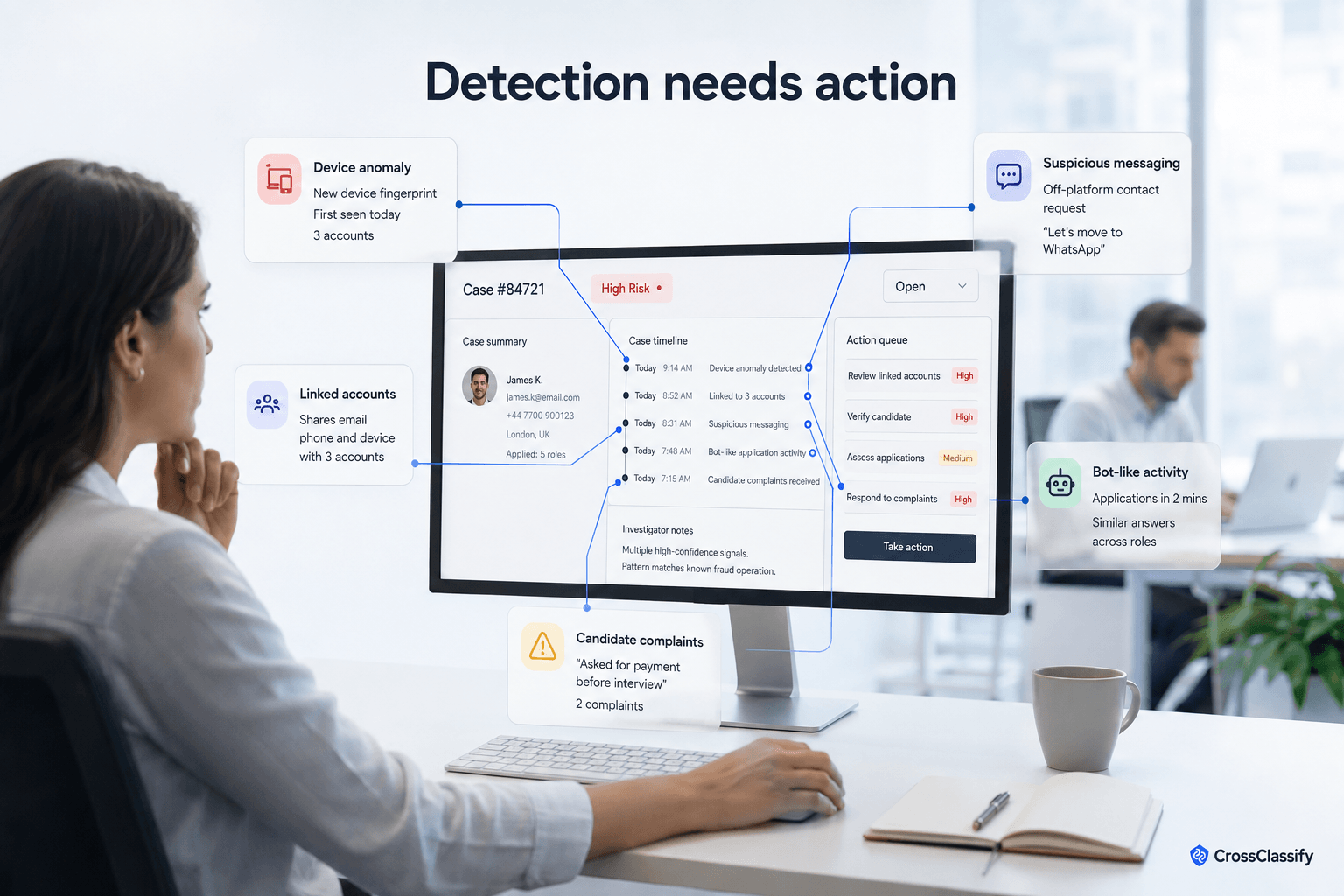
High volume abuse often appears as many separate applications. Reviewing each application independently hides the relationships between accounts and creates repeated work. Several profiles may share devices, networks, contact information, submission timing, or navigation patterns.
Case grouping allows the platform to understand the total activity. Instead of asking several reviewers to investigate the same device or behavior sequence, the system can create one case containing all connected accounts and applications. This improves investigation speed and makes operational impact visible.
Grouping must still preserve uncertainty. A shared device may belong to a household, university, public service, or recruitment agency. The case should explain which relationships exist and allow reviewers to record legitimate context.
Device relationships can be added through persistent device fingerprinting. This context becomes more useful when combined with account roles, organization information, behavior, and application history. Human reviewers remain responsible for deciding whether the cluster represents normal shared access or coordinated abuse.
Case grouping table
| Relationship | What it may indicate | Context to review | Recommended handling |
|---|---|---|---|
| Shared device | Household, public access, agency, or coordinated control | Account roles, identities, and behavior | Create one case when several signals align |
| Shared network | Office, university, proxy, or infrastructure reuse | Device diversity and organization relationship | Do not escalate based on network alone |
| Repeated navigation | Similar workflow or automation | Timing, device, and account age | Compare across connected sessions |
| Shared contact information | Legitimate household or identity reuse | Profile history and candidate explanation | Clarify or investigate according to context |
| Similar resume content | Template use or copied identities | Distinctive content and wider relationships | Combine document and platform evidence |
Do this now
Identify the ten largest connected application clusters from the previous month. Determine whether they were reviewed as campaigns or as separate candidate cases.
A practical daily review workflow
Begin each day by checking queue health. Review the number of applications ready for recruiters, waiting for clarification, under platform review, and exceeding the expected response time. This reveals whether pressure is concentrated in one workflow rather than across the entire system.
Next, group connected integrity cases. Several applications associated with the same device, account network, or automation pattern should become one investigation. Grouping prevents analysts from reviewing the same campaign repeatedly and makes the total impact visible.
Review high impact cases first. Consider account permissions, activity scale, candidate or employer exposure, and the strength of the evidence. One account submitting several unusual applications may be less urgent than a connected network reaching thousands of roles.
End the cycle by recording outcomes. Confirmed cases, cleared activity, successful clarifications, and false alerts should update future thresholds and guidance. Daily feedback helps the platform adapt faster than occasional model reviews.
Daily operations table
| Time | Activity | Operational purpose |
|---|---|---|
| Start of day | Review queue health and overdue cases | Identify delays and urgent exposure |
| Morning | Group related accounts and devices | Reduce duplicated investigation |
| Midday | Review the highest impact integrity cases | Protect users and platform workflows |
| Afternoon | Resolve clarifications and update recruiter statuses | Keep genuine applications moving |
| End of day | Record confirmed, cleared, and false alert outcomes | Improve future decisions |
A practical weekly quality check
Review a sample from every queue. Confirm that complete applications reach recruiters, clarification requests are specific, and integrity cases contain enough evidence. Sampling can reveal problems that aggregate metrics hide.
Compare reviewer decisions. Similar evidence should produce similar outcomes unless the business context differs. Large variation may indicate unclear policies, missing reason codes, or inconsistent training.
Examine candidate friction. Measure abandoned clarification requests, delayed applications, verification failures, and support complaints. A control that reduces noise but creates excessive candidate frustration may need adjustment.
Collect recruiter feedback. Determine whether the queue feels more useful, whether repeated suspicious patterns continue reaching hiring teams, and whether platform statuses are understandable. The workflow should improve recruiter work, not merely increase the number of technical controls.
Weekly review checklist
| Quality area | Question | Possible improvement |
|---|---|---|
| Queue accuracy | Are applications entering the correct workflow? | Refine routing rules and ownership |
| Clarification quality | Are questions specific and neutral? | Improve candidate communication templates |
| Reviewer consistency | Do similar cases receive similar outcomes? | Update policy examples and reviewer training |
| Candidate friction | Are genuine applicants delayed unnecessarily? | Adjust thresholds and communication |
| Recruiter value | Does the queue help recruiters reach credible candidates sooner? | Remove low value alerts and fields |
Measuring application review quality
Measure time to first meaningful review rather than only the number of applications processed. This shows whether the workflow helps recruiters reach credible candidate information sooner. It also reveals whether applications are becoming stuck in clarification or integrity queues.
Track confirmed integrity cases and false reviews. A growing number of alerts is not automatically positive. The platform needs to know how often escalated evidence leads to a meaningful outcome and how often legitimate users enter unnecessary review.
Measure repeated pattern reduction. If the same device clusters, automation methods, or account networks continue returning, the workflow may detect incidents without preventing recurrence. Grouped cases and reviewer feedback should support broader operational action.
Candidate and recruiter experience should remain visible. Application completion, support contacts, queue delays, recruiter review time, and trust in the platform all matter. A balanced workflow improves operational signal without making the process inaccessible.
Practical measurement dashboard
| Metric | What it shows | Desired direction |
|---|---|---|
| Time to first meaningful review | How quickly recruiters reach usable candidate information | Decrease |
| Clarification resolution rate | How often missing or conflicting information is resolved | Increase |
| Confirmed integrity case rate | The precision of specialist review | Maintain useful precision |
| False review rate | How often legitimate activity enters unnecessary review | Decrease |
| Repeated network rate | Whether coordinated patterns continue returning | Decrease |
| Recruiter review time | Whether application noise consumes less attention | Decrease without reducing review quality |
Do this now
Choose three workflow metrics before changing your application review process. Measure the current baseline so later improvement can be demonstrated.
A thirty day implementation plan
During the first five days, map the current application workflow. Identify where submissions enter, which systems organize them, who handles missing information, and where fraud concerns are reported. Record every point where applications become delayed or duplicated.
During days six through ten, define the three queues and assign owners. Write clear requirements for ready for recruiter review, clarification needed, and platform integrity review. Establish response times and candidate communication responsibilities.
During days eleven through twenty, test the workflow with historical cases. Include active genuine candidates, incomplete submissions, repeated profiles, shared devices, automation patterns, and confirmed account misuse. Compare reviewer decisions and improve the guidance.
During days twenty one through thirty, connect selected account and submission events. Registration, login, profile changes, and application submission are practical starting points. Launch a limited workflow, measure outcomes, and expand only after the initial process is understandable.
Implementation table
| Period | Main action | Expected output |
|---|---|---|
| Days 1 to 5 | Map the current application journey | Owners, systems, delays, and duplicated work |
| Days 6 to 10 | Define queues and service levels | Clear routing and ownership |
| Days 11 to 20 | Test historical applications | Improved rules and more consistent decisions |
| Days 21 to 30 | Launch a limited operational pilot | Measured outcomes and refinement priorities |
Conclusion
High volume application review does not need to become a choice between speed and fairness. The practical solution is to reduce unnecessary intake complexity, separate relevance from integrity, and route each application to the correct team. Automation should organize evidence and repeated activity rather than silently determine hiring outcomes.
Role specific questions, completeness checks, clarification workflows, and human relevance review help recruiters manage professional information. Device, behavior, bot, network, account, and relationship signals help platform teams identify suspicious activity. Keeping these functions separate protects recruiter attention and candidate fairness.
CrossClassify supports the integrity lane by providing risk context around accounts, devices, sessions, and application activity. Recruitment platforms retain control of queue design, thresholds, candidate communication, verification, and final actions.
A well designed workflow gives recruiters more time for meaningful evaluation. It also gives genuine candidates a clearer path through the process and helps platform teams respond to coordinated application abuse with stronger evidence.
See How CrossClassify Protects Recruitment Platforms
Detect fake recruiters, fraudulent resumes, and job scams instantly

Check a CV for Fraud Signals in 60 Seconds
Upload any resume and get an instant risk score, flagged signals, and a recruiter-ready action checklist.
Try the CV Risk CheckerNo credit card required
Share in
Related articles

Frequently asked questions
Let's Get Started
Create your free
account today
Discover how to secure your app against fraud using CrossClassify
No credit card required