Last Updated on 18 Jul 2026
When More Applications Create Less Hiring Signal: Protecting Recruiter Attention at Scale
Share in
Introduction
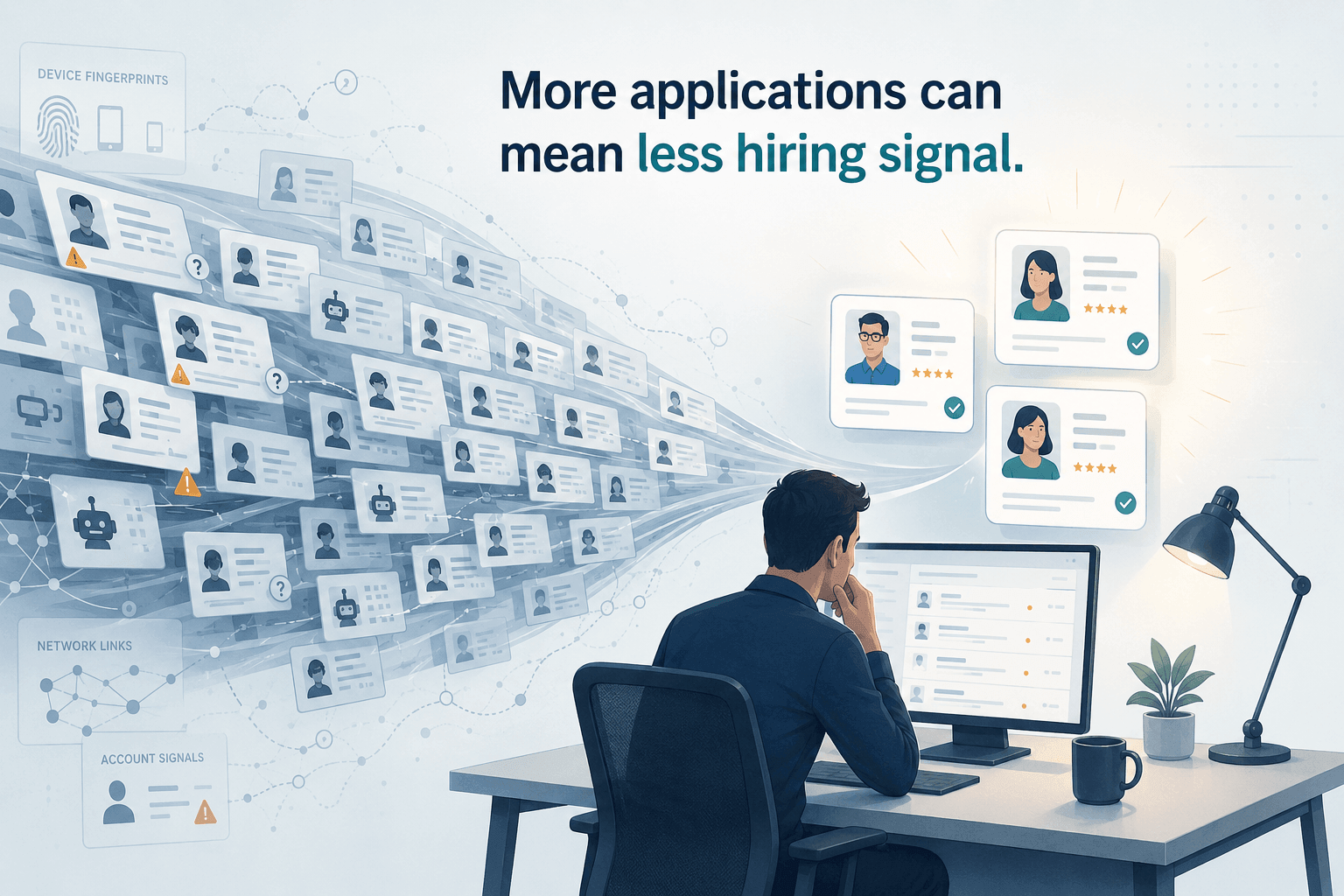
Recruitment platforms are built to create useful connections between employers and candidates. More applications can appear to indicate better reach, stronger engagement, and a healthier marketplace. A growing application count can reassure employers that a role is visible and that the platform is bringing candidates into the hiring journey. However, the number displayed in a dashboard does not explain whether those submissions will lead to productive recruiter conversations.
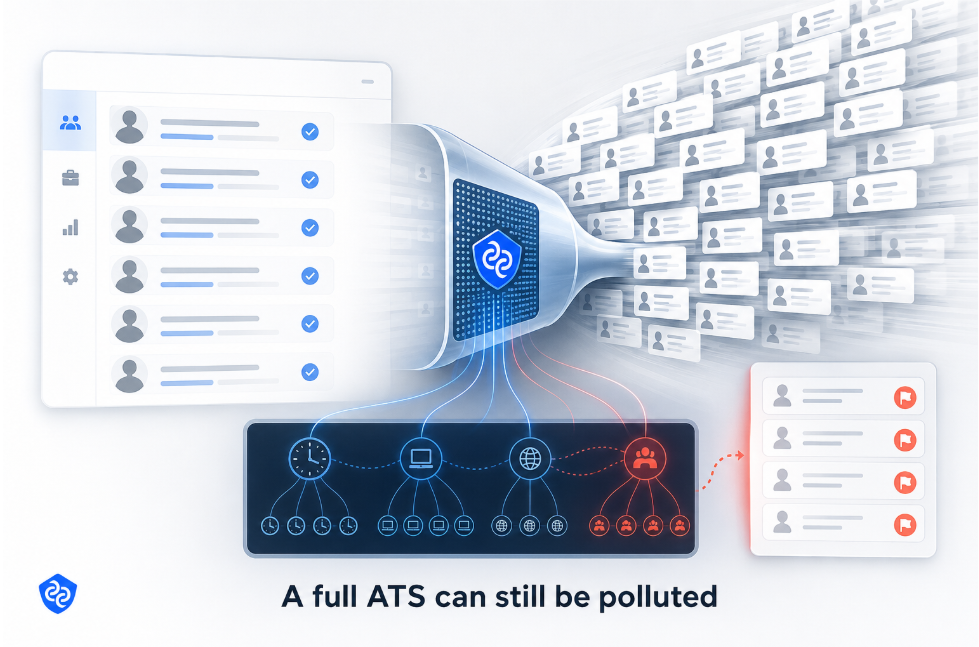
Application volume and hiring value are not the same thing. A pipeline can appear full while still containing large amounts of poorly aligned, repeated, automated, or suspicious activity. When recruiters must open each profile before they can understand its value, every low trust submission consumes part of a limited attention budget. The platform may report strong activity while the recruiter experiences a slower and more frustrating search for credible candidates.
The pressure is increasing as digital tools make it easier to prepare, customize, and submit applications at scale. Legitimate candidates can use these tools to communicate their experience more clearly, but automated systems can also create large amounts of activity with limited human involvement. Recent research into technology hiring has highlighted both the growing volume created by AI assisted applications and widespread concern about allowing automated systems to control important hiring decisions. The practical challenge is therefore to reduce application noise without treating every efficient or technology assisted candidate as suspicious.
The underlying problem is not merely application quantity. It is the loss of reliable signal inside the application stream. CrossClassify helps recruitment platforms evaluate the activity surrounding each submission by combining account history, device context, session behavior, network information, submission velocity, and relationships between accounts. These signals help explain whether an application followed a normal candidate journey or arrived through a pattern that deserves closer platform review, while recruiters remain responsible for assessing candidate suitability.
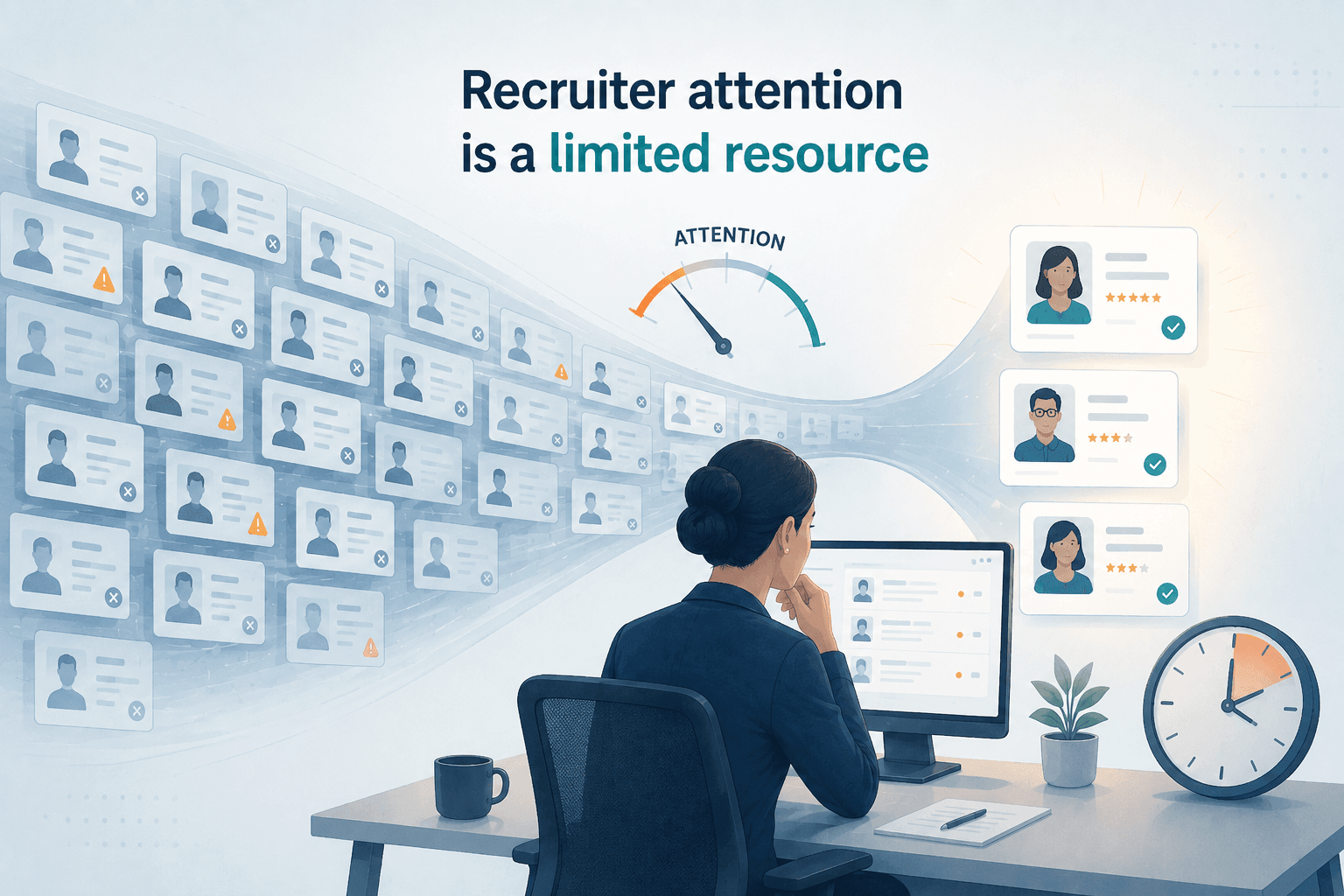
Recruiter attention is a limited platform resource
Recruitment platforms usually measure job views, candidate registrations, completed applications, recruiter messages, profile searches, and employer engagement. These measurements provide useful information about product activity and marketplace demand. They can show whether a job attracts interest and whether candidates are moving through the application journey. They do not automatically show whether that activity creates proportional value for the recruiter receiving it.
A recruiter can receive a full pipeline and still struggle to identify credible candidates. Every low trust application creates another profile to inspect, another resume to interpret, another set of claims to compare, and another decision that may need to be recorded. Even when an application can be dismissed quickly, the recruiter must still spend attention understanding why it should not move forward. Repeated across hundreds of submissions, these small decisions become a significant operational burden.
This creates an attention cost that traditional volume metrics often hide. The platform may technically deliver more applicants while the recruiter experiences more work, slower review, and less confidence in the pipeline. Time spent filtering repeated, misleading, or automated activity is time that cannot be spent speaking with promising candidates, understanding employer needs, or building trusted professional relationships. Application noise therefore affects not only efficiency, but also the quality of the human interactions that make recruitment valuable.
Protecting recruiter attention means giving hiring teams stronger context before they invest substantial time in a submission. CrossClassify supports this objective through its recruitment fraud detection solution, which connects device, account, behavior, and relationship signals around recruitment activity. This context can help platform teams prioritize suspicious submissions for review before the same pattern repeatedly reaches recruiters. The resulting signal supports recruiter workflows without making judgments about candidate skills, experience, or professional potential.
Why traditional screening cannot explain application trust
Traditional screening tools are generally designed to organize candidate information and compare it with role requirements. They can extract skills, job titles, certifications, education history, employment dates, and relevant keywords from resumes or profiles. This helps recruiters manage information that would otherwise require extensive manual reading. It can also support faster discovery when a large candidate pool contains people with clearly different backgrounds.
These tools answer an important hiring question: Does the information presented in this application appear relevant to the role? They may help identify whether a candidate mentions a required programming language, industry certification, leadership responsibility, or type of experience. That information can support recruiters as they decide which profiles deserve deeper attention. It does not necessarily explain whether the account and activity behind the application are trustworthy.
Application trust requires a different set of questions. Was the account created through a normal user journey? Did the candidate interact with the role before submitting? Is the same device connected with many apparently unrelated accounts? Does the session show natural variation, or does it repeat the same pattern across many submissions? These questions concern platform integrity rather than professional qualification.
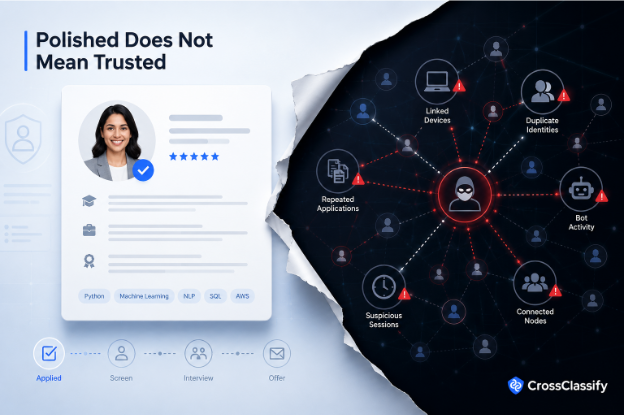
A polished resume may still come from a newly created account that applies to unrelated jobs at unusual speed. Several apparently different candidates may use the same device environment, network infrastructure, or repeated submission sequence. A scripted session may complete application fields with identical timing across many profiles while changing the visible content enough to avoid simple duplicate checks. The resume alone cannot explain these conditions, which is why recruitment platforms need a separate fraud signal and risk intelligence layer around the application workflow.

The signals behind application quality
Application trust should be evaluated through several types of evidence rather than one rigid rule. Each signal describes a different part of the candidate journey and may have a legitimate explanation when viewed alone. The purpose of risk intelligence is to combine these signals so platform teams can understand the complete pattern. This produces more useful review context than a basic rule that treats every fast, active, or unfamiliar user as suspicious.
Submission velocity shows how frequently an account applies and whether the timing fits a plausible candidate journey. Device intelligence shows whether many accounts or submissions share the same environment, whether a device has appeared in earlier suspicious activity, and whether its configuration changes in unusual ways. Behavioral analysis can identify mechanical navigation, repeated field timing, unusual pointer movement, and interaction sequences that resemble scripts rather than normal variation. Network context can add information about proxy infrastructure, rapid region changes, unusual traffic origins, and repeated connections between accounts.
Link analysis brings these individual signals together. A single account may not appear especially risky, but several accounts may share devices, network patterns, behavioral rhythms, contact details, or submission sequences. By connecting these relationships, a recruitment platform can see whether the activity is isolated or part of a wider coordinated pattern. This is especially important when visible identity information changes but the operational method behind the applications remains similar.
None of these signals should decide whether someone is qualified for a job. They explain whether the activity surrounding an application deserves additional attention from platform fraud, trust, or operations teams. CrossClassify combines persistent device evidence with behavior and session context through its device fingerprinting technology. This context becomes more meaningful when it is evaluated alongside account history, submission velocity, network information, and connected account activity.
Separating enthusiastic candidates from automated volume
A genuine candidate may apply to several relevant positions during a focused job search. Someone who has recently lost a role, completed a contract, or entered a competitive market may be highly active over a short period. Candidates may also save profile information, reuse parts of a resume, and move quickly through familiar application forms. High activity by itself does not establish automation, deception, or abuse.
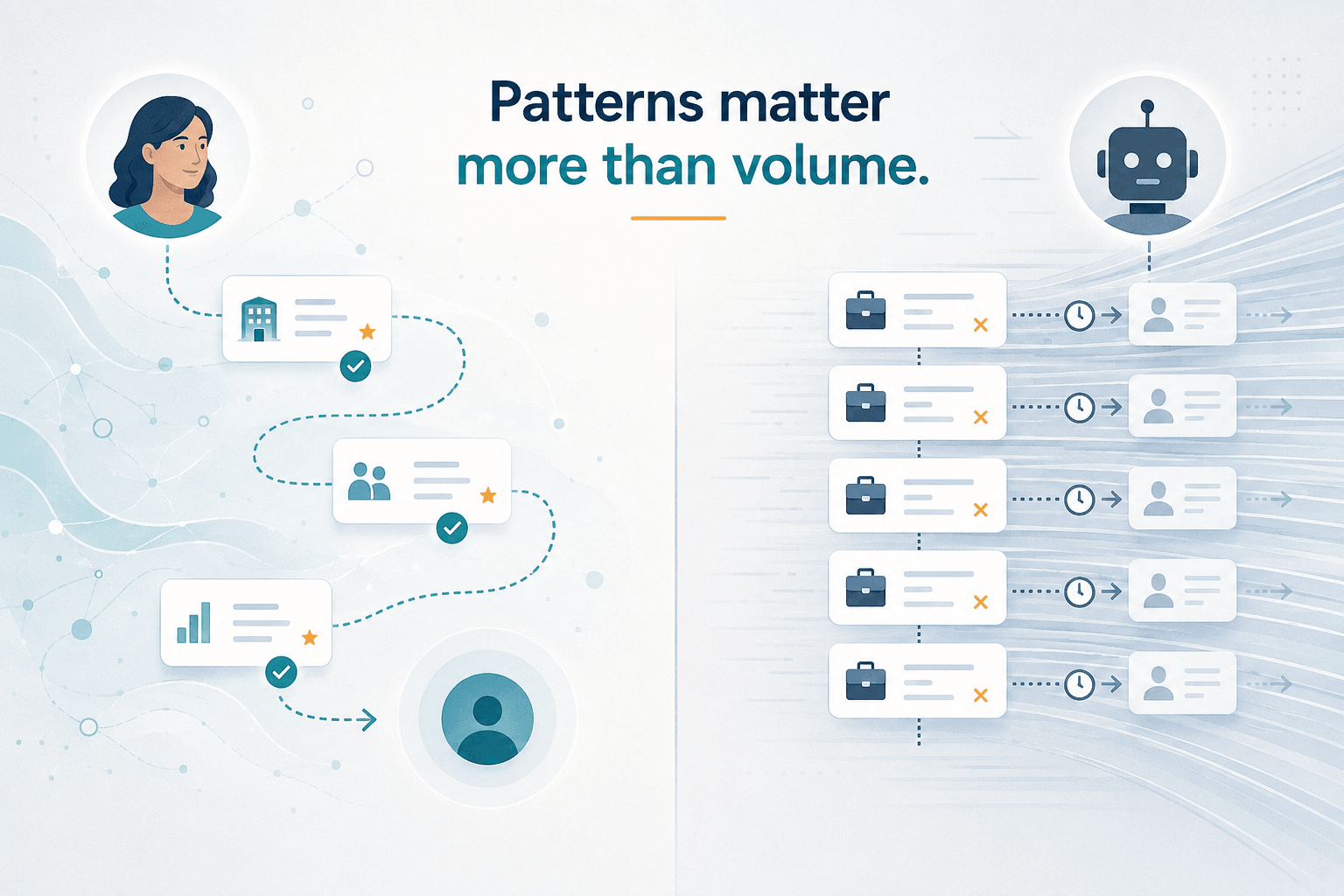
The difference often appears in the complete pattern rather than the raw application count. A human candidate is likely to read role information, move through pages with natural variation, reconsider answers, update materials, and concentrate on opportunities that share some professional relevance. Even an efficient user tends to show changes in timing and interaction because every role and application contains different information. Automated activity is more likely to repeat identical navigation, submit at mechanical intervals, skip meaningful engagement, and move across unrelated roles without normal variation.
This is why rigid limits can create unintended harm. A simple rule that restricts every candidate after a fixed number of applications may affect genuine people during an intensive job search. A rule based only on speed may flag users who rely on saved profiles, accessibility tools, or efficient application workflows. At the same time, sophisticated automation can adapt its timing to remain below static thresholds, which means a blunt limit may inconvenience legitimate users without stopping the activity it was intended to prevent.
CrossClassify uses multiple signals to create risk context instead of treating one behavior as proof. Its behavioral biometrics solution can evaluate typing cadence, navigation rhythm, pointer behavior, scrolling, and session timing alongside device intelligence and velocity. Recruitment platforms can use these signals to identify activity that deserves review without using behavior to infer candidate intelligence, motivation, personality, or professional suitability.
How automated submissions create operational damage
Automated submission activity does not need to cause a direct security breach to create meaningful damage. Its first effect may simply be a larger review queue. Recruiters receive more profiles, operations teams receive more complaints, and support teams spend more time explaining why application results feel less relevant. The cost appears gradually through lost time, reduced confidence, and weaker engagement rather than through one obvious incident.
Application noise can also distort product analytics. A role may appear to perform well because it receives a high number of submissions, even when much of that activity comes from repeated accounts or automated workflows. Product teams may then optimize job distribution, campaign spending, or recommendation systems around unreliable engagement. Commercial teams may report strong application delivery while employers quietly become less satisfied with the quality of the activity.
The damage can spread to candidate experience as well. When recruiters face overloaded pipelines, response times become longer and communication becomes more limited. Genuine applicants may receive no feedback because recruiter attention has already been consumed by reviewing low value submissions. This creates a cycle in which candidates submit more applications to improve their chances of receiving a response, which produces even more volume and further reduces the attention available for each person.
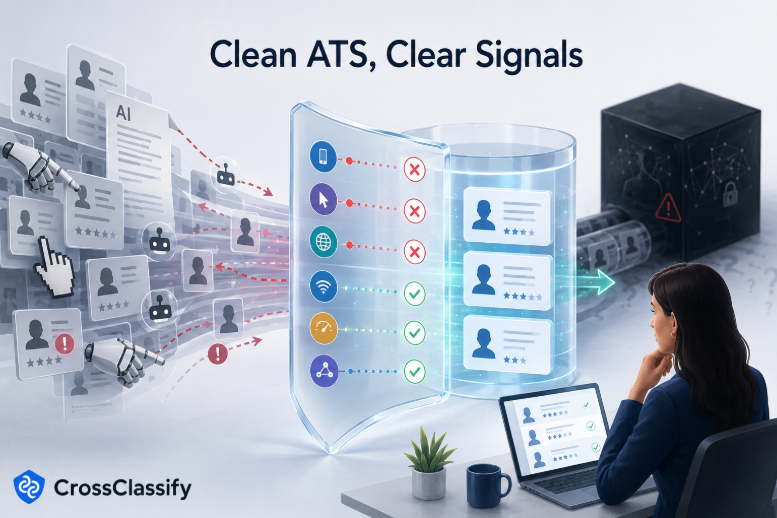
A risk aware application layer helps platforms interrupt this cycle at the operational level. Suspicious activity can be identified, grouped, and prioritized before it repeatedly consumes recruiter time. Trusted candidates can continue through normal workflows, while platform teams receive evidence about automation, repeated devices, abnormal velocity, or connected accounts. This approach improves the quality of the application stream without turning fraud detection into an automated hiring authority.
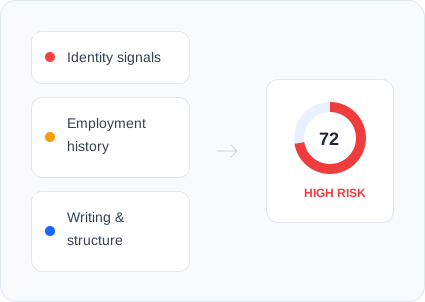
Turn CV Red Flags Into a
Documented Risk Score
A checklist tells you what to look for. CV Risk Checker scans any resume in seconds and shows you exactly where the fraud signals are — before you book the interview.
Creating a trust aware application workflow
A trust aware application workflow does not need to interrupt every candidate or add visible checks to every submission. Most candidates should be able to create accounts, browse roles, update profiles, and apply normally. Risk analysis can operate in the background, collecting only the signals needed to evaluate account and session integrity. Additional friction should appear only when the evidence and business context justify it.
The first stage collects relevant account, device, network, and behavior signals during registration, login, profile activity, and application submission. The second stage evaluates the current event against account history and connected activity. The third stage attaches understandable reasons to elevated risk, such as unusual application velocity, a device connected to several accounts, or a mechanical session pattern. This structure gives review teams evidence instead of a vague label.
The next stage routes selected events to the correct operational process. Some activity may remain under observation, while stronger patterns may require internal review, additional account verification, a temporary submission limit, or another response defined by the platform. Reviewer outcomes can then be recorded so policies and thresholds improve over time. This feedback helps reduce noise because the platform learns which combinations of signals are genuinely useful in its own recruitment environment.
CrossClassify can connect to these flows through REST APIs, JavaScript integration, and mobile SDKs. Teams evaluating implementation can review how CrossClassify integrates with digital applications before selecting the events that require monitoring. The risk layer can be introduced around registration, login, profile updates, or application submission without requiring a complete redesign of the recruitment product.
What recruiters should see
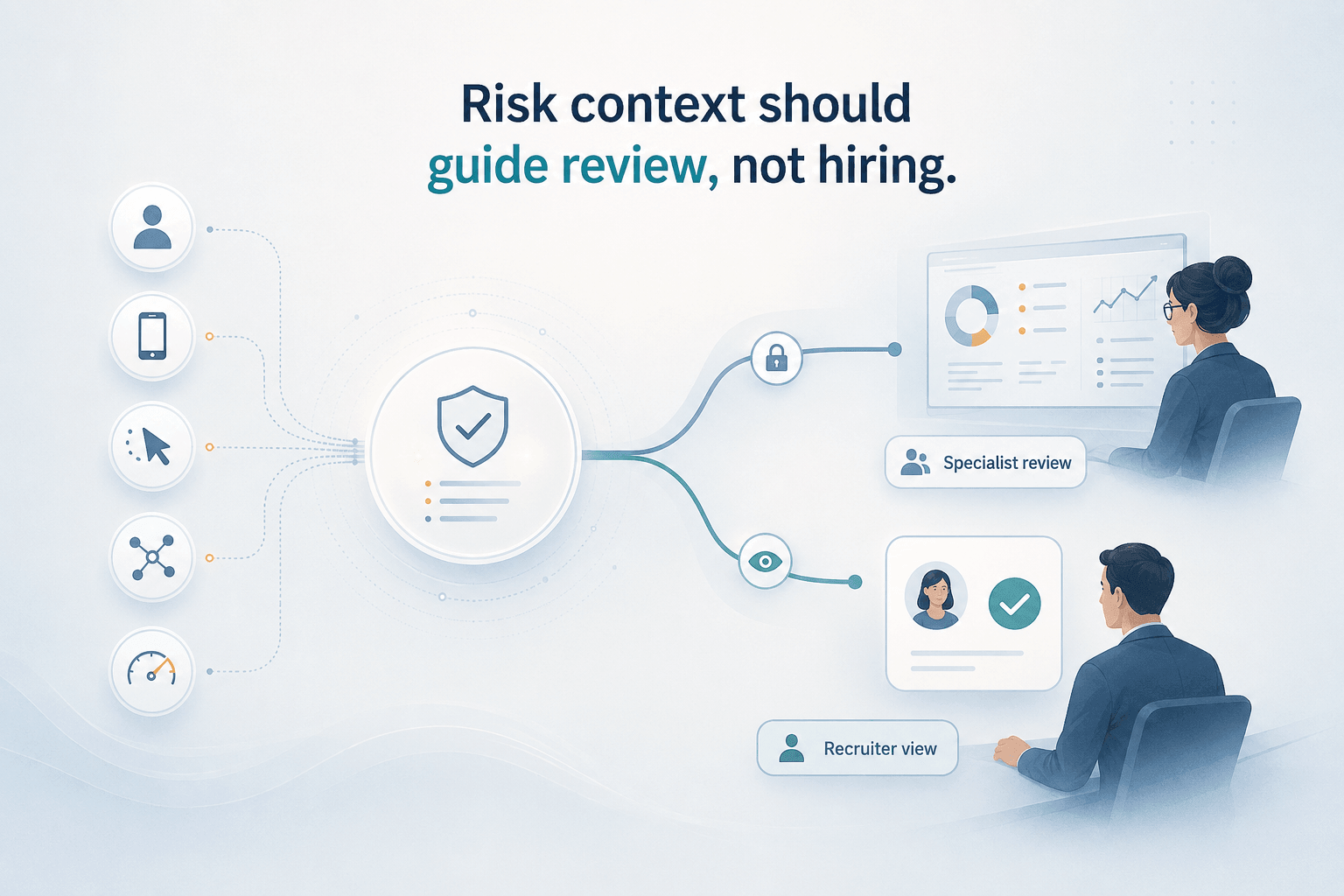
Recruiters should not receive a technical fraud dashboard filled with device attributes, network identifiers, behavior models, or unexplained risk values. Their primary responsibility is understanding employer needs and evaluating professional relevance. Asking them to interpret complex security evidence would create another form of workload rather than protecting their attention. The information displayed to recruiters should therefore be concise, role appropriate, and directly connected to the next action.
A useful indicator might explain that an application is being reviewed because it is connected with unusually high submission velocity, repeated device use, a recently created account, or several related profiles. The language should describe observable activity instead of accusing the candidate of fraud. It should never label the person as unqualified, unsuitable, dishonest, or unworthy of consideration. Platform integrity signals and candidate evaluation must remain separate.
Different teams may need different levels of detail. A recruiter may only need to know that an application is undergoing platform review and that no action is required yet. A trust analyst may need to see connected accounts, device history, session timing, and previous review outcomes. A security analyst may need network information and account access changes, while a product team may need aggregated patterns that reveal where application abuse enters the workflow.
This role based approach protects both usability and investigative quality. Recruiters receive enough context to understand why a submission may be delayed or prioritized differently, but they are not turned into fraud investigators. Specialist teams receive the evidence needed to evaluate the activity and document their decision. The platform remains responsible for deciding what information appears in each interface and how that information influences operational workflows.
Using application risk scoring responsibly
Application risk scoring can help recruitment platforms organize complex evidence, but the score must have a clearly defined purpose. It should summarize the likelihood that the surrounding account or submission activity deserves platform review. It should not become a hidden measurement of candidate quality or a substitute for recruiter judgment. Keeping this boundary explicit protects both operational usefulness and candidate fairness.
A single score should also be supported by reasons. Two applications may receive similar risk values for very different causes. One may involve mechanical submission behavior from a new account, while another may involve a familiar account suddenly appearing from a device connected to many profiles. Review teams need to understand these differences because the appropriate response may not be the same.
The platform should also account for uncertainty. A new device, fast submission, shared network, or repeated resume structure can each have legitimate explanations. Risk becomes more meaningful when multiple independent signals support the same concern. CrossClassify combines device fingerprinting, behavior analysis, velocity monitoring, and link analysis to identify harmful automation and coordinated activity rather than depending on one static rule.
Responsible scoring also requires monitoring outcomes. Teams should measure how often flagged activity is confirmed, how often trusted users are unnecessarily reviewed, and which signals create the most operational value. Thresholds should change as application behavior, platform features, and attacker methods evolve. A risk score is therefore the beginning of a decision process, not the final decision itself.
Measuring application value beyond volume
Recruitment platforms can improve reporting by separating raw application activity from reviewed and trusted activity. Raw volume remains useful because it shows reach and candidate interest. However, it should be accompanied by measurements that explain whether the activity is distributed naturally, connected to normal accounts, and likely to create useful recruiter engagement. This creates a more complete view of marketplace health.
Useful operational measurements include the number of suspicious application clusters sent to review, the frequency of repeat device patterns, abnormal submission velocity, account relationships, and reviewer outcomes. Teams can also measure how much time is spent investigating repeated patterns and whether earlier detection reduces the same activity in later workflows. These measurements help connect fraud detection with recruiter productivity rather than treating the two as separate concerns.
Product teams can use this information to identify vulnerable parts of the application journey. A large share of suspicious activity may originate during account creation, after a certain profile flow, or through a specific submission endpoint. Trust teams can refine review policies, while engineering teams can place additional monitoring around the events that create the greatest risk. Commercial teams can explain application value in terms of reliable opportunity rather than relying only on the largest possible number.
CrossClassify functions as a fraud signal and decision support layer within this measurement model. It can help organize evidence around accounts, devices, behavior, networks, and connected activity, while the recruitment platform remains responsible for thresholds, review policies, candidate communication, and hiring decisions. This separation allows teams to improve application trust without allowing a security score to control professional outcomes.
Protecting candidate trust while reducing noise
Reducing application noise should not require treating candidates as adversaries. Most applicants are genuine people trying to find suitable work in a competitive environment. They may use templates, writing tools, shared devices, saved profile information, or rapid application methods for legitimate reasons. A trustworthy recruitment platform must protect recruiter attention without creating unnecessary suspicion around normal candidate behavior.
Transparency and proportionality are important. When a platform requests additional verification or temporarily reviews an account, the communication should explain the operational reason without making an unsupported accusation. Candidates should understand what is required from them and what will happen next. Clear processes reduce frustration and make it easier for genuine users to resolve unusual account conditions.
Human judgment is equally important. Current hiring research shows significant concern about fully automated hiring decisions and the possibility that automated systems may overlook qualified candidates. Fraud controls should not recreate that problem by silently allowing technical risk signals to determine who receives consideration. CrossClassify is most useful when its signals are reviewed within defined trust and safety workflows while recruiters continue to evaluate skills, experience, and role relevance.
A balanced model protects both sides of the marketplace. Recruiters receive cleaner and more understandable application streams. Genuine candidates face less competition from coordinated automation and repeated low trust activity. Platform teams gain better visibility into abuse patterns, while hiring decisions remain where they belong, with employers and human reviewers.
Conclusion
A successful recruitment platform should not force recruiters to choose between pipeline volume and usable signal. A large application count can create value when it represents genuine interest and relevant candidate journeys. It creates operational cost when repeated, automated, or suspicious activity hides the profiles that deserve meaningful attention. Protecting recruiter attention therefore requires more than faster resume screening.
Application trust depends on context that cannot be found in resume content alone. Device history, session behavior, submission velocity, network information, account age, and relationships between profiles can reveal whether an application followed a normal journey or belongs to a wider pattern. These signals become most valuable when they are combined, explained, and routed to the right review team.
CrossClassify helps recruitment platforms place this risk context around account creation, login, profile activity, and application submission. It combines device intelligence, behavioral analysis, bot detection, and link analysis while supporting integration through APIs and SDKs. The platform can then decide when to monitor, verify, review, or limit activity according to its own policies.
The result is not automated candidate rejection. It is better protection for recruiter attention, stronger operational visibility, more reliable application reporting, and greater confidence in the activity reaching hiring teams. Recruitment platforms can preserve an accessible candidate journey while giving recruiters more time to focus on the people and conversations that create real hiring value.
See How CrossClassify Protects Recruitment Platforms
Detect fake recruiters, fraudulent resumes, and job scams instantly

Check a CV for Fraud Signals in 60 Seconds
Upload any resume and get an instant risk score, flagged signals, and a recruiter-ready action checklist.
Try the CV Risk CheckerNo credit card required
Share in
Related articles
Frequently asked questions
Let's Get Started
Create your free
account today
Discover how to secure your app against fraud using CrossClassify
No credit card required