Last Updated on 08 May 2026
How to Detect Auto Apply Candidate Fraud Before It Pollutes Your ATS
Share in
Introduction
Your ATS can look healthy and still be full of noise.
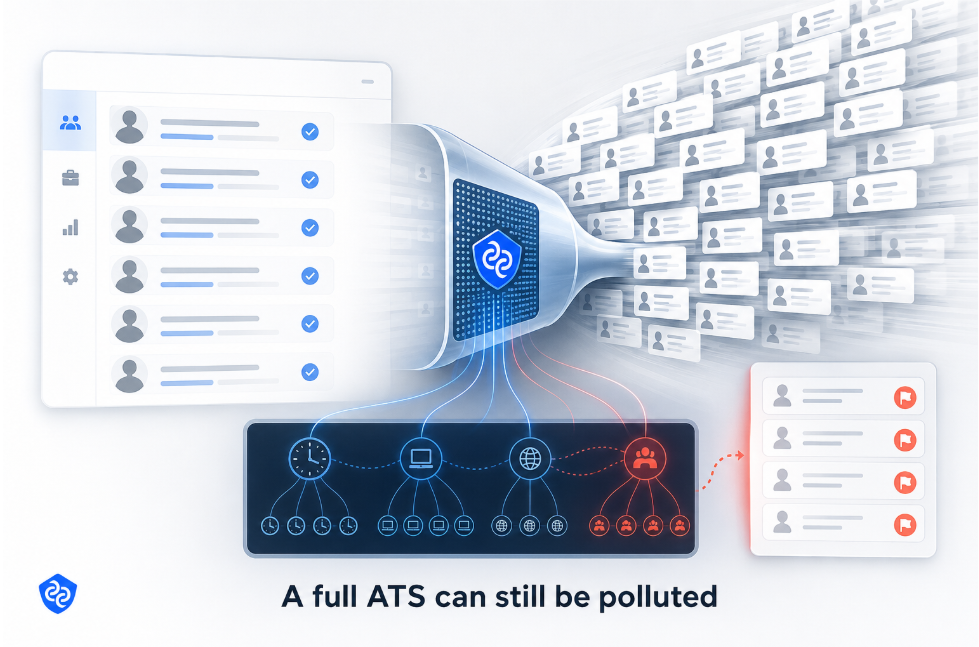
A recruiter opens a role and sees hundreds of applications. On paper, this looks like demand. In practice, many of those submissions may come from auto apply tools, repeated fake candidate accounts, copied resume structures, suspicious browser sessions, or low intent applicants who never read the job description.
The problem is not that candidates use AI. Many real candidates use AI to improve a resume, check grammar, or prepare for interviews. The real problem starts when automation turns job applications into volume spam. At that point, the ATS stops being a candidate pipeline and starts becoming a polluted database.
Auto apply candidate fraud is difficult because it often looks normal in isolation. One resume may look fine. One email may look fine. One application may look fine. The pattern only becomes visible when you connect behavior, timing, device, browser, network, and account history.
That is where CrossClassify fits. CrossClassify gives recruitment platforms, ATS providers, staffing firms, and hiring teams a fraud signal layer that helps humans identify suspicious activity before it consumes the review process.
Auto apply fraud is a behavior problem
Auto apply abuse is not only about resume text. It is about how applications are created, submitted, repeated, and connected.
A normal candidate often reads the job, pauses, edits answers, checks details, and applies with some variation in behavior. An automated or assisted submission can behave differently. It may move too quickly. It may repeat the same timing pattern. It may submit to many jobs in a short period. It may reuse the same device fingerprint across many identities. It may come from a browser environment that looks manipulated.
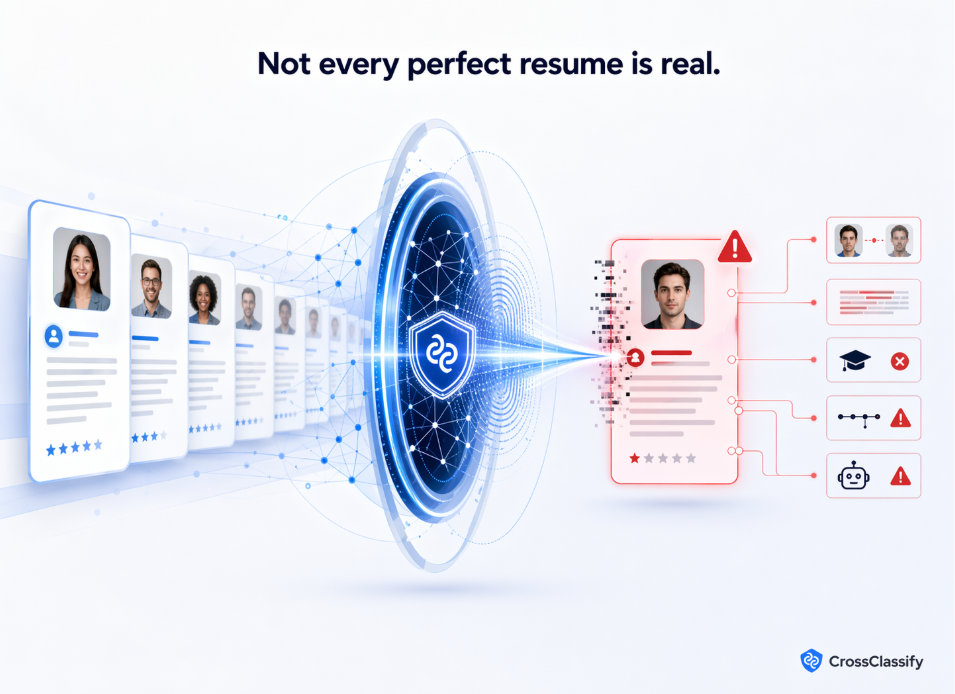
This is why resume screening alone is weak. A perfect resume can still come from a suspicious session.
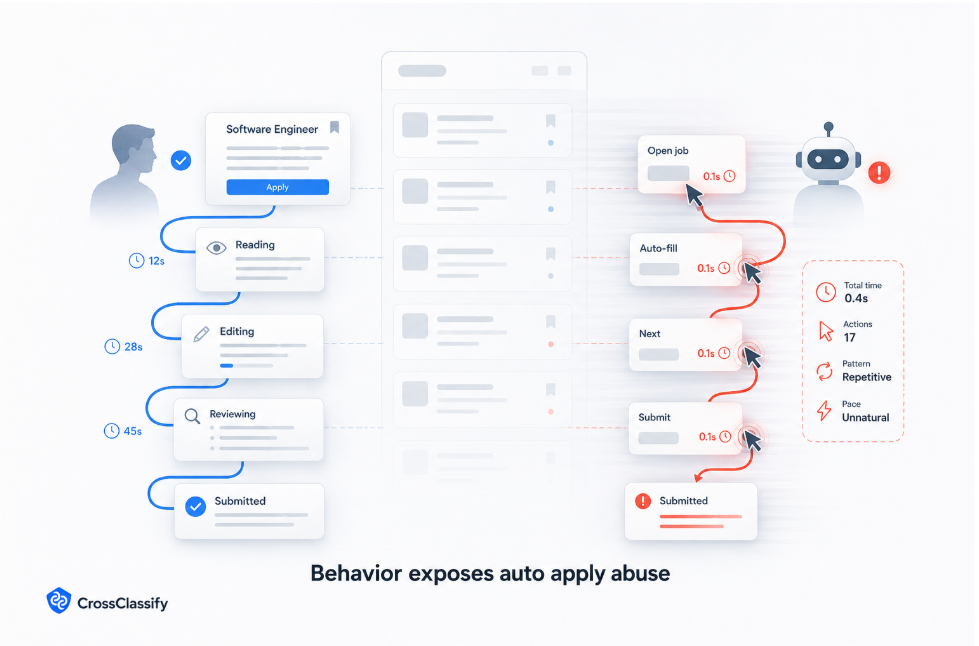
CrossClassify helps recruitment teams look beyond the resume. Its recruitment fraud solution supports suspicious application detection by connecting candidate activity with fraud signals. This gives recruiters useful context before they spend time reviewing a low trust submission.
Signals that reveal auto apply candidate fraud
The strongest auto apply fraud signals usually appear across multiple layers.
First, there is submission velocity. A candidate who applies to many unrelated jobs in a short window may deserve review. Velocity alone should not decide anything, but it is a useful risk signal.
Second, there is device reuse. Many candidate accounts coming from the same device, browser profile, or suspicious environment can suggest account farming or repeated abuse.
Third, there is session behavior. Scripted sessions often show unusual typing rhythm, page timing, scrolling behavior, field movement, or navigation order.
Fourth, there is network inconsistency. VPNs, proxies, hosting providers, impossible geography, and region hopping can all help explain why a submission looks risky.
Fifth, there is graph overlap. If many applicants share devices, IP patterns, behavioral rhythm, or account creation traits, the platform may be seeing a coordinated application pattern.
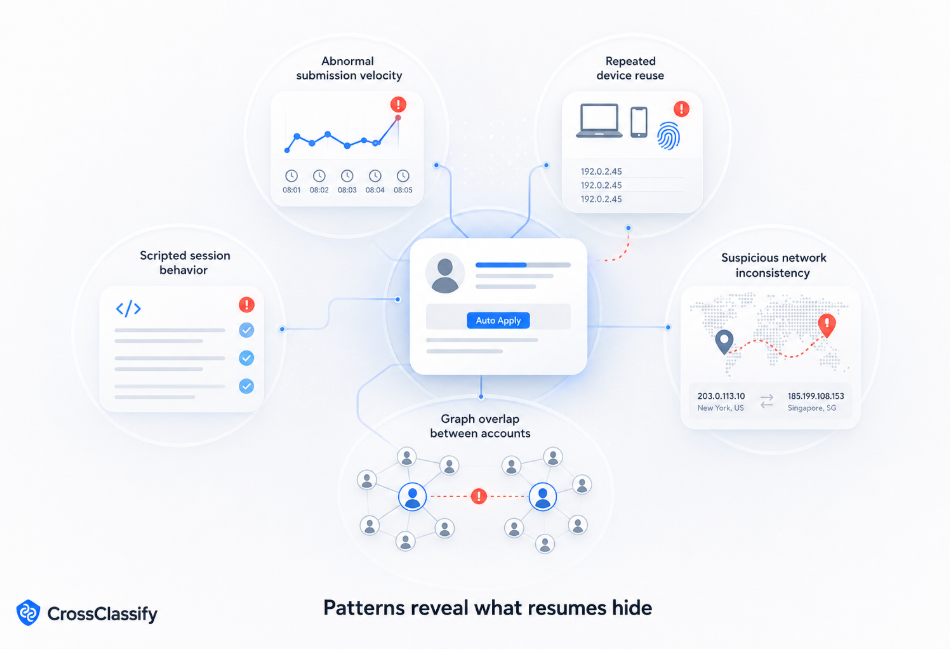
CrossClassify’s device fingerprinting solution helps identify repeated or suspicious device patterns across accounts and sessions. That context matters because bad actors often change emails faster than they change infrastructure.
Why CAPTCHA and email verification are not enough
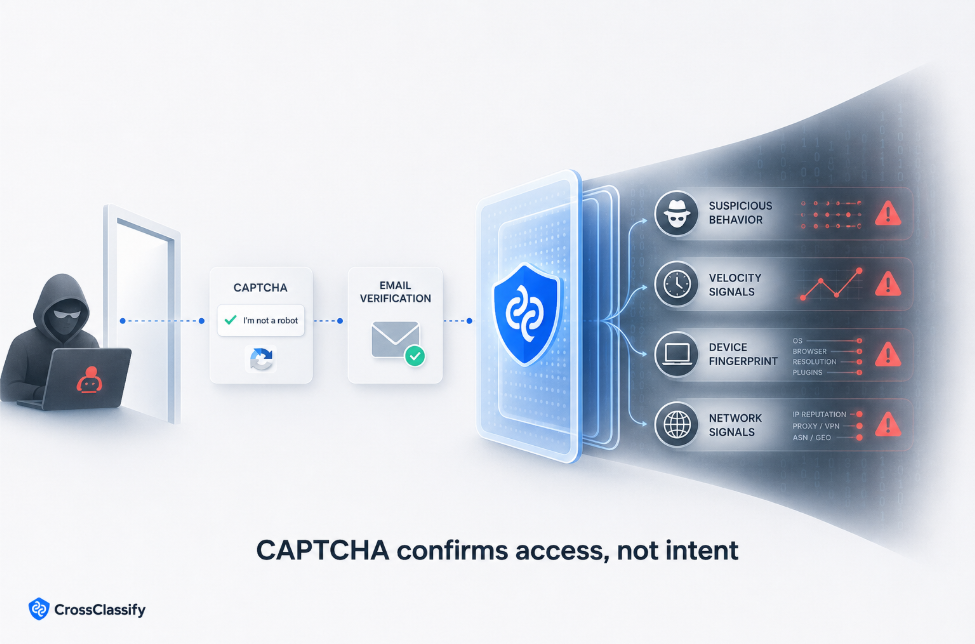
CAPTCHA can stop some simple automation. Email verification can confirm access to an inbox. Neither one proves candidate intent.
A motivated actor can pass CAPTCHA. A bot assisted tool can use real email addresses. A fake applicant can create many accounts. A low trust submission can still look valid at the form level.
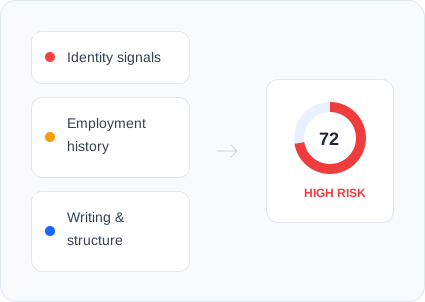
Turn CV Red Flags Into a
Documented Risk Score
A checklist tells you what to look for. CV Risk Checker scans any resume in seconds and shows you exactly where the fraud signals are — before you book the interview.
This is why recruitment platforms need layered detection. CrossClassify’s bot attack protection helps detect suspicious automation across behavior, velocity, and interaction patterns. In recruitment workflows, this means the platform can flag suspicious application activity without adding friction to every candidate.
How to detect auto apply fraud without rejecting candidates automatically
The safest approach is not to block every suspicious application. The safer approach is to explain why a submission deserves review.
CrossClassify provides review signals such as unusual velocity, repeated device use, suspicious browser environment, proxy mismatch, and account graph overlap. These signals help recruiters prioritize review. They do not decide who gets hired.
This distinction matters. Recruitment teams need decision support, not an automated hiring authority. A fraud signal can protect ATS data quality while keeping human reviewers in control.
CrossClassify’s behavioral biometrics solution adds another layer by looking at how people interact with the application flow. This helps detect automation patterns while keeping the normal candidate experience smooth.
Practical workflow for ATS teams
A strong auto apply detection workflow has five steps.
Step one, collect signals at candidate signup and application submission.
Step two, enrich each application with device, browser, behavior, network, and velocity context.
Step three, assign a fraud risk level with explainable reason codes.
Step four, route suspicious submissions to a human review queue.
Step five, measure whether recruiters see cleaner pipelines and fewer low trust applications.
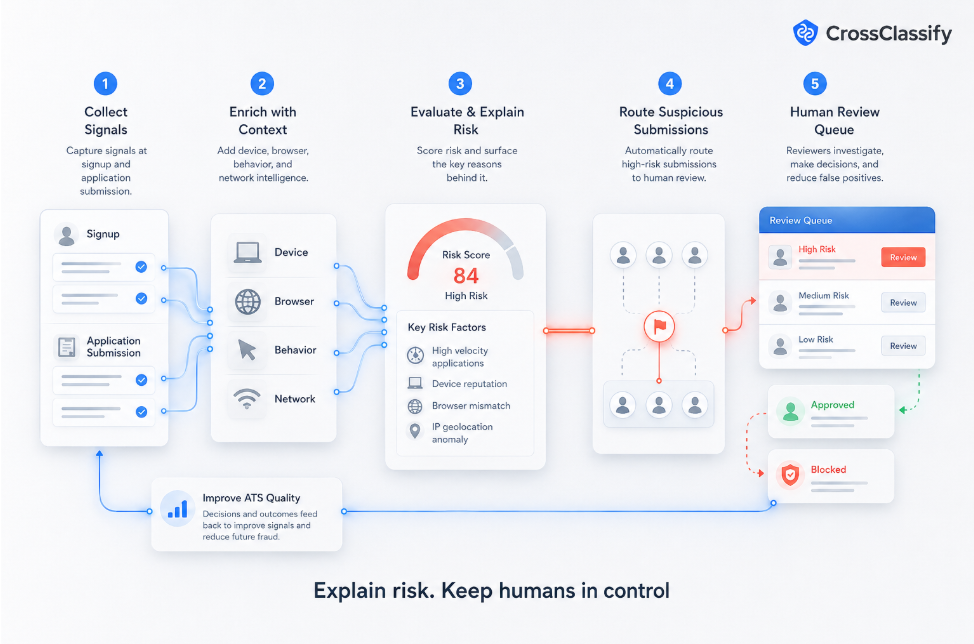
CrossClassify is designed to sit inside this workflow through SDKs and APIs. The platform can support recruitment SaaS teams that need fraud intelligence without rebuilding their ATS.
Conclusion
Auto apply candidate fraud is not solved by reading resumes harder.
It is solved by protecting the trust layer around the application. That means looking at behavior, device, browser, network, timing, and graph signals before suspicious submissions become recruiter workload.
CrossClassify helps recruitment platforms and hiring teams detect suspicious application behavior, protect ATS hygiene, and support human review without turning fraud detection into automated hiring decisions.
See How CrossClassify Protects Recruitment Platforms
Detect fake recruiters, fraudulent resumes, and job scams instantly

Check a CV for Fraud Signals in 60 Seconds
Upload any resume and get an instant risk score, flagged signals, and a recruiter-ready action checklist.
Try the CV Risk CheckerNo credit card required
Share in
Related articles


Frequently asked questions
Let's Get Started
Create your free
account today
Discover how to secure your app against fraud using CrossClassify
No credit card required