Last Updated on 11 Aug 2026
Recruitment Fraud Operations: Turning Risk Signals Into Review Queues, Alerts, and Security Workflows
Share in
Introduction
Fraud detection creates value only when a team can understand and act on the result. Recruitment platforms may collect login alerts, device anomalies, account relationships, bot indicators, suspicious postings, and candidate reports. When these signals remain scattered across separate systems, reviewers must reconstruct incidents manually.
More alerts do not automatically create better protection. An operations team can receive hundreds of warnings without knowing which event affects candidates, which account is compromised, or which pattern belongs to a larger campaign. Noise consumes the same attention that the fraud system was intended to protect.
Recruitment fraud operations is the discipline of turning detection into repeatable action. It includes risk categories, review ownership, case timelines, escalation, user communication, incident response, and feedback. The objective is to help each team see the evidence relevant to its responsibility.
CrossClassify can deliver identity, behavior, network, and device risk signals through web and mobile SDKs, REST APIs, dashboards, alerts, and other integration paths. Its official pages also describe notifications through webhooks and security workflows.
Why isolated fraud signals fail operational teams
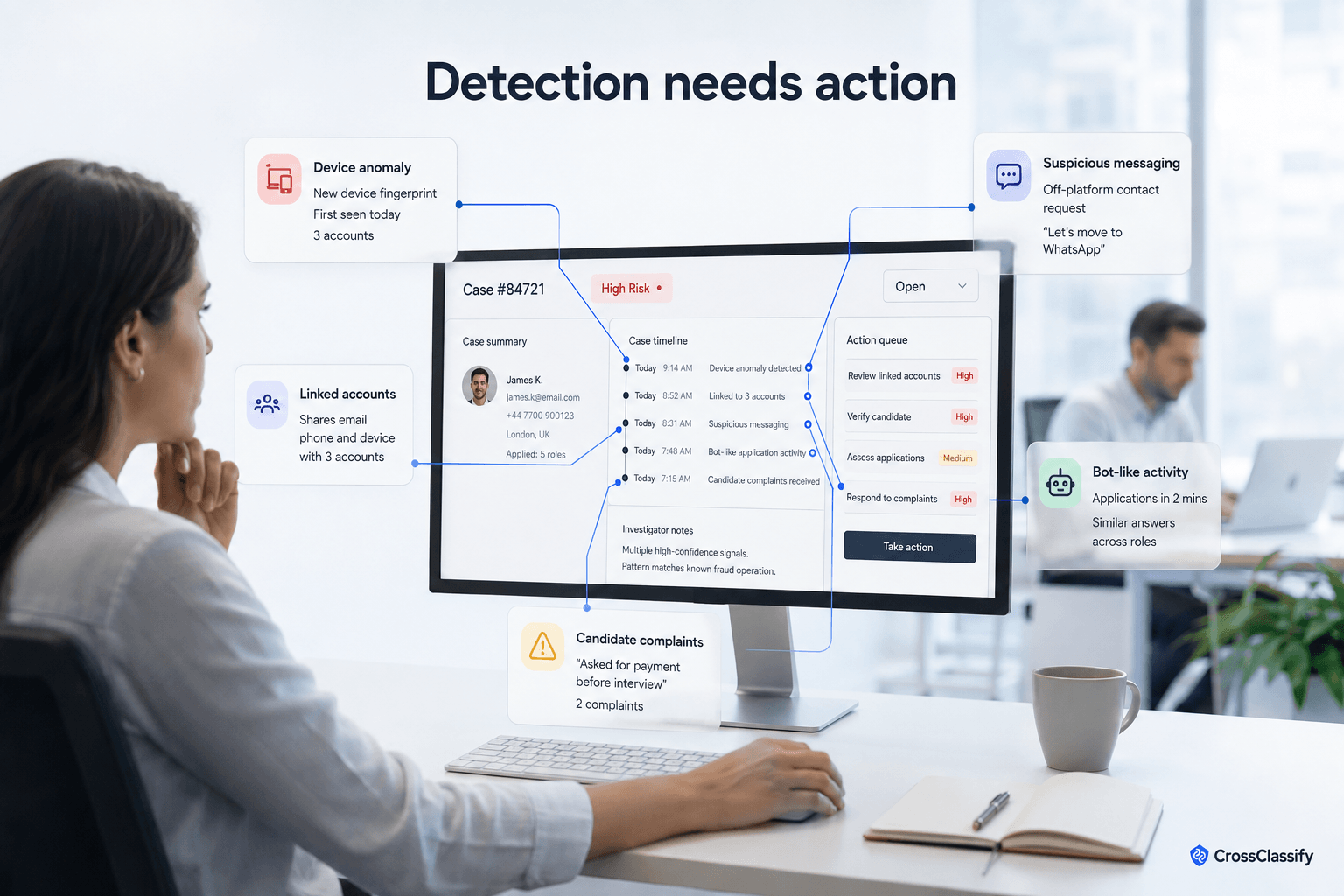
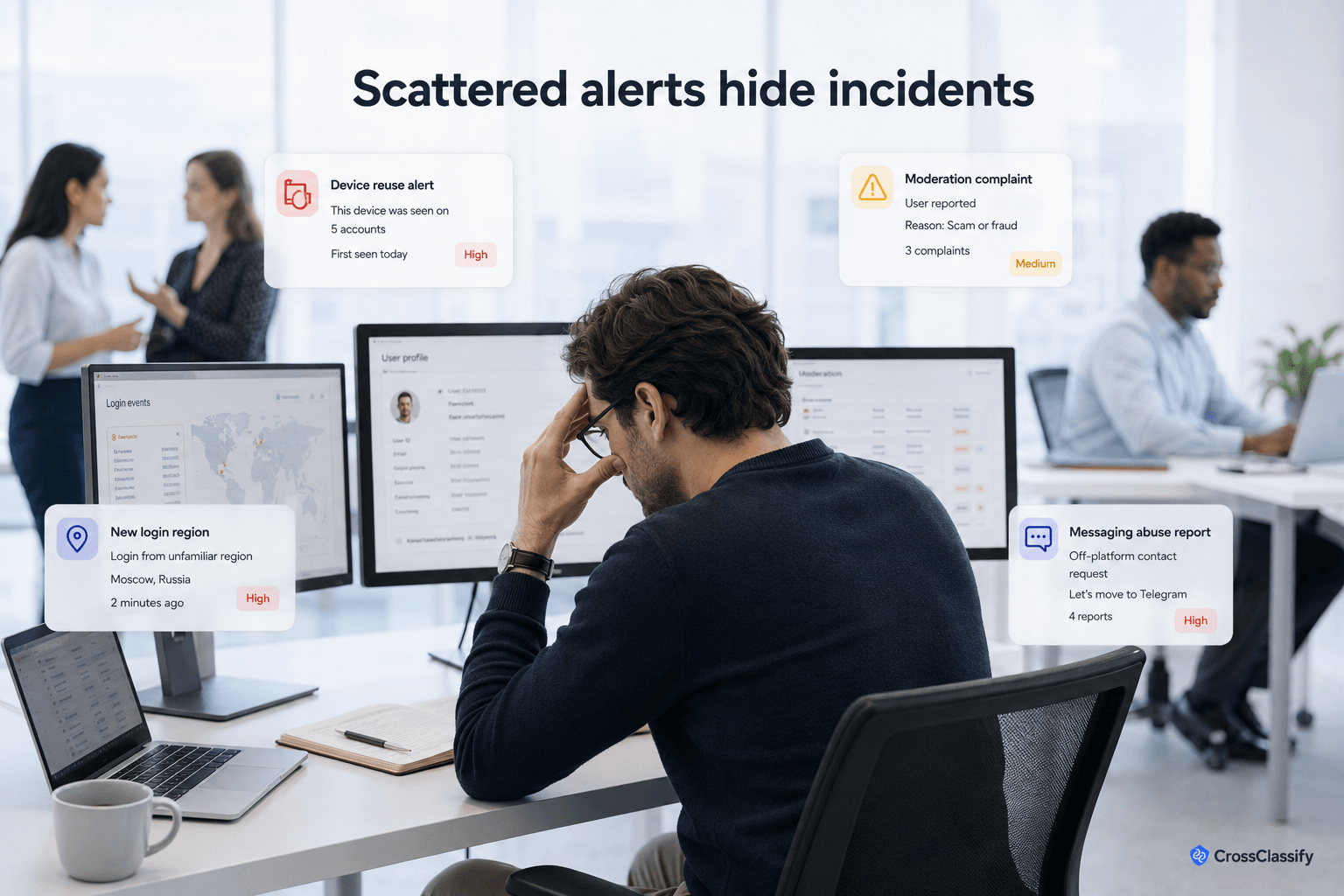
A device alert may show that several accounts share an environment. A login system may separately report a new region, while a moderation tool receives candidate complaints about messages from one of those accounts. Each signal contains part of the incident, but no team sees the complete pattern.
Fragmentation increases investigation time. Analysts search across dashboards, request logs from engineering, and ask support teams for conversation history. During that delay, the account may continue posting, messaging, applying, or accessing candidate data. The technical detection occurred, but operational response remained slow.
Isolated signals also create inconsistent decisions. One reviewer may restrict the account because of a new device, while another clears a similar event because the context is missing. Without shared reason codes, timelines, and policies, outcomes depend too heavily on individual interpretation.
A fraud operations layer connects events around the account and workflow. CrossClassify can provide device, behavior, network, and relationship context, while the recruitment platform adds jobs, applications, messages, permissions, and user reports. The result is a case that explains the incident rather than a list of alerts.
Building a recruitment risk taxonomy
A risk taxonomy gives teams a shared language for different forms of abuse. Useful categories may include account opening risk, account takeover, automated application activity, profile harvesting, messaging abuse, assessment continuity, job source integrity, and connected account networks. Each category should map to an operational owner.
Categories should remain separate from evidence. Device reuse is a signal that may support several risk types. Unusual velocity may indicate automation, compromised access, or legitimate campaign activity. The taxonomy should describe the suspected workflow problem while reason codes show what evidence contributed.
Clear categories improve routing. Account takeover cases may go to security operations, while suspicious job listings may go to trust teams. Candidate profile scraping can involve privacy, product, and customer teams. Assessment integrity may require a specialist review process that remains separate from recruiter evaluation.
CrossClassify combines several risk layers, but the recruitment platform defines its business taxonomy. The same device or behavior signal can be presented differently according to the affected event. This prevents one universal suspicious activity label from controlling every case.
Prioritizing cases by risk and impact
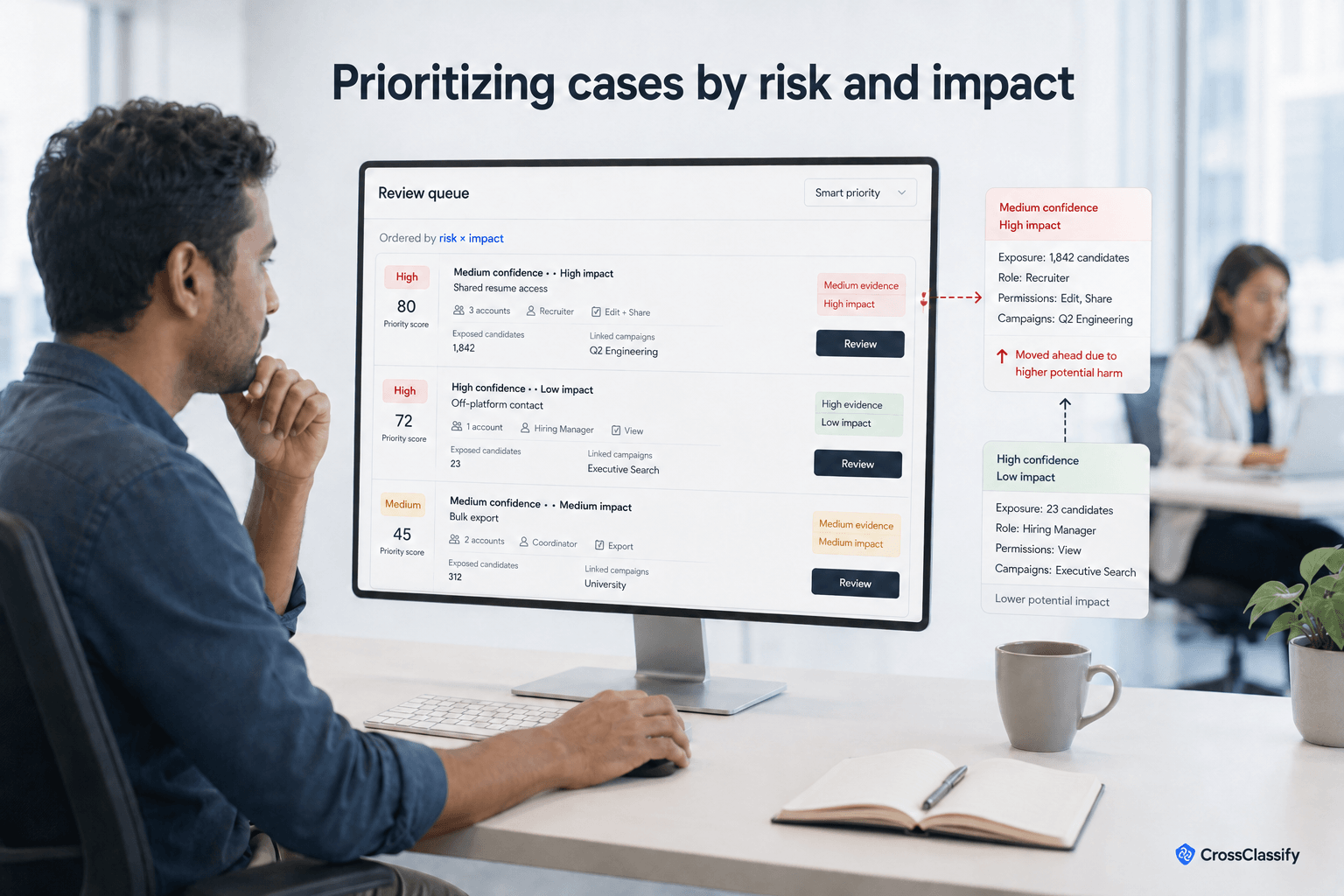
Risk confidence explains how strongly the available evidence supports concern. Impact explains what can happen if the activity continues. A medium confidence event involving access to sensitive candidate data may deserve faster attention than a higher confidence event with limited permissions.
Recruitment platforms should consider account role, workflow, data access, candidate exposure, employer visibility, and activity scale. A candidate account submitting several unusual applications creates a different impact from a recruiter account messaging thousands of profiles. Priority should combine technical evidence with business context.
Case grouping also affects priority. Ten alerts connected to one device and campaign should not compete separately for reviewer attention. Grouping related accounts, listings, messages, or applications allows teams to investigate the campaign as one operational incident.
CrossClassify’s link analysis and risk scoring can help identify connected activity. The platform can combine those results with event sensitivity and user permissions. Human teams remain responsible for defining service levels and escalation priorities.
Creating explainable review queues
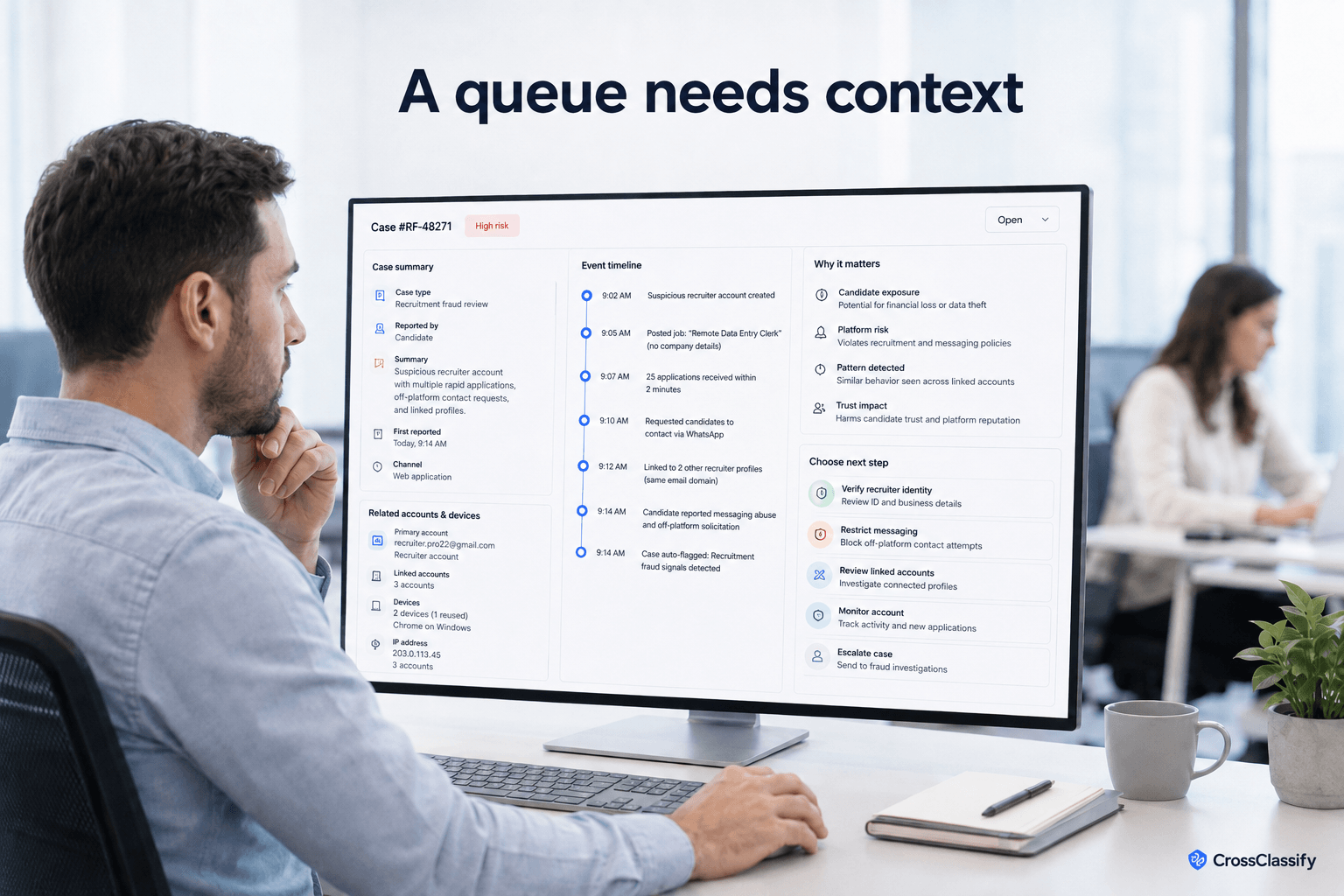
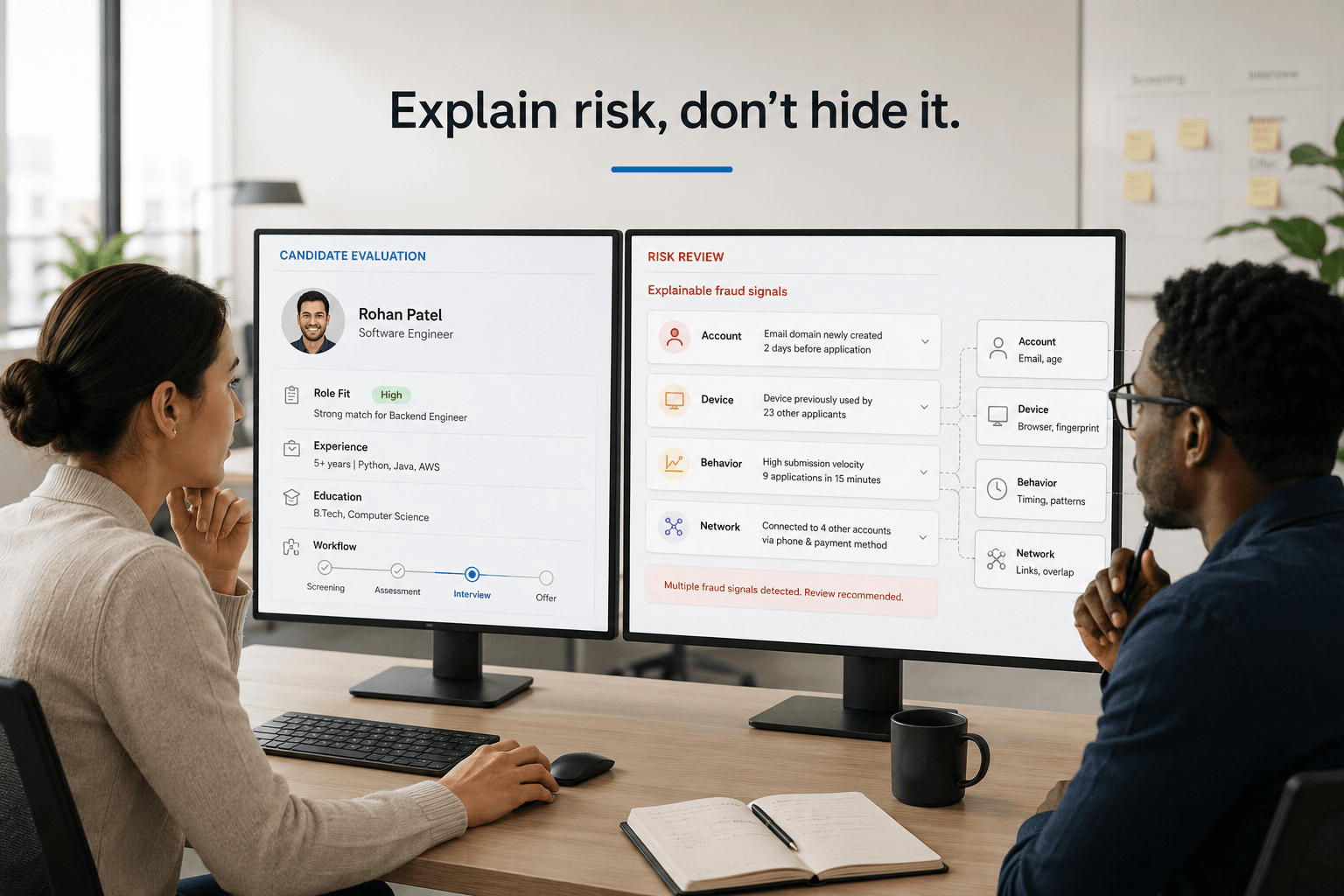
A review queue should tell the analyst what happened, why it matters, and what decision is required. The initial view needs a concise summary, risk category, affected workflow, account role, and contributing reasons. Technical detail should remain available without overwhelming triage.
A useful case timeline connects account creation, login, device changes, profile edits, job posts, applications, messages, and reports. Reviewers can then see whether the event developed gradually or followed a sudden access change. Related accounts and devices should appear as evidence rather than separate unexplained alerts.
The queue should support structured outcomes. Reviewers may confirm abuse, clear the event, request verification, continue monitoring, restrict a permission, or escalate the incident. Recording the reason for each outcome improves consistency and future tuning.
CrossClassify can send enriched risk context into platform tools through APIs and alerts. Teams can use the CrossClassify integration approach to connect risk events with existing review systems. The recruitment platform controls the interface and available actions.
Connecting fraud signals with security operations
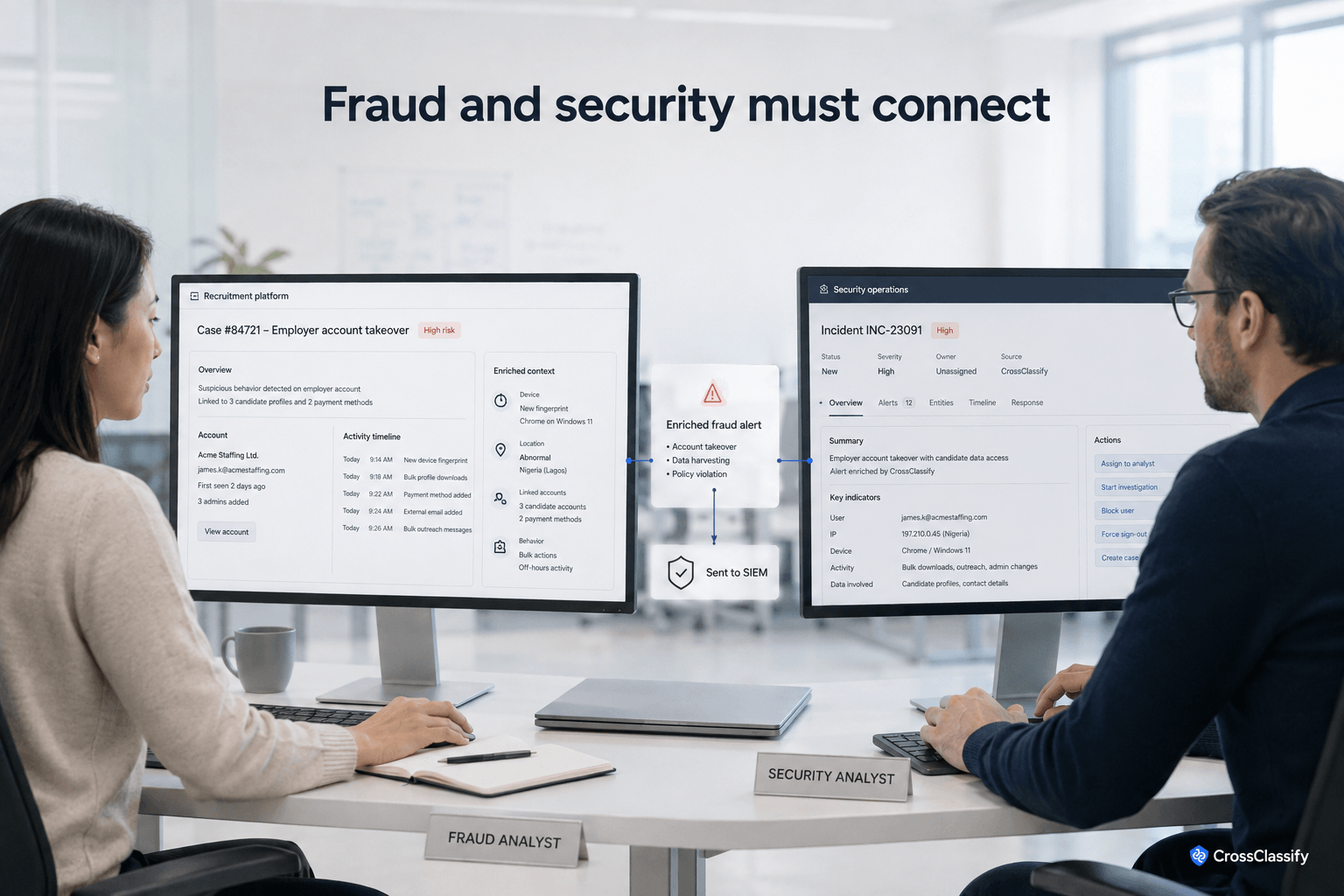
Some recruitment incidents are security incidents. Employer account takeover, credential abuse, suspicious recruiter permissions, API token misuse, and candidate data harvesting may require security operations involvement. Fraud and security teams need a clear escalation path.
Security teams often work from SIEM alerts, identity logs, network events, and incident playbooks. Fraud teams work from account relationships, user behavior, candidate reports, and marketplace outcomes. Connecting these views helps both teams understand the complete event.
An enriched alert can include account identity, device risk, behavior anomalies, network context, affected action, and related profiles. The SIEM can route the event according to severity, while the fraud platform maintains the wider marketplace case. This avoids forcing either team to abandon its normal tools.
CrossClassify’s behavioral biometrics page describes routing enriched notifications through SIEM, email, webhooks, and other operational channels. Recruitment platforms can use these connections to bring fraud context into existing security response without treating every marketplace event as a critical incident.
Role based evidence for different teams
Different teams need different parts of the same incident. A recruiter may need to know that a candidate account is under platform review. A trust analyst may need device and relationship details. A security analyst may need session and network context, while support needs the current account status and required user steps.
Showing every technical signal to every team creates confusion and privacy concerns. Recruiters should not be asked to interpret device fingerprints or behavioral models. Security teams do not need detailed candidate qualification information. Role based views keep each user focused on the decision they own.
Language should also match the audience. A reviewer may see unusual device binding and linked account velocity. A candidate or recruiter may see that unusual account activity requires confirmation. The explanation can remain honest without exposing detection methods that make evasion easier.
CrossClassify provides the underlying risk evidence, while the recruitment platform controls presentation and access. Clear separation helps prevent fraud signals from becoming hidden hiring judgments or unnecessary personal data exposure.
Turn CV Red Flags Into a
Documented Risk Score
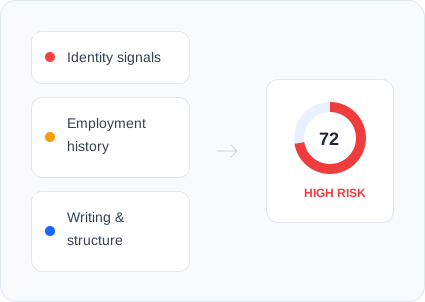
A checklist tells you what to look for. CV Risk Checker scans any resume in seconds and shows you exactly where the fraud signals are — before you book the interview.
Incident response for high impact cases
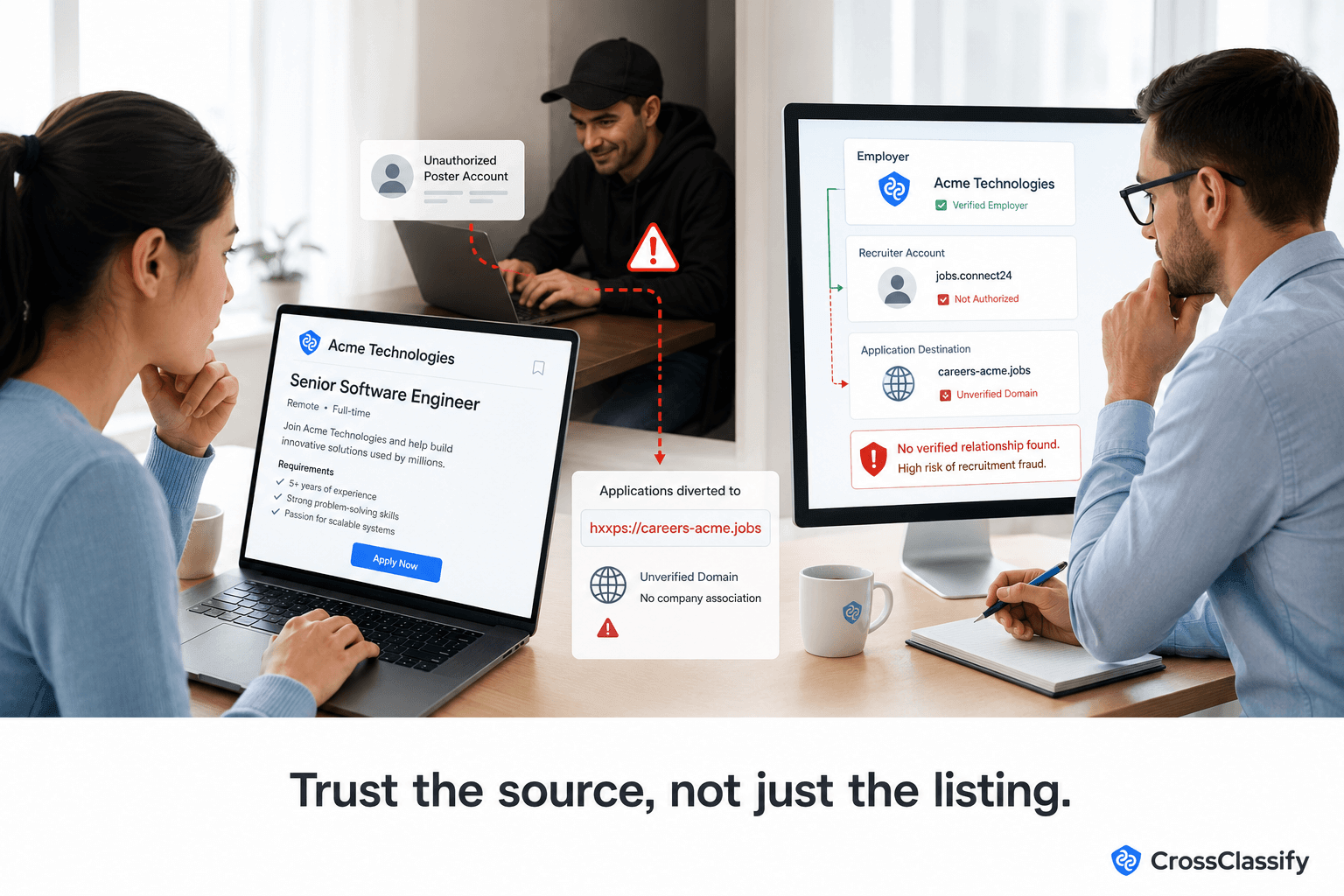
High impact recruitment incidents need prepared playbooks. Examples include a compromised employer account posting fake jobs, a scraping campaign accessing candidate data, or a coordinated network creating many accounts. Teams should know who can restrict activity, preserve evidence, contact affected users, and involve legal or privacy specialists.
The first response should reduce ongoing harm. The platform may suspend a permission, hide a listing, revoke a session, rotate a token, or limit messaging. Temporary action can protect candidates while the investigation continues. The response should be reversible when uncertainty remains.
Evidence preservation matters. Teams need account timelines, device and network records, messages, application destinations, related profiles, and reviewer actions. This information supports recovery, notification, policy enforcement, and later learning. Scattered logs make incident reconstruction difficult.
CrossClassify can contribute risk scores, device relationships, behavior evidence, and alerts. The recruitment platform remains responsible for containment, recovery, user communication, and legal decisions. A prepared process converts detection speed into operational protection.
Feedback loops and threshold tuning
Reviewer outcomes are essential for improving fraud operations. A confirmed case shows which signals and relationships mattered. A cleared case reveals legitimate patterns that should produce less friction. Verification results, support complaints, and user abandonment also provide important feedback.
Tuning should occur at the reason level rather than only changing one global score. Device novelty may be noisy for remote recruiters but useful around account recovery. High velocity may be expected during a hiring campaign but suspicious during new account creation. Context determines signal value.
Product changes can also affect normal behavior. A new application flow may alter timing and navigation, causing earlier behavioral expectations to become inaccurate. Fraud teams need release awareness and testing so the system does not interpret product design changes as user risk.
CrossClassify supports configurable event monitoring and risk context, while the recruitment platform provides outcome data and operational knowledge. Continuous feedback keeps controls aligned with the actual marketplace rather than a static model of user behavior.
Governance and auditability
Governance defines what fraud signals may influence, who may view them, and how decisions are recorded. Recruitment platforms should document the purpose of each risk category and the actions available at different confidence levels. This prevents technical evidence from expanding into unrelated hiring decisions.
Audit records should show the signals presented, the reviewer, the decision, and any user communication. This supports internal quality review and helps teams understand why similar cases received different outcomes. It also provides evidence when policies or models are changed.
Access to detailed device, behavior, and relationship data should follow role and need. Recruiters may need only status information, while fraud and security teams receive deeper evidence. Data retention should also match the platform’s privacy and operational requirements.
CrossClassify provides risk information and integration capability, but governance remains with the recruitment platform. The platform defines policy, access, escalation, review, retention, and final action. This keeps decision authority transparent.
Measuring fraud operations
Fraud operations should be measured through outcomes, speed, accuracy, and user impact. The number of alerts generated is not enough because a noisy system can produce high volume without improving protection. Teams need to know whether incidents are detected earlier and resolved more consistently.
Useful measures include time to triage, time to containment, confirmed case rate, false alert rate, repeated incident reduction, verification completion, and reviewer workload. Platforms can also measure candidate exposure, employer impact, profile access, and the number of related accounts identified through each case.
Operational quality includes consistency. Similar evidence should lead to similar outcomes unless business context differs. Regular case review can identify policy gaps, training needs, and reason codes that reviewers interpret differently. This creates a more reliable program.
CrossClassify can supply risk and relationship context, while the platform records case outcomes. Together, these measurements show whether the fraud layer protects users and marketplace value without creating excessive friction or operational noise.
Conclusion
Recruitment fraud detection is not complete when a model generates a score. The value appears when teams can understand the evidence, prioritize the event, choose an appropriate response, and learn from the outcome. Isolated alerts leave too much operational work unresolved.
A mature fraud operations program connects risk categories, reason codes, account timelines, product events, and team ownership. It brings fraud context into review queues, support tools, and security workflows while preserving role based access and clear decision authority.
CrossClassify helps recruitment platforms collect and connect identity, behavior, network, and device signals. Its SDKs, APIs, alerts, and integration options allow these signals to enter existing product and security operations. The platform retains control over policy, escalation, communication, and final action.
The result is more than better detection. It is faster containment, clearer human review, more consistent decisions, and stronger protection for candidates, recruiters, employers, and recruitment platform trust.
See How CrossClassify Protects Recruitment Platforms
Detect fake recruiters, fraudulent resumes, and job scams instantly

Check a CV for Fraud Signals in 60 Seconds
Upload any resume and get an instant risk score, flagged signals, and a recruiter-ready action checklist.
Try the CV Risk CheckerNo credit card required
Share in
Related articles

Frequently asked questions
Let's Get Started
Create your free
account today
Discover how to secure your app against fraud using CrossClassify
No credit card required