Last Updated on 02 Aug 2026
Candidate Data Boundary Protection: Detecting Automated Profile Harvesting Without Slowing Legitimate Sourcing
Share in

Introduction
Candidate databases create value by helping recruiters discover people with relevant skills, experience, availability, and professional interests. Detailed profiles can make sourcing faster because recruiters do not need to begin every search from an empty list. The same information also creates a valuable target for automated extraction, resale, impersonation, and unauthorized enrichment.
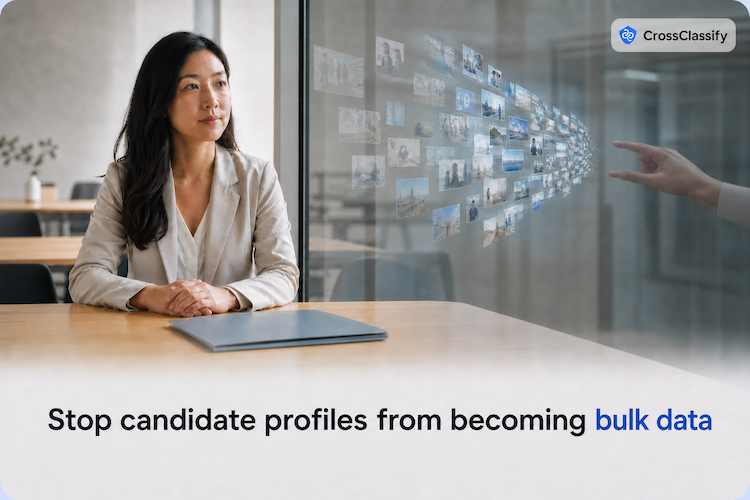
Profile harvesting does not always look like an obvious attack. A scraper may log in through a valid recruiter account, move through search results slowly, and collect information over time. It may distribute activity across several accounts or devices so no single session exceeds a simple limit. The user appears to be sourcing candidates while the underlying objective is bulk data collection.
The challenge is protecting the candidate data boundary without damaging legitimate recruiter search. Recruitment platforms need active sourcing, profile views, saved searches, messaging, and exports to remain useful. Overly rigid limits can affect real recruitment teams, while weak controls allow automated systems to extract information at scale.
CrossClassify helps platforms evaluate browser and API activity through behavioral analysis, device fingerprinting, velocity, network context, and link analysis. Its official bot protection page includes web scraping and API abuse among the automated threats it is designed to detect.
Why candidate profiles attract automated harvesting
Candidate profiles may contain professional history, location, skills, contact information, work authorization, employment preferences, and links to external portfolios. A large database can therefore provide valuable commercial intelligence. Unauthorized actors may attempt to copy profiles for resale, competing services, unsolicited outreach, identity abuse, or broader data enrichment.
The value does not depend on obtaining every field. A scraper may collect names, job titles, employers, technologies, locations, or public profile links, then combine them with information from other sources. Even partial extraction can create privacy concerns and weaken the platform’s commercial value. Candidates may also receive communication they did not expect because their information escaped the intended recruitment context.
Profile harvesting can occur through browser automation, compromised recruiter accounts, shared subscriptions, API misuse, or manual operations supported by extraction tools. The method may change as the platform introduces new controls. This makes static request limits insufficient as the only defense.
A stronger approach evaluates who is accessing data, how the session behaves, which device is involved, how activity relates to other accounts, and whether the search journey resembles normal sourcing. Candidate data protection becomes a behavior and account problem rather than only a page access problem.
Legitimate sourcing and automated extraction can look similar
Recruiters may conduct intensive searches during active hiring campaigns. They can open many profiles, compare similar candidates, save searches, send messages, and return to the same talent pool over several days. High activity is not automatically suspicious because sourcing is one of the platform’s primary functions.
Automated extraction can imitate this workflow. A script may search for common skill combinations, open profiles, collect fields, and move to the next result. It can introduce delays to avoid simple velocity rules and vary the search terms used. The activity looks superficially similar to a diligent recruiter using the platform efficiently.
The distinction appears in the full interaction pattern. Genuine recruiters usually spend different amounts of time on profiles, change queries according to what they learn, save selected candidates, and begin communication with a smaller group. Automated harvesting often produces more consistent timing, broader extraction coverage, repeated navigation, and weaker connection between profile views and legitimate hiring actions.
CrossClassify helps platforms evaluate these patterns without treating every active recruiter as a bot. Behavioral signals can be combined with account role, subscription level, device history, organization context, and product events. This allows controls to respond to evidence rather than one universal activity limit.

Behavioral signals behind profile scraping
Browser automation often creates repeated timing and navigation patterns. The system may load a search result, open each profile in order, extract selected fields, and return to the list with little variation. Even when delays are introduced, the relationship between actions may remain unusually consistent across long sessions.
Human sourcing usually contains more irregularity. Recruiters pause on relevant profiles, compare experience, revisit search filters, open external work samples, and skip candidates who do not fit the current role. The session reflects professional decision making rather than complete coverage of every available result.
Behavioral analysis can examine pointer movement, scrolling, page timing, navigation order, and interaction with profile features. These signals should not be used alone because skilled recruiters may work quickly and accessibility tools may change interaction patterns. Their value increases when combined with device, velocity, network, and account evidence.
CrossClassify’s behavioral biometrics solution can help recruitment platforms identify mechanical sessions while allowing ordinary search behavior to continue. The platform defines which patterns lead to monitoring, rate adjustment, verification, or review.
Device intelligence and shared scraping operations
A scraping operation may distribute activity across several recruiter accounts to remain below account limits. The accounts can use different names and organizations while sharing devices, browser environments, automation tools, or network infrastructure. Reviewing activity one account at a time can hide the total extraction pattern.
Device fingerprinting helps connect sessions that appear separate. A persistent device may access several recruiter accounts, reset browser storage, or rotate network addresses while maintaining deeper configuration characteristics. This provides evidence that visible account separation does not represent independent users.
Shared devices can be legitimate in staffing firms, libraries, training centers, or managed enterprise environments. The platform should compare device overlap with organization membership, account permissions, behavior, and activity outcomes. Several users from one verified employer are different from unrelated organizations sharing the same suspicious environment.
CrossClassify’s device fingerprinting solution links devices with sessions and accounts, including attempts to reset or disguise the environment. This context helps platforms identify distributed harvesting while preserving legitimate shared business infrastructure.

Account takeover and profile data access
Candidate profile harvesting may begin through an established recruiter account. Attackers value real accounts because they may already have search permissions, message history, export access, and trusted organization status. A compromised account can access candidate data without triggering new account controls.
The account may pass login because the attacker has valid credentials or a stolen session. Suspicious activity may appear later when search volume changes, the device becomes unfamiliar, or profile access no longer resembles earlier recruiter behavior. Continuous monitoring is therefore important after authentication.
The platform can evaluate whether the current session fits the account’s history. Relevant evidence includes device continuity, network changes, time of access, search patterns, export activity, and interactions with sensitive profile fields. A sudden increase in broad profile viewing may deserve review even when the login itself appeared successful.
CrossClassify’s account takeover protection solution combines device and behavior context around access and later actions. Recruitment platforms can use the resulting signals to protect candidate data after login without requiring every recruiter to complete repeated authentication.
API abuse and unauthorized extraction
Recruitment platforms may offer APIs or integration endpoints for approved customers and partners. These interfaces can make data access more efficient and easier to govern than browser automation. They can also be abused when credentials are stolen, permissions are too broad, or an integration exceeds its intended purpose.
API abuse may create high request volume, systematic pagination, repeated field access, or unusual activity across several tokens. Attackers may attempt to distribute requests or use legitimate credentials from an account with excessive permissions. Static rate limits can reduce some abuse but may not explain whether the activity fits the customer’s agreed workflow.
Context should include token history, organization, device or application identity, network origin, requested resources, and downstream recruiter actions. An approved integration accessing profiles for a defined workflow is different from a token collecting every available record. The platform should also separate public data, recruiter visible data, and sensitive contact information.
CrossClassify’s bot protection positioning includes API abuse detection, behavior profiling, velocity, device intelligence, and link analysis. Recruitment platforms can combine these signals with their own authorization model and contractual limits. The objective is to detect misuse while keeping legitimate integrations reliable.
Turn CV Red Flags Into a
Documented Risk Score
A checklist tells you what to look for. CV Risk Checker scans any resume in seconds and shows you exactly where the fraud signals are — before you book the interview.
Protecting candidate trust and data expectations
Candidates share professional information because they expect it to support employment opportunities. They may understand that verified recruiters can search or contact them, but they may not expect their data to be copied into unrelated databases or used for unsolicited campaigns. Automated harvesting can violate this contextual expectation even when some fields are publicly available.
Loss of control affects platform trust. Candidates may remove information, reduce profile completeness, or leave the service if they believe access is not governed. Recruiters then receive less useful data, which weakens the value of the marketplace. Candidate privacy and recruiter sourcing quality are therefore connected.
The platform should provide clear permissions, access controls, and reporting channels. Candidates may need options to control visibility or understand how recruiter access works. Recruiter accounts should receive only the data and actions appropriate for their role, organization, and subscription.
CrossClassify adds behavioral and device evidence around access, but it does not replace privacy policy or authorization design. The recruitment platform remains responsible for deciding who may view each field, how long data can be retained, and how suspected misuse is investigated.
Designing adaptive controls for profile access
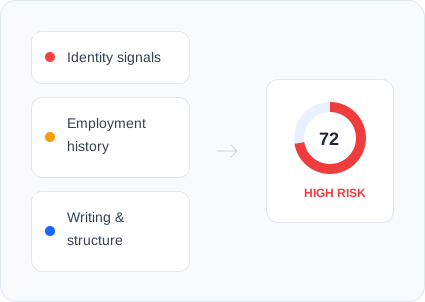
Adaptive controls allow the platform to respond to risk without applying the same limit to every recruiter. Low risk accounts can search and view profiles normally. Moderate risk activity may receive reduced velocity, additional monitoring, or account confirmation. Stronger connected evidence may justify a temporary restriction or specialist review.
The response should consider business context. A verified enterprise recruiter conducting a new campaign may create a legitimate activity spike. A new account with limited hiring history that opens large portions of the database through mechanical sessions deserves different treatment. Organization size, account tenure, search history, and communication outcomes help explain volume.
Controls should also focus on sensitive actions. Viewing a public summary may carry less risk than revealing contact information, exporting data, or opening many complete resumes. The platform can apply stronger monitoring around these boundaries rather than interrupting ordinary search.
CrossClassify can send risk scores and reason context into these product decisions. Teams can use the CrossClassify integration page to place monitoring around login, search, profile access, export, messaging, and API events. The platform keeps final control of permissions and restrictions.
Review workflows for suspected harvesting
Review teams need a clear case summary rather than thousands of separate profile view alerts. The system should group related sessions, accounts, devices, and tokens so analysts can understand the total extraction pattern. A timeline can show when the activity began, which data was accessed, and how it changed.
Useful evidence includes search diversity, profile coverage, dwell time, device reuse, network origin, export events, message activity, and organization relationships. The reviewer should also see whether the account has legitimate hiring history and whether similar patterns previously received approval. This helps distinguish business use from unauthorized harvesting.
The case may involve several teams. Security teams investigate compromised accounts and tokens. Trust teams review user behavior and contractual use. Privacy teams assess exposure, while product teams adjust controls around vulnerable workflows. A shared evidence view prevents each team from investigating a different fragment.
CrossClassify provides device, behavior, network, and relationship signals that can enrich the case. The recruitment platform can combine those signals with access logs, permissions, candidate reports, and customer agreements. Human reviewers determine whether the activity violated policy.
Measuring candidate data boundary protection
Candidate data protection should be measured through both security and product outcomes. Counting blocked requests does not reveal whether controls prevented meaningful extraction or simply interrupted ordinary recruiting. Platforms need measures that show precision, impact, and user friction.
Useful measures include confirmed harvesting cases, suspicious profile coverage, compromised account incidents, false restriction rate, verification success, export anomalies, and repeat device clusters. Teams can also measure whether legitimate recruiter search completion remains stable after controls are introduced.
Candidate outcomes matter as well. The platform can monitor privacy complaints, unsolicited contact reports, profile visibility changes, and candidate retention. A reduction in suspicious access should support stronger confidence and profile completeness rather than merely producing more security alerts.
CrossClassify can supply risk evidence, while the recruitment platform records access and business outcomes. This feedback helps teams tune thresholds and identify where stronger controls create the greatest value. Candidate data boundary protection becomes an ongoing operational program rather than a one time bot rule.
Conclusion
Candidate databases create significant value for recruitment platforms and the recruiters who use them. The same detailed information attracts automated harvesting, unauthorized enrichment, and account misuse. Protecting the database requires more than counting page requests or applying one limit to every user.
Legitimate sourcing and scraping can look similar at first. The distinction becomes clearer through behavior, device history, organization context, search patterns, API activity, and relationships between accounts. These signals help platforms understand whether access supports a genuine hiring workflow or systematic extraction.
CrossClassify helps recruitment platforms detect browser automation, API abuse, suspicious devices, account takeover, and coordinated access patterns. The platform can use this evidence to apply adaptive controls while preserving productive recruiter search and candidate discovery.
A strong candidate data boundary protects privacy, commercial value, and marketplace trust at the same time. Candidates can share useful professional information with greater confidence, and legitimate recruiters can continue sourcing without competing with invisible extraction operations.
See How CrossClassify Protects Recruitment Platforms
Detect fake recruiters, fraudulent resumes, and job scams instantly

Check a CV for Fraud Signals in 60 Seconds
Upload any resume and get an instant risk score, flagged signals, and a recruiter-ready action checklist.
Try the CV Risk CheckerNo credit card required
Share in
Related articles
Frequently asked questions
Let's Get Started
Create your free
account today
Discover how to secure your app against fraud using CrossClassify
No credit card required