Last Updated on 07 May 2026
Device Fingerprinting for Glassdoor Fake Accounts and Review Abuse
Share in
Introduction
Fake accounts are the foundation of many trust problems on recruitment platforms.
- A fake account can submit a review.
- A fake account can post a job.
- A fake account can impersonate a recruiter.
- A fake account can apply to jobs.
- A fake account can report legitimate content.
- A fake account can help manipulate employer scores.
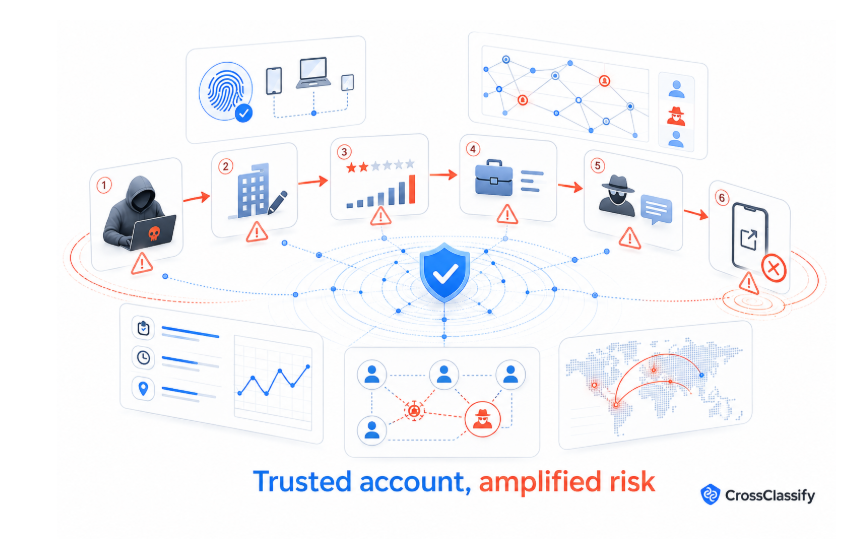
For Glassdoor style platforms, account trust begins with device trust.
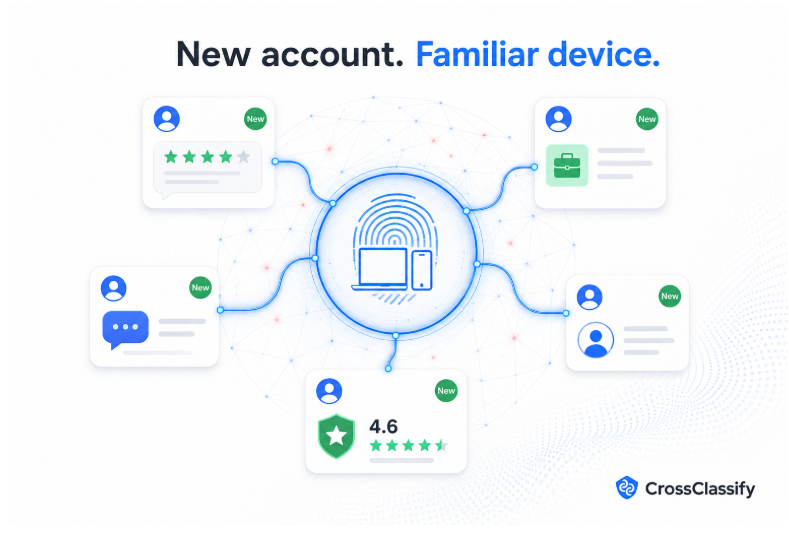
Fraudsters can change emails, delete cookies, rotate IP addresses, use VPNs, and create new profiles. But they often leave behind device, browser, network, and behavioral patterns that connect abusive activity.
This is why device fingerprinting matters.
It helps platforms detect repeat abuse even when the account looks new.
Why fake accounts are hard to stop
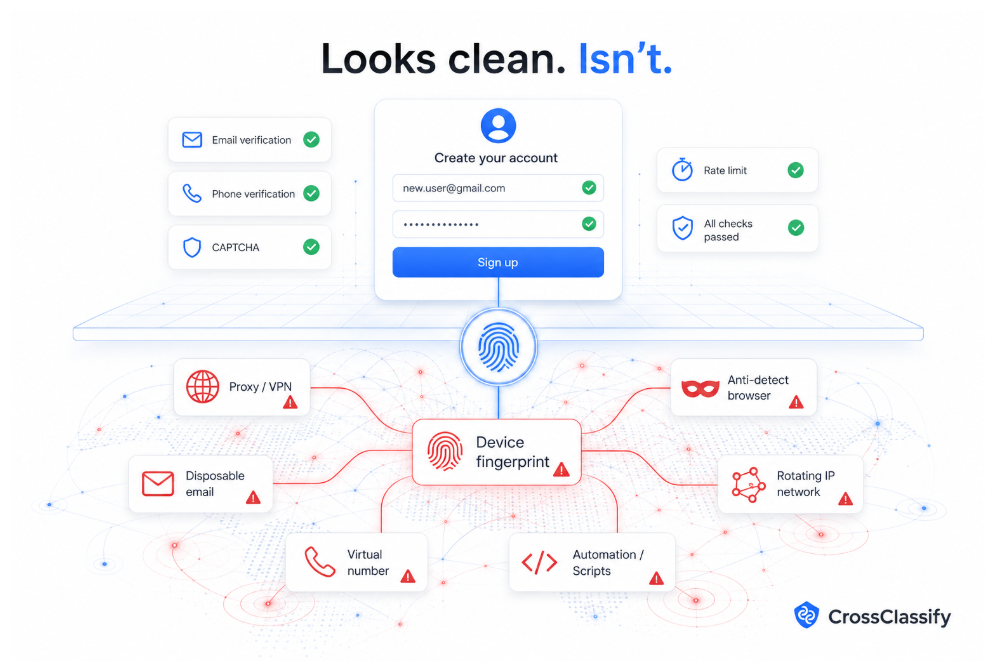
Many platforms begin with basic signup controls. Email verification, phone verification, CAPTCHA, IP rules, and rate limits can help. But sophisticated attackers know how to work around these controls.
- They use disposable emails.
- They use virtual numbers.
- They use residential proxies.
- They use automation tools.
- They use anti detection browsers.
- They use scripts or human operators.
- They clear cookies and storage.
- They create accounts slowly to avoid simple velocity checks.
A fake account may look clean on the surface.
The device behind it may not.
That is why a Glassdoor style platform needs a persistent view of account behavior across sessions.
What device fingerprinting adds
Device fingerprinting looks at attributes that help distinguish one device or browser environment from another. This can include browser configuration, operating system traits, screen attributes, hardware signals, network patterns, and environment consistency.
No single device signal should be treated as perfect. Fraudsters can spoof some attributes. But when device signals are combined with behavior, account history, and link analysis, they become much more useful.
CrossClassify’s device fingerprinting solution is built around device intelligence, continuous device monitoring, and fraud detection. For recruitment platforms, that means suspicious devices can be recognized across account creation, login, review submission, job posting, and recruiter activity.
Device fingerprinting is especially valuable when fraudsters try to restart after takedown. The account is new, but the environment may look familiar.
Fake accounts and fake Glassdoor reviews
Fake review campaigns often require account volume.
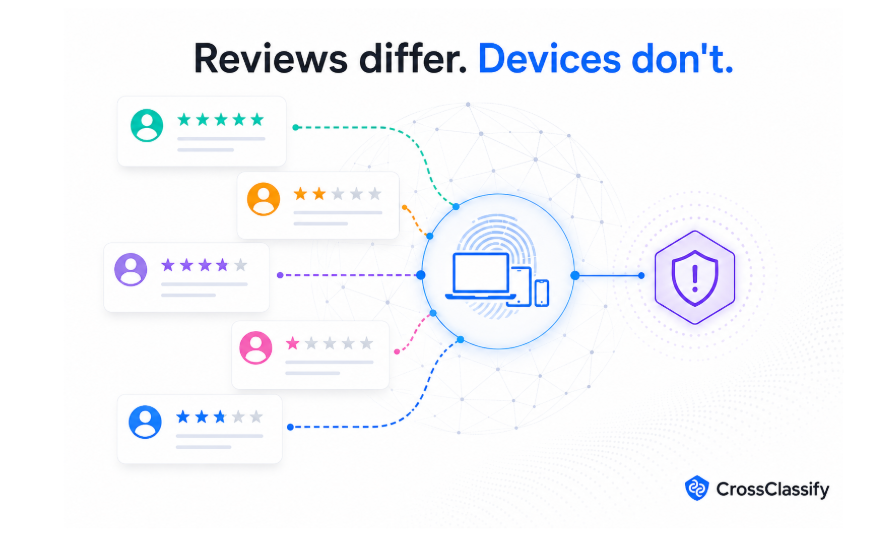
A single fake review may have limited effect. A cluster of fake reviews can change perception. This is why fake reviewer accounts matter.
If a platform only reviews the content, each review may appear plausible. But if five accounts share similar devices, session timing, traffic patterns, and submission behavior, the risk becomes clearer.
CrossClassify’s Review Integrity Intelligence module connects fake review detection to fake account detection. It can identify whether suspicious reviews are connected by device, behavior, account age, rating timing, employer page activity, or network context.
This helps platforms ask better questions.
- Is this review suspicious.
- Is this account suspicious.
- Is this device suspicious.
- Is this rating shift suspicious.
- Is this part of a wider campaign.
The campaign question is the most important one.
Fake accounts and fake job scams
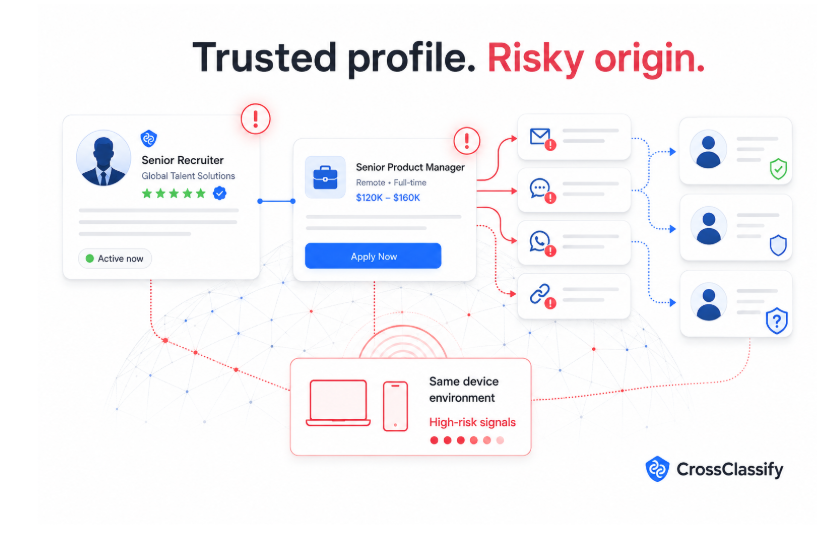
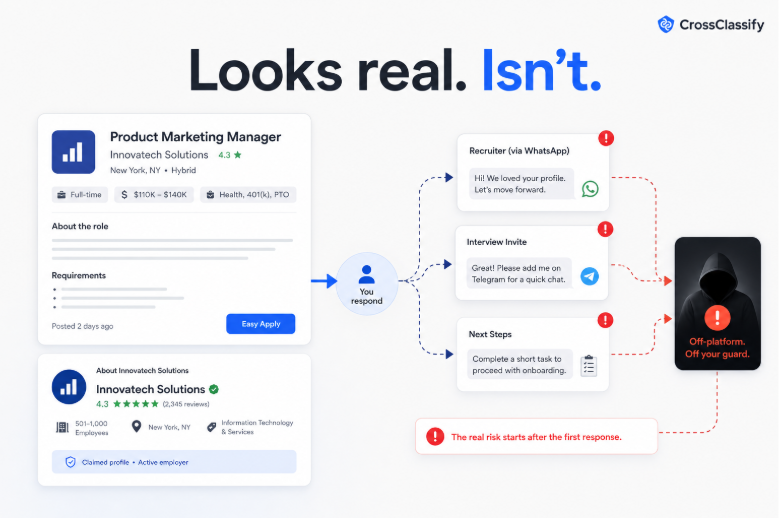
Fake employer accounts can create fake jobs, impersonate companies, and move candidates into scam conversations.
The FTC has continued to warn consumers about unexpected job offer texts and fake recruiters. In the April 2026 warning, the agency described fake recruiters offering fake jobs and stealing money.
That is why fake account detection should not be limited to candidate accounts. It must also apply to employer and recruiter accounts.
CrossClassify’s Job Scam and Recruiter Impersonation Monitor uses device fingerprinting as one input among many. It can flag a new employer account created from a suspicious device, a recruiter account linked to prior scam reports, or a posting flow that resembles known abuse.
CrossClassify’s account opening solution is directly relevant here because fake employer and fake reviewer accounts often begin at signup. Stopping suspicious accounts early reduces the pressure on later moderation and incident response.
Why device fingerprinting alone is not enough
Device fingerprinting is powerful, but it should not be the only layer.
Fraudsters can spoof devices. Legitimate users can share devices. Privacy settings can reduce signal quality. Browser changes can create noise. Remote workers may appear from different networks.
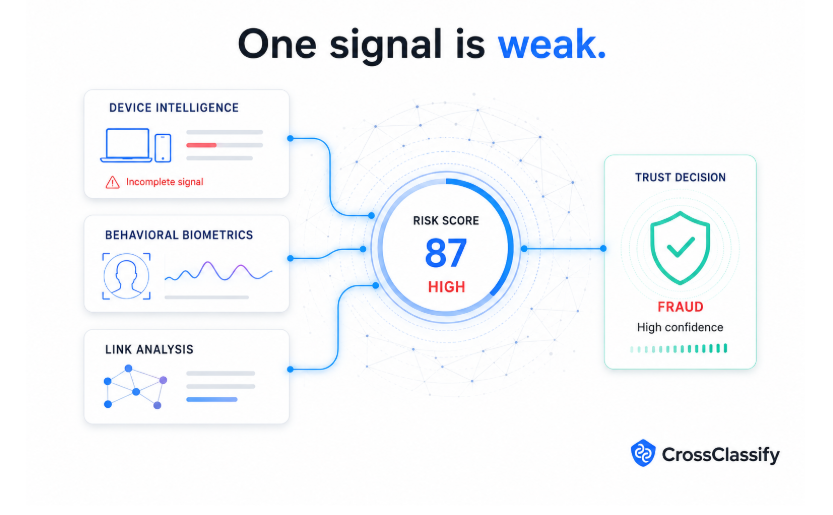
This is why CrossClassify combines device intelligence with behavioral biometrics and link analysis.
Behavioral biometrics helps answer whether the user interaction looks natural, consistent, automated, rushed, copied, or unusual. CrossClassify’s behavioral biometrics solution explains how interaction patterns can support passive trust decisions. For fake account detection, this helps separate real users from scripted or coordinated behavior.
Link analysis helps connect many weak signals into a stronger picture. One shared device may not be enough. But shared device, similar account age, similar review timing, similar rating direction, and similar navigation behavior may point to coordinated abuse.
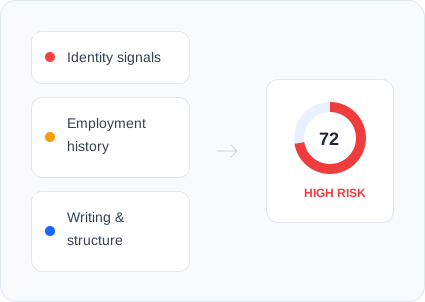
Turn CV Red Flags Into a
Documented Risk Score
A checklist tells you what to look for. CV Risk Checker scans any resume in seconds and shows you exactly where the fraud signals are — before you book the interview.
How device intelligence supports privacy aware review protection
Glassdoor style platforms must protect user anonymity. This is especially important for employee reviews.
A privacy aware device intelligence system should not expose reviewer identity to employers. It should not require unnecessary identity checks for every user. It should not turn anonymous contribution into public identification.
Instead, it should help the platform detect abuse risk internally.
For example, the platform can know that an account belongs to a suspicious device cluster without telling the employer who the reviewer is. It can route the review to deeper moderation without exposing personal details. It can block repeated fake account creation without weakening anonymity for honest employees.
This distinction matters.
Anonymity protects employees. Fraud detection protects the platform from abuse of anonymity.
How CrossClassify integrates device intelligence into the user journey
At account creation, CrossClassify can detect suspicious device reuse, manipulated environments, and abnormal signup behavior.
At login, it can compare the current device with previous trusted sessions.
At review submission, it can detect whether the device is linked to other suspicious reviews or accounts.
At job posting, it can detect whether an employer account is using a risky environment.
At recruiter messaging, it can detect suspicious outreach behavior tied to repeated devices.
At moderation review, it can provide reason codes so trust teams can understand why an account or review was flagged.
This creates a layered fraud prevention model.
Instead of one rigid rule, the platform receives a risk score that reflects context.
Why device fingerprinting is useful for SEO driven concerns
The search queries around glassdoor fake account, fake Glassdoor account, glassdoor fake reviews, fake reviews glassdoor, glassdoor jobs real or fake, and does Glassdoor have fake jobs all point to the same deeper issue.
Users are asking whether the accounts and content behind the platform can be trusted.
Device fingerprinting helps answer that concern because it gives platforms a way to detect repeat abuse even when fraudsters change visible identifiers.
It is not a reputation management shortcut. It is a platform trust control.
What good device fingerprinting should avoid
A good device fingerprinting system should avoid overclaiming.
- It should not say every device match proves fraud.
- It should not block users based on one weak signal.
- It should not store more data than needed.
- It should not create hidden discrimination against legitimate shared devices.
- It should not replace human review for sensitive moderation decisions.
CrossClassify should position device intelligence as one layer in a broader trust system. The strongest decisions come from multiple signals.
Conclusion
Fake accounts are the root of many Glassdoor style trust problems. They can power fake reviews, fake jobs, scam messages, recruiter impersonation, and employer reputation abuse.
Device fingerprinting gives recruitment platforms a stronger way to detect repeat abuse, especially when combined with behavioral biometrics, account risk scoring, and graph analysis.
CrossClassify helps platforms recognize suspicious devices, connect related accounts, protect review integrity, and stop fake account abuse before it becomes visible trust damage.
See How CrossClassify Protects Recruitment Platforms
Detect fake recruiters, fraudulent resumes, and job scams instantly
Check a CV for Fraud Signals in 60 Seconds
Upload any resume and get an instant risk score, flagged signals, and a recruiter-ready action checklist.
Try the CV Risk CheckerNo credit card required
Share in
Related articles

Frequently asked questions
Let's Get Started
Create your free
account today
Discover how to secure your app against fraud using CrossClassify
No credit card required