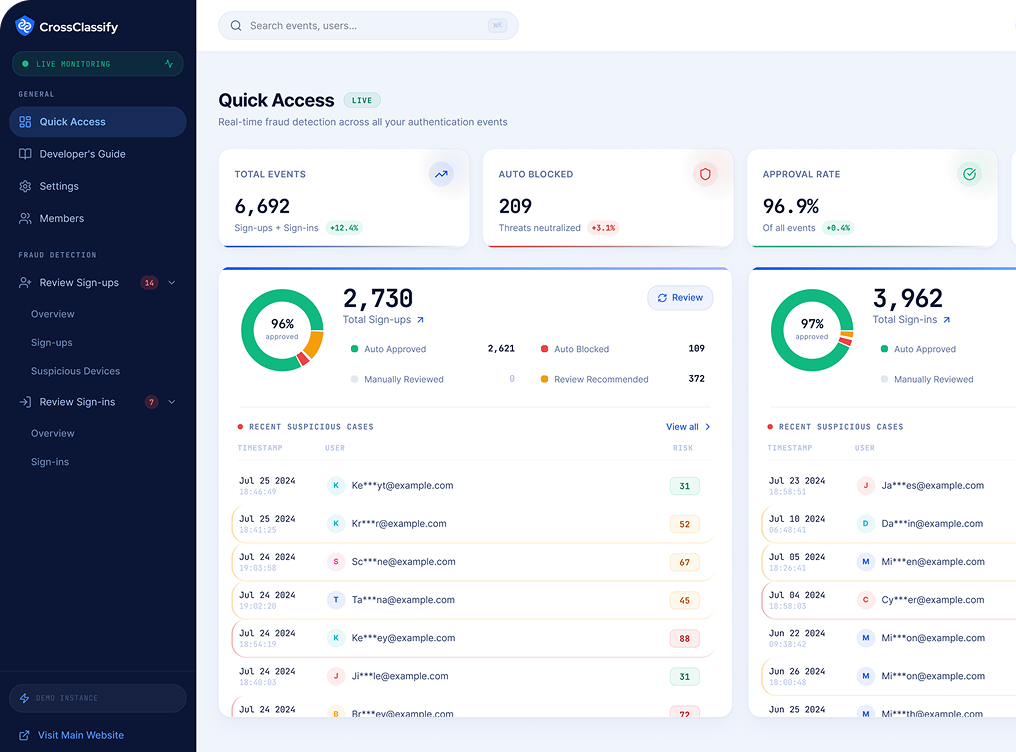
Last Updated on 18 Aug 2026
Resume Checking Best Practices: A Practical Framework for Verifying Claims, Identity, and Submission Context
Share in

Introduction
Resume checking is often treated as a comparison between a candidate document and a job description. Recruiters examine employment history, job titles, skills, education, certifications, projects, and other information that may indicate whether someone should receive closer consideration. These checks are necessary, but they answer only the professional relevance question. They do not establish whether the resume, candidate account, device, and application journey can be trusted as one consistent submission.
A polished resume can contain accurate information, exaggerated information, copied material, or claims assembled from several unrelated sources. A poorly written document can still belong to a genuine and highly qualified person. Candidates also use templates, translation services, writing assistants, resume builders, and professional editors for legitimate reasons. The quality of the writing should therefore never become the main method for deciding whether a resume or candidate identity is trustworthy.
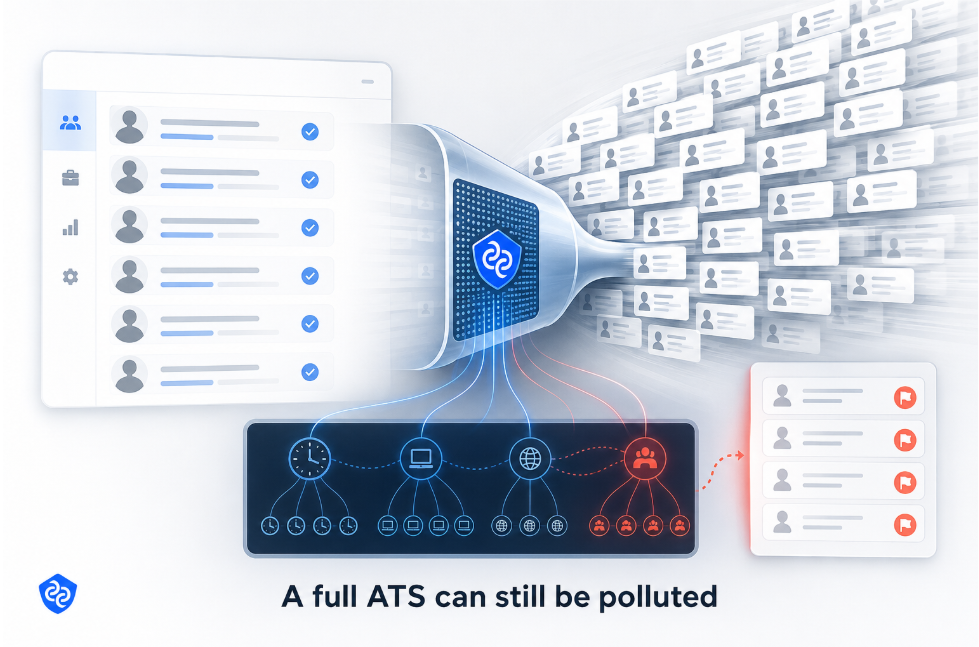
Misleading candidate profiles create a direct operational cost for recruitment teams. Industry guidance has noted that fake profiles increase the time recruiters need to search through candidates and make it more difficult for genuine people to stand out. Some recruitment platforms combine automated profile evaluation with human review of exceptional cases, which supports the wider principle that technology should organize evidence and direct attention rather than make an unexplained final judgment.
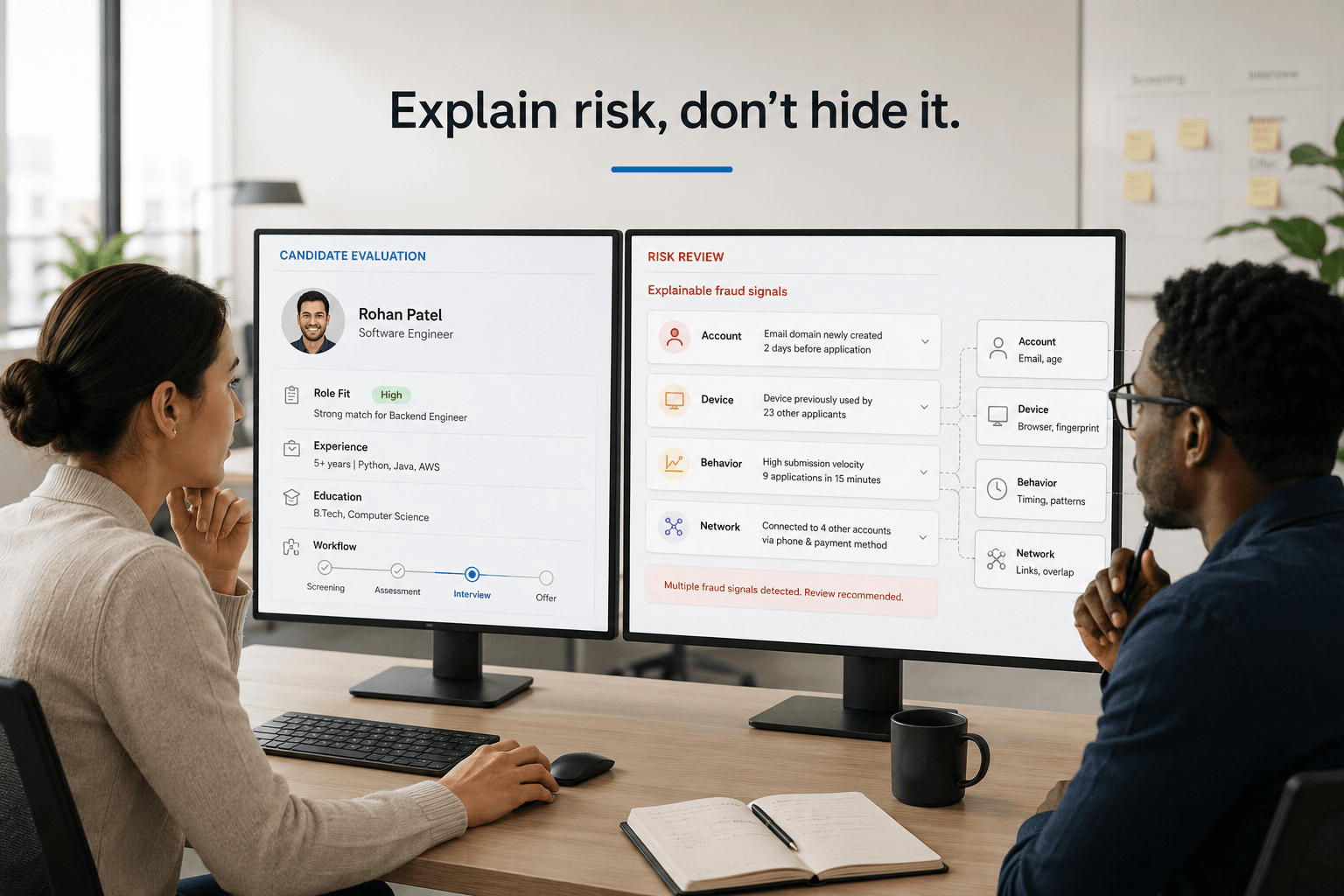
A practical resume checking process must separate candidate evaluation from platform integrity. Recruiters should evaluate skills, experience, communication, and relevance to the role. Fraud, trust, security, or platform teams should evaluate whether the resume is connected with suspicious accounts, repeated devices, automated behavior, identity changes, or coordinated application activity. CrossClassify supports this second layer by connecting account, device, behavior, network, and relationship evidence around recruitment activity.
What practical resume checking should achieve
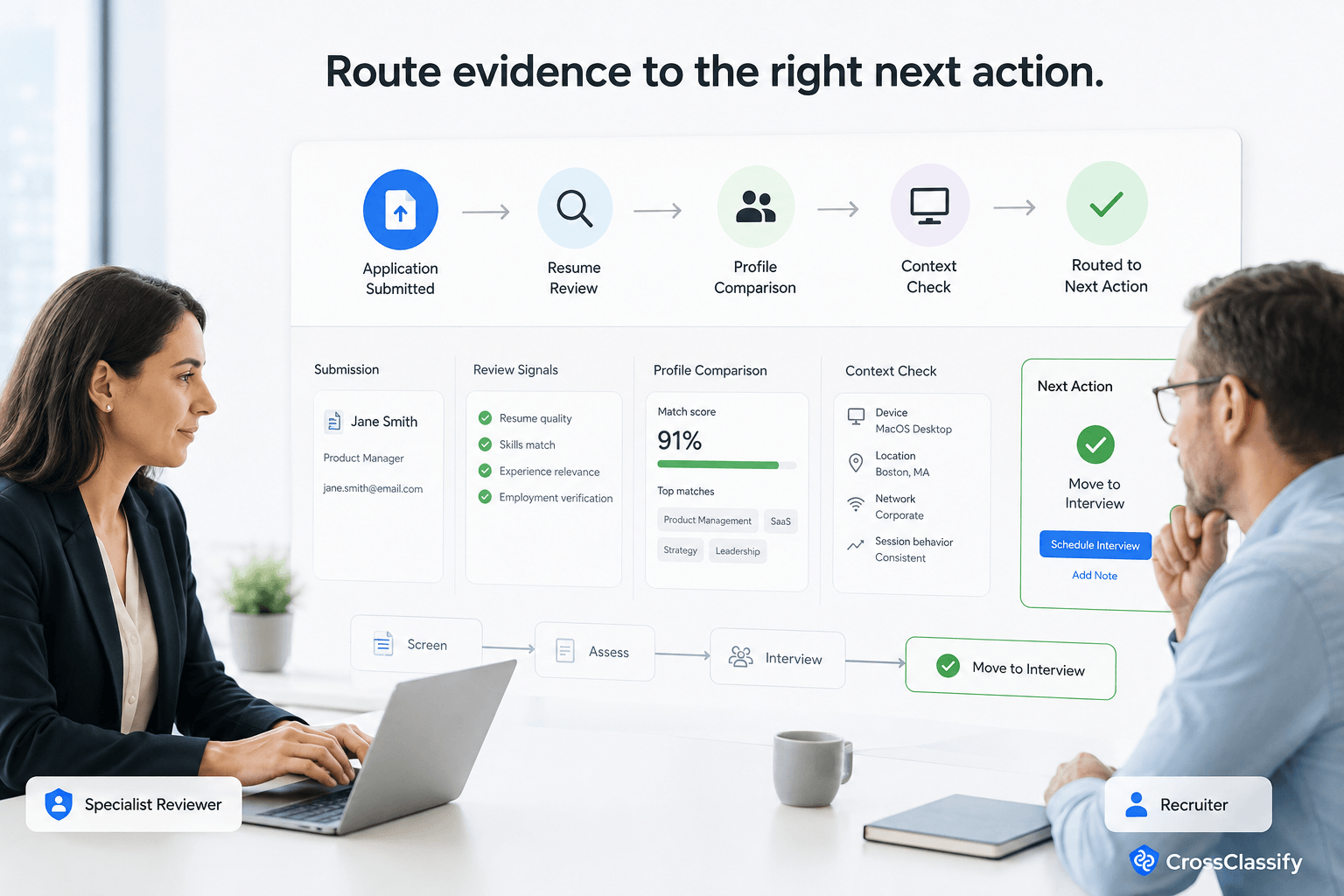
A practical framework should help a reviewer move from a visible concern to a clear next action. The process should not end with vague labels such as unusual resume or suspicious applicant. Every observation should produce one of four operational outcomes: continue normal recruiter review, request a specific clarification, open a platform integrity review, or apply a controlled platform response after authorized human review.
The framework should also protect recruiter attention. Recruiters should not spend time reconstructing device history, interpreting network data, or comparing large clusters of connected accounts. Their role is to understand the candidate and the position. Technical and relationship evidence should be collected and organized by the platform, then routed to the team responsible for fraud and trust decisions.
Candidate fairness is equally important. A date overlap, location difference, device change, or repeated phrase can have a legitimate explanation. The framework must preserve uncertainty until enough evidence exists to justify additional action. A candidate should not lose an opportunity because one isolated signal was interpreted without context.
The practical goal is not to prove that every resume is true. No document review can guarantee every professional claim by itself. The goal is to identify the right questions, connect relevant evidence, reduce repeated low trust activity, and keep professional hiring decisions separate from platform protection decisions.
The practical resume checking workflow
A useful workflow begins with the visible document and gradually adds the surrounding account context. Reviewers should first examine whether the resume is internally coherent. They should then compare it with the candidate profile, account history, device relationships, and submission behavior. Only after these stages should the platform assign an operational review status.
The sequence should be consistent across cases. A standard process reduces the chance that one reviewer focuses only on writing style while another focuses only on dates or contact information. It also makes training easier because every reviewer knows which evidence belongs at each stage and which team owns the next decision.
The recommended sequence is: resume received, document consistency review, profile comparison, account and device context, submission behavior review, and operational outcome. The first three stages usually produce candidate facing questions. The later stages primarily produce internal platform evidence.
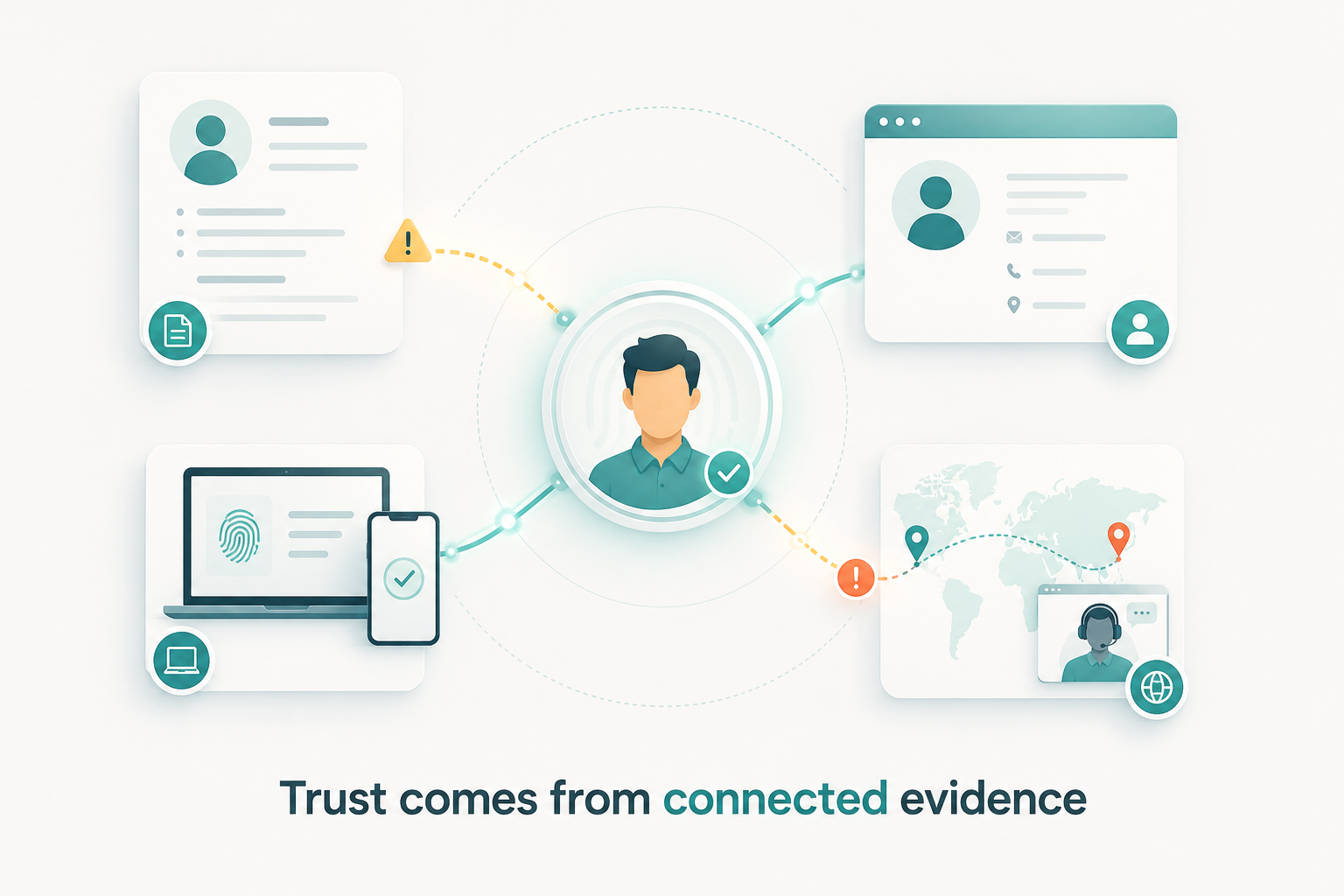
CrossClassify can provide the account, device, behavior, network, and connected activity context around these stages. Its recruitment fraud detection solution describes a broader risk layer for fake profiles, suspicious devices, automation, account abuse, and linked activity. Recruiters can continue evaluating professional relevance while the platform manages the integrity workflow.
Do this now
Write the name of the team that owns each stage of the workflow. A stage without a clear owner will usually become a delay, a duplicated investigation, or an unsupported recruiter decision.
Best practice 1: Separate qualification review from integrity review
Qualification review asks whether the candidate appears to meet the requirements of a position. It considers experience, skills, education, work examples, certifications, availability, and other job related information. Integrity review asks whether the account, identity details, device, session, and submission journey contain conditions that require clarification or investigation. These questions can exist at the same time, but they should never be merged into one unexplained score.
A candidate may have highly relevant experience while using an account that recently changed identity information from an unfamiliar device. Another candidate may have limited professional relevance while using a completely normal account. The first case may need both recruiter consideration and a separate platform review. The second case needs only a normal hiring decision.
When these dimensions are mixed, a recruiter may interpret a technical fraud signal as proof that the candidate lacks ability. A fraud reviewer may interpret poor role alignment as evidence that the account is deceptive. Both conclusions are unsafe because they extend the evidence beyond what it can support. The platform should define what every score and status is allowed to influence.
CrossClassify should be positioned as a fraud signal and decision support layer. It can explain device reuse, behavior anomalies, related accounts, or application patterns without determining who should receive an interview. A layered approach that combines technical detection, verification, human review, and collaboration is more reliable than dependence on one automated detector.
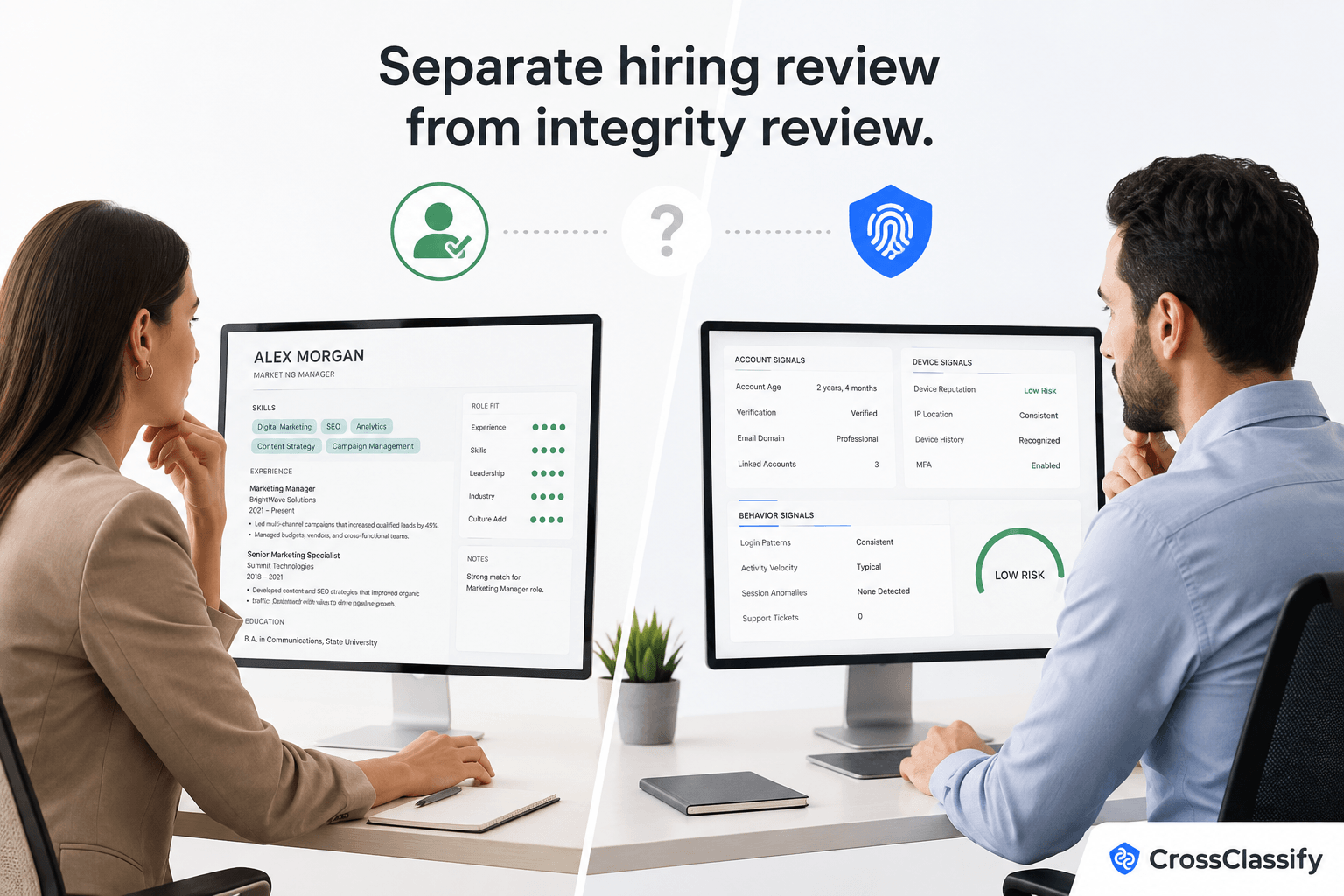
Practical responsibility table
| Review question | Primary owner | Evidence used | Possible outcome |
|---|---|---|---|
| Does the candidate appear relevant to the role? | Recruiter or hiring team | Skills, experience, education, work examples, and answers | Continue, decline, or interview according to hiring policy |
| Does the resume contain information that needs clarification? | Recruiter or recruitment operations | Dates, titles, location, contact information, and professional claims | Ask one specific clarification question |
| Does the submission journey contain suspicious activity? | Fraud, trust, or platform team | Account, device, behavior, network, velocity, and relationships | Monitor, verify, or investigate |
| Does the activity violate platform policy? | Authorized platform reviewer | Completed review and documented evidence | Apply a controlled platform response |
Practical scenario
A candidate has strong experience for a cloud engineering role. The resume is relevant and detailed, but the account recently changed its name, email address, and phone number from a device connected with several other candidate profiles.
The recruiter can continue evaluating the person’s professional relevance. At the same time, the platform team can review whether the account change reflects a legitimate recovery, a transferred account, or misuse. Neither team should use the other team’s evidence as a substitute for its own decision.
Do this now
Add a written rule to your review policy stating that fraud and integrity indicators must not directly determine candidate qualification, interview selection, or professional ranking.
Best practice 2: Check internal resume consistency
The first document check should focus on the employment timeline. Review start dates, end dates, overlapping roles, unexplained gaps, and the sequence of positions. An overlap does not automatically indicate deception because candidates may hold contract, advisory, freelance, part time, or concurrent roles. The reviewer should identify the exact period that needs explanation.
Next, compare job titles with the responsibilities described. Titles vary across employers, industries, organization sizes, and regions. A senior title may include limited responsibility in one company, while a modest title may include broad ownership in another. The reviewer should not decide what the title must mean. The correct action is to request context when the listed responsibility and title appear materially different.
Skills and certifications should be compared with the rest of the document. A claim of advanced expertise is easier to understand when it appears in work history, projects, achievements, or a recent qualification. The absence of supporting detail does not prove that the skill is false. It gives the recruiter a practical interview or clarification question.
Finally, compare names, locations, email addresses, phone numbers, portfolio links, and other identity related details within the document. Candidates relocate, change names, use international contact information, and maintain several professional profiles. The reviewer should record the difference, determine whether it affects the application, and preserve the possibility of a legitimate explanation.
Resume consistency action table
| Check | What to review | What may need clarification | Practical next action |
|---|---|---|---|
| Employment timeline | Start dates, end dates, gaps, and concurrent roles | Unexplained overlap or conflicting dates | Ask whether the roles were held concurrently |
| Job titles | Title compared with responsibilities | Major difference between title and role scope | Ask the candidate to describe the actual role structure |
| Skills | Relationship between claimed expertise and experience | Important skill with no supporting role or project | Ask for one practical example |
| Certifications | Qualification name, issuer, date, and status | Missing, contradictory, or incomplete information | Request clarification or verification where appropriate |
| Contact information | Name, location, email, phone, and profile links | Identity or location details that do not match | Confirm which details are current |
Worked example: clarification is enough
A resume shows two full time roles overlapping for four months. The candidate profile contains the same dates, the account has a long and consistent history, and no identity fields recently changed.
Recommended response: Ask whether one role was contract based, part time, or held during a transition. Keep the application in normal recruiter review while the candidate provides context.
Worked example: platform context is also needed
A resume contains overlapping roles, a different name from the platform profile, and contact details that changed immediately before submission. The current device also appears across several recently created accounts.
Recommended response: Preserve the recruiter’s professional review, but route the account and device evidence to the platform integrity team.
Do this now
Select ten resumes that were previously described as suspicious. Identify whether each concern came from a specific contradiction or only from writing style, formatting, or document polish.
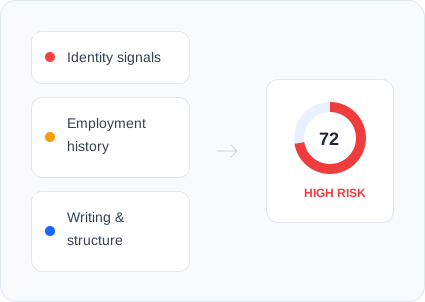
Turn CV Red Flags Into a
Documented Risk Score
A checklist tells you what to look for. CV Risk Checker scans any resume in seconds and shows you exactly where the fraud signals are — before you book the interview.
Best practice 3: Compare the resume with the platform profile
The platform profile provides another version of the candidate’s declared information. Compare names, locations, employment dates, education, skills, contact details, and uploaded documents. Small formatting differences are normal. The focus should be on meaningful contradictions or identity related changes that affect the interpretation of the application.
The history of profile edits can be more useful than the final profile alone. An account completed gradually across several sessions may reflect a normal candidate journey. An account that replaces its name, work history, location, phone number, and resume immediately before a large number of applications creates a different operational question.
The type and timing of each change matter. Updating a phone number or adding a recent position may be routine. Replacing several identity fields during an unfamiliar session may indicate a legitimate account recovery, account sharing, or unauthorized control. The platform needs access and device context before choosing the next action.
CrossClassify’s device fingerprinting solution can help identify returning devices, configuration changes, spoofing attempts, and relationships across accounts even when visible browser, cookie, or network information changes. This context helps determine whether a major profile update occurred inside a familiar candidate journey or from a newly connected environment.
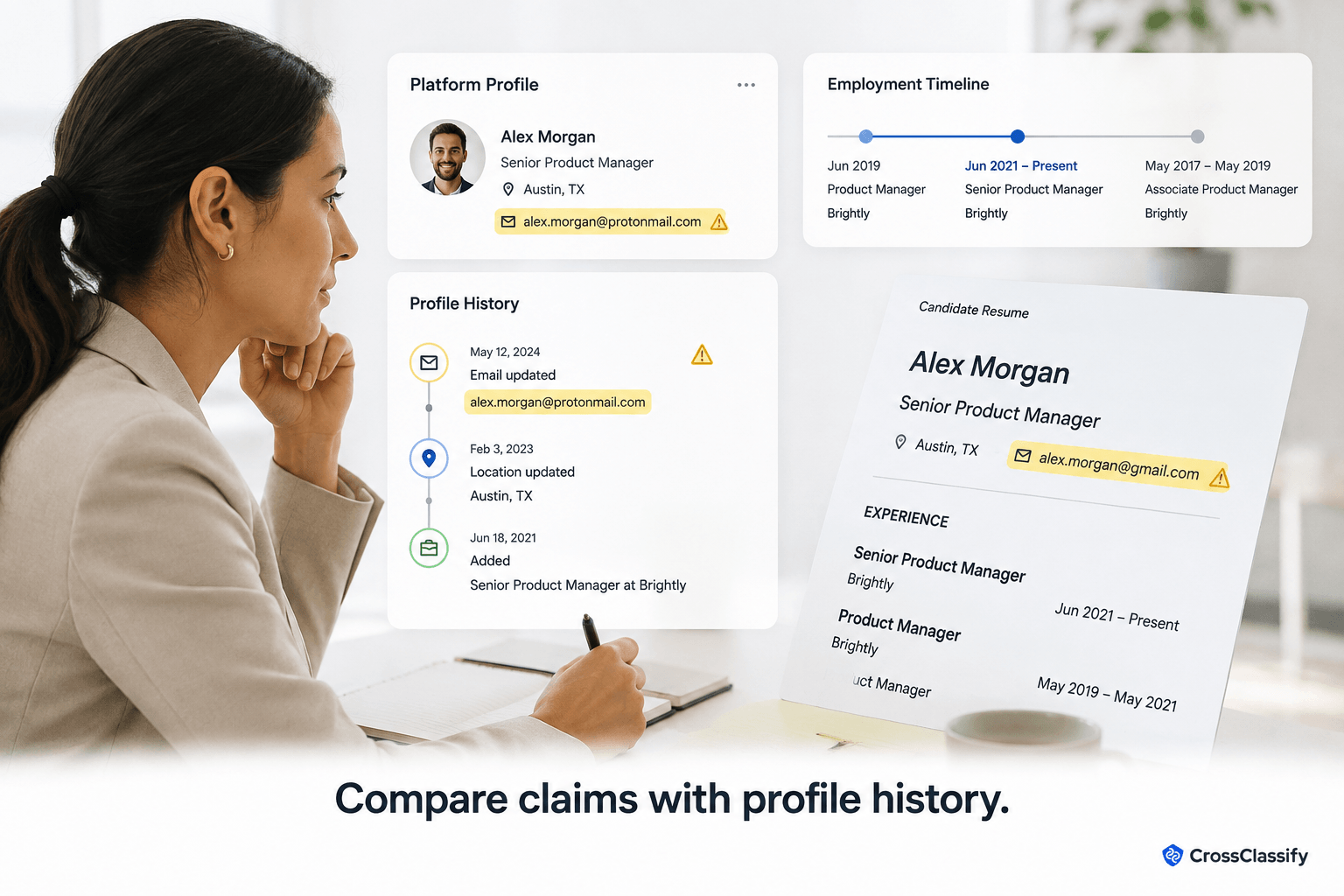
Profile comparison table
| Profile field | Compare against | Lower concern example | Higher concern example |
|---|---|---|---|
| Name | Resume, current profile, profile history, and account records | Spelling correction or documented name change | Complete identity replacement before submission |
| Location | Resume, profile, application preferences, and access history | Recent relocation or remote work preference | Repeated contradictory locations across connected accounts |
| Employment | Resume, profile fields, and earlier uploads | More detail added to the latest version | Entire work history replaced during one unfamiliar session |
| Contact details | Resume, account, recovery history, and messages | New phone number with otherwise consistent activity | Email and phone replaced before unusual application volume |
| Resume file | Earlier versions and related profiles | Role focused revision of the same career history | Different identity and career attached to an established account |
Practical scenario
A candidate updates their location from Munich to Berlin, adds a new phone number, and applies to roles in Berlin. The account uses a familiar device and retains the same name, work history, and education.
Recommended response: Continue normal review unless other evidence creates concern.
Another account changes its name, email address, phone number, location, resume, and complete work history during one unfamiliar session. The device is also linked with several candidate profiles.
Recommended response: Preserve the earlier profile history and open a platform integrity review.
Do this now
Confirm that authorized reviewers can see when important identity fields changed. A comparison process is incomplete when only the latest profile version is visible.
Best practice 4: Check repeated content without treating templates as fraud
Repeated resume language is common. Candidates use templates, common professional terminology, writing services, and AI assistance. A matching summary sentence, standard skill list, or common responsibility description is weak evidence. Reviewers should focus on distinctive combinations that are unlikely to appear naturally across unrelated profiles.
Stronger relationships may include identical unusual achievements, matching errors, the same project narrative, repeated numerical results, or the same employment sequence with slightly changed company names. The reviewer should record the exact shared content. Vague labels such as copied resume do not provide enough evidence for another reviewer to reproduce the finding.
Document similarity becomes more useful when it aligns with account and platform context. Several related resumes may also share devices, contact patterns, account creation timing, network infrastructure, or submission behavior. The resume then becomes one component of a wider pattern rather than the sole basis for a conclusion.
CrossClassify can connect devices, accounts, sessions, behavior, and related activity. The platform should show which relationships exist and how strong they are. Human reviewers must still decide whether the relationship reflects a template, shared organization, public environment, recruitment service, or coordinated abuse.

Evidence strength matrix
| Observed relationship | Strength alone | Context that increases significance | Recommended response |
|---|---|---|---|
| Common resume template | Low | No additional evidence | Continue normal review |
| Identical generic summary | Low | Common public template or writing service | Do not escalate without stronger context |
| Identical unusual project and metrics | Moderate | Different claimed identities | Compare profile and account history |
| Distinctive duplicate content plus shared device | Elevated | Similar submission behavior and account timing | Open platform integrity review |
| Several connected accounts with repeated identity elements | High | Human review confirms a coordinated relationship | Apply the documented platform process |
Worked example: normal template use
Three candidates use the same common template and similar descriptions of customer service responsibilities. Their employment histories are different, the accounts use different devices, and their application journeys show natural variation.
Recommended response: Treat the similarity as ordinary template use.
Worked example: connected activity
Three profiles contain the same unusual project, identical performance numbers, the same formatting error, and slightly changed employer names. The accounts share a persistent device and follow nearly identical submission sequences.
Recommended response: Group the accounts into one platform integrity case rather than asking three separate recruiters to investigate them independently.
Do this now
Review your duplicate detection rules and remove any rule that escalates a resume only because it contains common professional language.
Best practice 5: Review the submission journey
A resume should be evaluated together with the way it entered the platform. Review whether the candidate opened the role, interacted with relevant information, updated profile fields, completed required questions, and followed a plausible application sequence. A saved profile can make a genuine application very fast, so submission time alone is not enough.
Application velocity becomes useful when it is considered with role diversity. A candidate may apply to several related positions during an active search. Concern increases when an account applies mechanically across unrelated occupations, experience levels, and locations. The relationship between volume and relevance provides more context than a fixed application limit.
Behavioral signals can help identify repeated or automated interaction. Human users usually pause, edit, return to earlier fields, and move through different applications at different speeds. Automated sessions often repeat navigation order, field timing, and submission behavior. Accessibility tools and efficient workflows can also change interaction patterns, which is why behavior should not be used alone.
CrossClassify’s behavioral biometrics solution analyzes interaction patterns such as typing, pointer movement, scrolling, touch behavior, and navigation while combining them with device and risk context. In recruitment, these signals should support bot, automation, or account review. They should not be used to infer candidate intelligence, personality, motivation, or professional capability.
Submission context checklist
| Signal | Question to ask | Normal explanation | Condition that increases concern |
|---|---|---|---|
| Application speed | How quickly was the application completed? | Saved profile and familiar form | Repeated identical timing across many accounts |
| Role diversity | Are the roles professionally related? | Broad but understandable career search | Mechanical submissions across unrelated occupations |
| Navigation | Did the session interact with role and form content? | Efficient review and submission | Repeated direct submission sequence with little variation |
| Device relationship | Is the device familiar or connected with other accounts? | Shared household or organization device | Many unrelated accounts with similar activity |
| Account age | How long has the account existed? | Genuine new candidate | New account plus high velocity and connected profiles |
Contrasting scenarios
Normal active candidate
A candidate applies to six related security engineering positions over two days. The account uses one familiar device, reads each role, changes several answers, and updates a portfolio link.
Recommended response: Continue normal recruiter review.
Potential automated activity
A new account applies to sixty unrelated roles in a short period. The sessions use nearly identical timing and navigation, and several other accounts use the same persistent device.
Recommended response: Route the connected activity to platform integrity review. Do not convert the integrity signal into a candidate qualification decision.
Do this now
Select twenty high velocity applicants and compare role diversity, device relationships, and session variation. This will show whether your current rules confuse active candidates with automation.
Best practice 6: Use a four status review model
A practical resume checking process should end with a status that tells the next team what to do. The first status is normal recruiter review. Use it when the document and account journey contain no unresolved integrity concern. This status does not certify every claim. It means no separate platform action is currently required.
The second status is clarification requested. Use it when a specific issue can reasonably be explained by the candidate. Examples include overlapping roles, location changes, unreadable documents, title differences, or a recent qualification. The request should identify one clear question and avoid language that assumes deception.
The third status is platform integrity review. Use it when document concerns appear with account, device, behavior, network, or relationship evidence. Recruiters should receive a neutral workflow status. The specialist team should receive the detailed evidence needed to investigate the pattern.
The fourth status is controlled platform action. Use it only after an authorized review has applied the platform’s policy. Possible actions include account confirmation, temporary submission limits, account recovery controls, or restrictions. CrossClassify supplies risk evidence, while the recruitment platform remains responsible for the final action.
Decision matrix
| Evidence level | Example | Recommended response | Effect on hiring evaluation |
|---|---|---|---|
| Low | One document inconsistency with a plausible explanation | Ask a specific clarification question | None until the candidate responds |
| Moderate | Recent identity changes from an unfamiliar device | Request account confirmation or specialist review | Keep separate from professional evaluation |
| Elevated | Repeated content, connected accounts, shared device, and mechanical activity | Open a platform integrity case | Recruiter sees a neutral review status |
| Confirmed policy issue | Human review confirms coordinated account misuse | Apply the documented platform response | Hiring team receives only the final operational status |
Recommended status language
Use Normal review instead of verified candidate.
Use Clarification requested instead of inconsistent candidate.
Use Platform review in progress instead of suspicious candidate.
Use Platform action completed instead of fraudulent candidate unless the completed policy process specifically supports stronger terminology.
Do this now
Replace vague warning labels in your recruiter dashboard with statuses that describe the workflow and the next action.
A copyable resume review worksheet
The worksheet below gives teams one consistent place to record findings. It separates candidate facing clarification from internal platform review and makes it easier to compare decisions across reviewers.
| Review area | Observed finding | Supporting evidence | Candidate clarification needed | Platform review needed |
|---|---|---|---|---|
| Employment timeline | Yes or no | Yes or no | ||
| Titles and responsibilities | Yes or no | Yes or no | ||
| Skills and certifications | Yes or no | Yes or no | ||
| Profile consistency | Yes or no | Yes or no | ||
| Contact information | Yes or no | Yes or no | ||
| Repeated content | Yes or no | Yes or no | ||
| Device relationship | Not candidate facing | Yes or no | ||
| Submission behavior | Not candidate facing | Yes or no | ||
| Final review status |
Reviewers should record observations rather than assumptions. Write “employment dates overlap by five months” instead of “candidate lied about dates.” Write “three accounts share a persistent device” instead of “one person controls all accounts.” Observable language allows another reviewer to reproduce the finding.
Candidate facing and internal evidence must remain separate. A candidate can explain dates, location, contact information, or a title. They should not be asked to interpret device fingerprint values, graph relationships, or internal risk scores. Those signals belong inside platform review.
Every clarification and integrity case should record an outcome. A legitimate explanation should remain attached to the case so the same issue does not cause repeated friction. A confirmed relationship should also be documented so future connected activity can be reviewed consistently.
Do this now
Test this worksheet with five historical cases. Ask two reviewers to complete it independently and compare whether they choose the same status.
Practical candidate clarification questions
Clarification questions should be neutral, specific, and easy to answer. Instead of asking whether a candidate lied about employment, ask whether two positions were held concurrently and what the arrangement was. Instead of challenging a location, ask which location is current and whether the candidate is applying for remote work.
Ask for context before requesting formal documents. A simple explanation may resolve a contract overlap, title difference, relocation, or recent account update. Additional verification should be reserved for claims or account actions that affect platform policy, identity continuity, or a defined employer requirement.
Recruiters should not discuss technical fraud evidence with candidates. Device relationships, behavior indicators, network information, and account graphs belong in specialist review. Candidate communication should focus on the information or account action that requires confirmation.
Record each response and its outcome. A clear explanation can close the clarification. An incomplete or contradictory answer may support further review, but it should still be considered together with the wider evidence.
Employment overlap template
“Your resume shows that you worked in both roles between March and July. Could you confirm whether one position was part time, contract based, or held concurrently?”
Location template
“Your resume and platform profile show different current locations. Could you confirm which location is current and whether you are considering remote opportunities?”
Job title template
“The title on your resume differs from the title shown in your profile. Could you explain which title was used by the employer and whether the responsibilities changed?”
Contact information template
“Your account contact information was recently updated. Please confirm which email address and phone number should be used for this application.”
Common resume checking mistakes
The first mistake is treating polished language as evidence of fraud. Candidates can use templates, editors, translation services, and AI assistance while presenting genuine experience. Writing quality can prompt a closer review of claims, but it cannot establish identity, account control, or submission authenticity.
The second mistake is relying on one signal. A shared device, location change, date overlap, or repeated phrase may have a normal explanation. Risk becomes more meaningful when several independent signals support the same concern and the reviewer can see how they connect.
The third mistake is silently allowing integrity concerns to influence hiring. Recruiters should know when the platform is reviewing account activity, but they should not receive unexplained labels that change their assessment of candidate ability. Platform integrity and professional relevance must remain separate.
The fourth mistake is recording alerts without recording outcomes. When teams do not document which cases were clarified, confirmed, or cleared, they cannot improve the workflow. The same genuine candidate may face repeated friction, while repeated abusive patterns may continue appearing as new cases.
Mistake correction table
| Common mistake | Why it creates risk | Better practice |
|---|---|---|
| Flagging polished language | Writing assistance is common and not proof of misrepresentation | Review claims and submission context |
| Using one signal | Legitimate activity can appear unusual in isolation | Combine independent evidence |
| Showing unexplained fraud labels to recruiters | Technical risk can influence hiring judgment unfairly | Show a neutral workflow status |
| Failing to record outcomes | Controls cannot improve and users face repeated friction | Capture clarification and review results |
Measuring whether resume checking works
Measure how often identified inconsistencies are clarified, confirmed, or connected with wider platform abuse. The number of flagged resumes alone does not show quality. A high flag rate may indicate strong coverage, or it may show that ordinary candidate behavior is being interpreted too aggressively.
Track recruiter workload and time to meaningful review. The framework should reduce repeated investigation rather than create another administrative layer. Measure whether connected profile networks are grouped and reviewed before they repeatedly reach recruiters.
Candidate friction must also be measured. Track clarification abandonment, unnecessary verification, review delay, support contacts, and repeated challenges after a legitimate explanation. A control that detects some suspicious activity but discourages genuine applicants may need different thresholds or communication.
CrossClassify can supply account, device, behavior, network, and relationship context, while the recruitment platform records its review and workflow outcomes. The CrossClassify integration overview describes SDK and API options for connecting risk analysis with important web and mobile events.
Practical measurement dashboard
| Metric | What it shows | Desired direction |
|---|---|---|
| Clarification resolution rate | How often specific questions resolve document concerns | Increase when clarification is the appropriate response |
| Confirmed integrity case rate | How often escalated evidence leads to a meaningful platform outcome | Maintain useful precision rather than maximum volume |
| False review rate | How often legitimate candidates enter unnecessary review | Decrease |
| Time to first recruiter review | Whether the process protects recruiter attention | Decrease without reducing review quality |
| Repeated connected profile rate | Whether coordinated patterns continue returning | Decrease |
| Candidate support contacts | Whether the process creates confusion or friction | Decrease |
Do this now
Select three outcome measures before launching the framework. A process without measurement will gradually become a collection of rules rather than an operational improvement.
A thirty day implementation plan
During the first five days, map the current resume and application review journey. Identify who reviews document quality, who contacts candidates, where account concerns are reported, and whether profile history is available. Record where work becomes delayed or duplicated.
During days six through ten, introduce the four review statuses and assign clear ownership. Define normal review, clarification requested, platform review in progress, and controlled platform action. Write the evidence and authorization required for each status.
During days eleven through twenty, test the worksheet and decision matrix with historical cases. Include normal candidates, resolved inconsistencies, shared device situations, automated patterns, and confirmed account misuse. Compare reviewer decisions and revise the guidance where interpretations differ.
During days twenty one through thirty, connect selected account and submission signals to the workflow. Begin with signup, login, profile changes, resume upload, and application submission. Measure review time, clarification quality, false reviews, candidate friction, and recruiter feedback before expanding the process.
| Period | Main action | Expected output |
|---|---|---|
| Days 1 to 5 | Map the current review journey | Owners, evidence sources, delays, and gaps |
| Days 6 to 10 | Define statuses and policies | Clear routing and decision ownership |
| Days 11 to 20 | Test historical cases | Improved worksheet and consistent decisions |
| Days 21 to 30 | Launch a limited operational pilot | Measured outcomes and refinement priorities |
Conclusion
Resume checking works best when it does more than compare keywords with a job description. A practical framework should examine internal consistency, compare the resume with the platform profile, identify meaningful document relationships, and review the account and submission journey. Each layer answers a different question and should lead to a clear operational next step.
No single inconsistency proves that a candidate or resume is fraudulent. Candidates hold concurrent roles, relocate, share devices, use templates, receive writing assistance, and update contact information. Reviewers should record exact observations, preserve reasonable explanations, and escalate only when several pieces of evidence create a meaningful platform concern.
CrossClassify helps recruitment platforms add account, device, behavior, network, bot, and relationship context around resume submissions. Its device fingerprinting, behavioral biometrics, bot protection, and recruitment capabilities can help identify returning devices, connected accounts, configuration anomalies, automated activity, and suspicious application patterns. These signals support platform teams while recruiters remain responsible for evaluating candidate skills, experience, and role suitability.
The result is a more practical, consistent, and defensible resume checking process. Genuine candidates receive fair consideration, recruiters spend less time investigating repeated low trust activity, and platform teams gain clearer evidence for responding to coordinated abuse. The system supports human judgment rather than hiding it behind a black box score.
See How CrossClassify Protects Recruitment Platforms
Detect fake recruiters, fraudulent resumes, and job scams instantly

Check a CV for Fraud Signals in 60 Seconds
Upload any resume and get an instant risk score, flagged signals, and a recruiter-ready action checklist.
Try the CV Risk CheckerNo credit card required
Share in
Related articles
Frequently asked questions
Let's Get Started
Create your free
account today
Discover how to secure your app against fraud using CrossClassify
No credit card required