Last Updated on 28 Sept 2026
CV Risk Analysis for Recruiters: What to Verify Before an Interview
Share in

Introduction
A polished CV can still create a strong first impression, but polish no longer tells recruiters whether every underlying claim is accurate. Resume builders, professional editors, templates, translation services, writing assistants, and generative AI can improve structure and language without changing the candidate's actual experience. Gartner reported in 2025 that candidates were already using AI for legitimate application tasks, including resume and cover letter writing, while employers were becoming more concerned about candidate fraud and identity uncertainty. The important distinction is that using technology to improve presentation is not the same as fabricating experience, manipulating a screening system, or impersonating another person. (Gartner)
This creates a more demanding problem than deciding whether a resume “looks fake.” Recruiters need to identify which claims or document patterns deserve attention, understand the evidence behind a concern, and choose a proportionate verification step. A vague warning can increase workload, while an unexplained numerical score can create false confidence. CV risk scoring is most useful when it organizes uncertainty for human review rather than presenting suspicion as a conclusion.
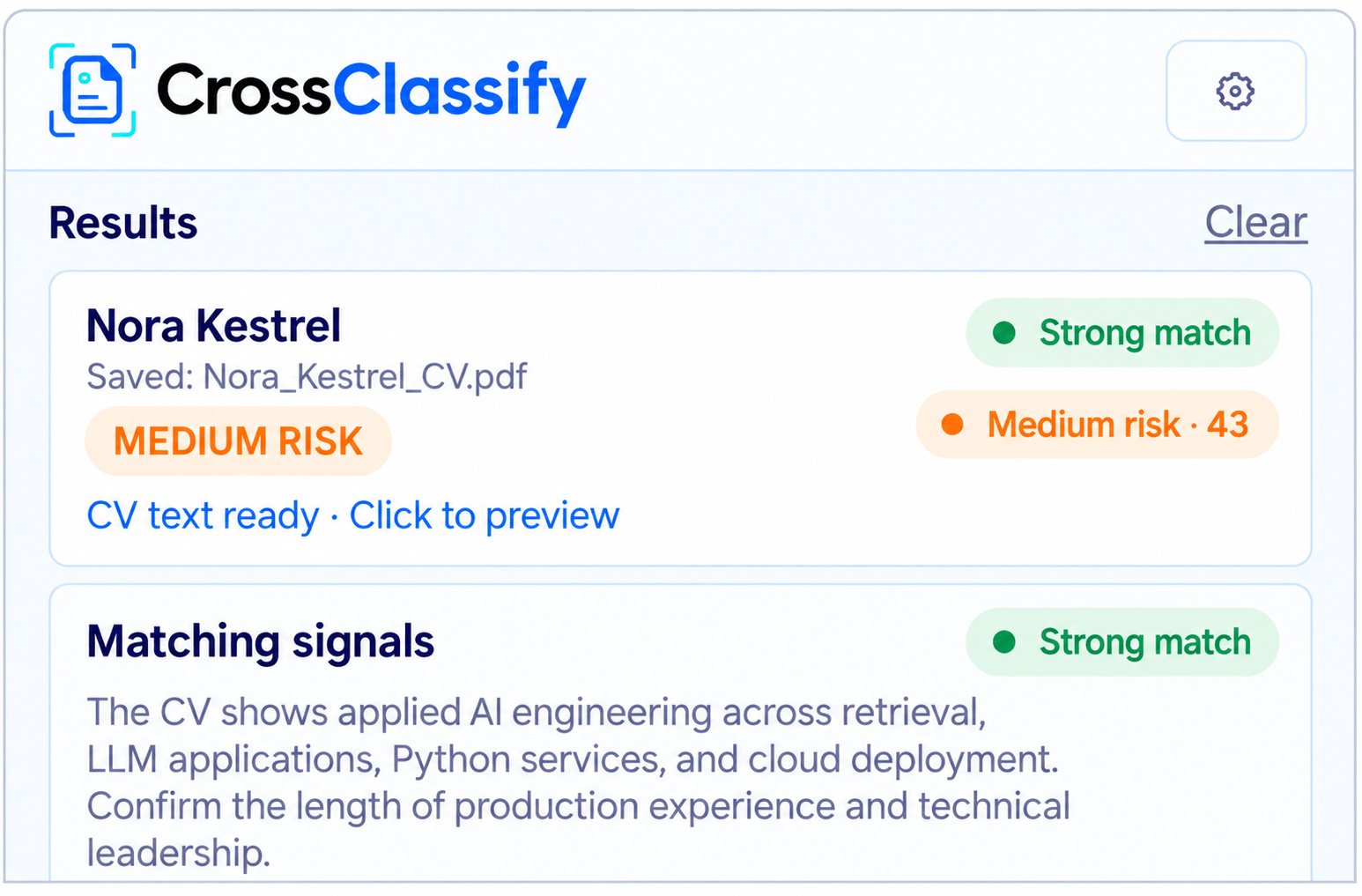
CrossClassify's CV Risk Checker extension is designed around that distinction. Its CV Risk Review can provide a CV Fraud Risk Score, Risk Level, Risk Summary, individual risk signals, signal severity, supporting evidence, and recommended verification steps. Together, those outputs are intended to help recruiters decide where closer review is justified while leaving clarification, verification, and hiring decisions with people.
Why recruiters cannot rely on a “fake looking” CV test
Some resume problems are relatively visible. Employment dates may contradict each other, a degree may not appear to exist, or a senior role may not align with the responsibilities described beneath it. The harder cases are CVs in which every individual detail appears plausible but several details together create uncertainty. Recruiters need a repeatable way to find those combinations without assuming that an unusual career path or formatting choice is dishonest.
Traditional resume fraud has long included inflated job titles, exaggerated responsibilities, adjusted employment dates, fabricated positions, and false education claims. SHRM has reported on surveys in which candidates acknowledged misrepresenting areas such as responsibilities and job titles, while its guidance emphasizes verifying material facts instead of judging a candidate from appearance alone. These issues matter because a believable document can still contain an inaccurate claim, and a visually imperfect document can still be entirely genuine. (SHRM)
A useful risk scoring workflow should examine specific inconsistencies, unsupported claims, manipulation patterns, or abnormal document content rather than infer honesty from writing style. CrossClassify's broader guidance applies the same principle by treating the resume as evidence to review, not as proof by itself. Read CrossClassify's Resume Checking Best Practices.

What a CV Fraud Risk Score should actually tell a recruiter
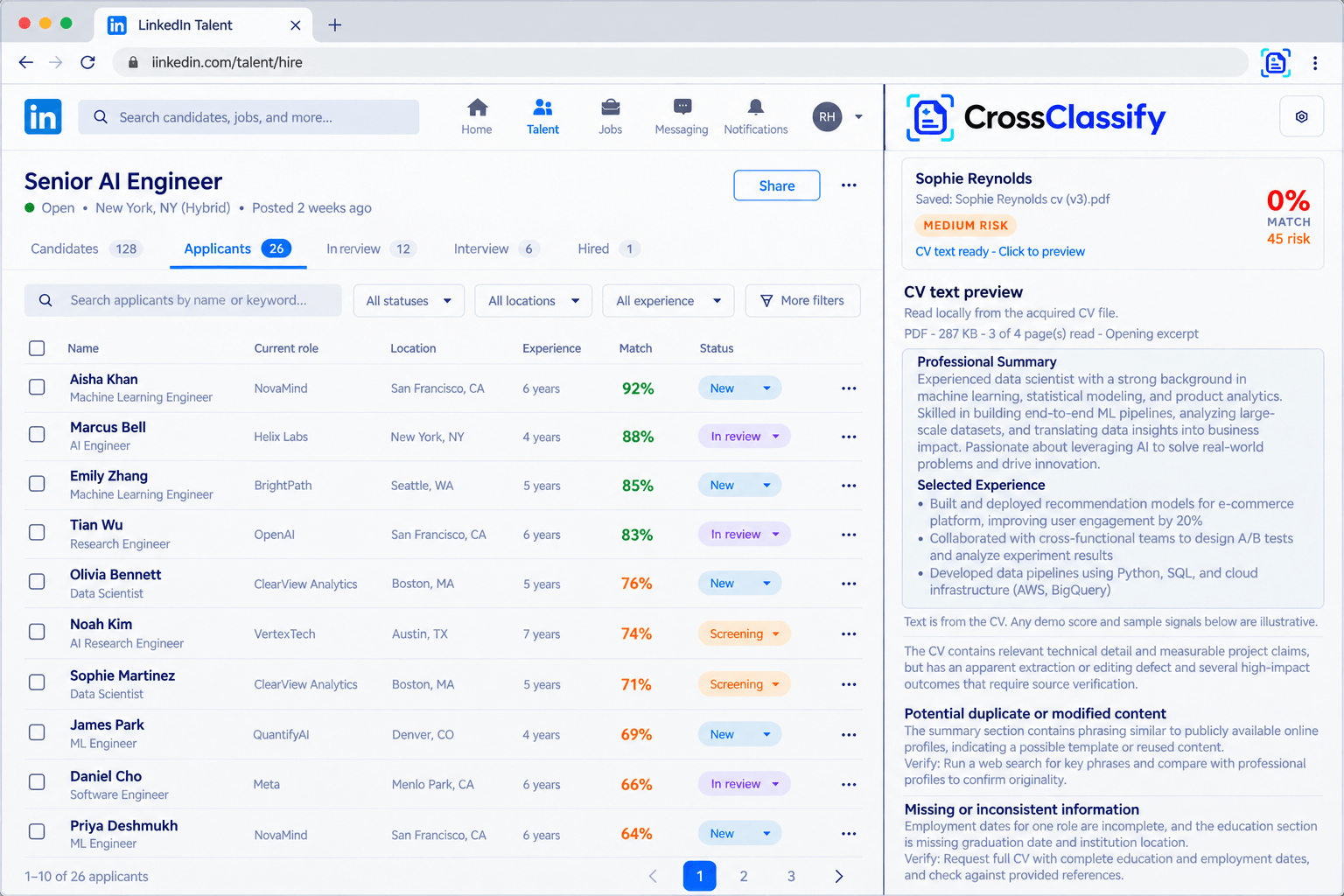
A CV Fraud Risk Score is useful because it compresses a complicated review into a signal that can help prioritize attention. However, the number becomes misleading when it is separated from the observations that produced it. A recruiter who sees an elevated score still needs to know whether it resulted from contradictory employment dates, inconsistent identity details, an unusual credential, hidden document content, repeated unsupported claims, or another pattern. Those situations require different questions and may justify very different responses.
The strongest scoring model therefore separates prioritization from explanation. The score and level indicate how much attention the CV may deserve, while the summary, individual signals, severity, and supporting evidence explain what contributed to that assessment. Recommended verification steps then translate the result into a practical next action, such as asking the candidate to clarify concurrent roles, checking a credential independently, reviewing a profile discrepancy, or treating the signal as low importance when the evidence is weak.
This design also reduces the anchoring effect created by a prominent score. If a system labels a candidate “high risk” without showing its reasoning, the recruiter may unconsciously treat the label as a factual accusation. When the evidence is visible, the reviewer can distinguish a meaningful contradiction from an ordinary variation caused by an outdated profile, an internal job title, contract work, or a resume builder. CrossClassify's recruitment integrity framework similarly recommends human review and stronger responses only when the strength and connection of the evidence justify them. (CrossClassify)
Risk is therefore not another word for fraud. It is a way to identify uncertainty, direct attention, and make the next review step more precise. A CV risk product that only generates suspicion has not solved the recruiter's problem; a useful product shows what deserves checking and why.
Resume manipulation is becoming more technical
Resume risk is no longer limited to exaggerated responsibilities or adjusted dates. As more recruitment systems use large language models to summarize, score, or rank applications, the resume can become an adversarial input aimed at the software rather than the human recruiter. Hidden instructions, visually concealed text, or wording designed to influence an automated evaluator can change how a document is processed without adding legitimate evidence of candidate suitability.
A 2026 study analyzing roughly 200,000 real world resumes collected through hireEZ found hidden prompt injection content in approximately 1% of the documents examined. The researchers reported that prevalence had increased over the preceding one to two years and that many injections did not rely on obvious instructions. The significance is not that every unusual document contains an attack, but that manipulation can target the screening system while remaining difficult for a recruiter to notice during ordinary review. (arXiv)
Separate ACL research examined prompt injection in automated resume screening and found that strategically inserted content could improve applicant rankings under some conditions, including scenarios in which weaker candidates could move above stronger candidates. Another ACL industry paper introduced a specialized framework for detecting resume based prompt injection, showing that the issue has become a practical security concern for AI supported recruitment. These findings expand the meaning of resume risk analysis: recruiters may need help reviewing human readable claims, while recruitment platforms also need safeguards against content written specifically for automated evaluators. (ACL Anthology)
AI assistance should not become a risk signal by itself
The existence of adversarial resume content does not make ordinary AI assistance suspicious. Candidates may use AI to improve grammar, reorganize experience, translate material, shorten bullet points, or adapt accurate information to the terminology used in a job description. Professional writers, templates, and editing services can produce the same polished effect without changing the truth of the application. Conversely, a manually written CV can contain fabricated experience while displaying none of the stylistic features commonly associated with AI.
The relevant distinction is therefore between assistance and deception, not between AI and human writing. CrossClassify's recruitment guidance warns against treating polished or AI assisted language as proof of fraud because that approach can penalize genuine candidates without producing verifiable evidence. A risk workflow should focus on material contradictions, unsupported claims, abnormal document behavior, hidden manipulation, or inconsistencies that a recruiter can investigate. (CrossClassify)
Explainability is essential to maintaining that boundary. A signal tied to a specific date conflict, credential, profile discrepancy, or concealed instruction gives the recruiter something concrete to examine. A warning that a resume merely “sounds artificial” is subjective, difficult to verify, and likely to be applied inconsistently across candidates with different writing styles or language backgrounds.
Verification should match the evidence
Not every anomaly deserves a background investigation. Candidates simplify internal job titles, omit short roles from public profiles, maintain outdated LinkedIn information, work several contracts at once, relocate between positions, or use different date formats across documents. Those variations may create apparent inconsistencies without showing an intention to deceive. A fraud risk score should help the recruiter determine the appropriate depth of review rather than making every anomaly look equally serious.
Weak or ambiguous signals may justify a clarification question, while a material credential conflict may warrant independent verification. Several connected discrepancies may require review by a fraud, compliance, or trust specialist, especially when they involve identity or coordinated activity beyond the document. This proportional approach prevents CV risk scoring from becoming an unofficial rejection score and keeps the recruiter focused on obtaining evidence that could resolve the concern.
Document software cannot complete every necessary check. Employment history may need confirmation from an employer, an academic credential may need independent validation, a questionable reference may require authentication, and an identity concern may need a separate verification workflow. CV risk scoring helps identify the question, but external evidence determines whether the underlying claim is true.
External hiring guidance supports fact checking material claims instead of relying on instinct. SHRM recommends checking employment, education, and credentials, while Gartner has urged recruiting leaders to strengthen screening and identity verification. Cifas also reported in 2025 that its survey of 2,000 UK workers found notable tolerance for behaviors including fake employment references. These findings support a layered process in which document analysis guides attention and appropriate verification methods resolve material concerns. (SHRM) (cifas.org.uk)
The purpose of risk scoring is to direct limited verification resources, not replace verification. CrossClassify's resume checking framework combines document review, candidate clarification, and independent verification so recruiters have a clearer basis for deciding what to check. See CrossClassify's practical resume verification framework.
Resume risk and job description matching signals answer different questions
Job description matching signals evaluate whether readable information in a CV relates to the requirements of a vacancy. CV risk analysis examines whether the document contains claims, patterns, or technical signals that deserve verification. These assessments can appear in the same recruiter workflow, but combining them into one score would make both results less clear and could turn ordinary suitability decisions into perceived integrity concerns.
A candidate can match a job description very well while still presenting one credential or employment claim that needs confirmation. Another candidate can be a poor match for the vacancy while submitting a completely ordinary, internally consistent CV. CrossClassify's extension therefore keeps Job Description Matching Signals and CV Risk results separate so low relevance does not become a fraud signal and high relevance does not become proof of authenticity.
The same separation should continue when people act on the results. Recruiters can evaluate skills, experience, and role fit, while appropriate platform, fraud, or trust teams evaluate distinct integrity evidence such as automation, account continuity, device context, or suspicious relationships. CrossClassify's wider recruitment integrity guidance uses this division to prevent a fraud control system from silently becoming a candidate quality model. (CrossClassify)
A CV cannot prove who is behind an application
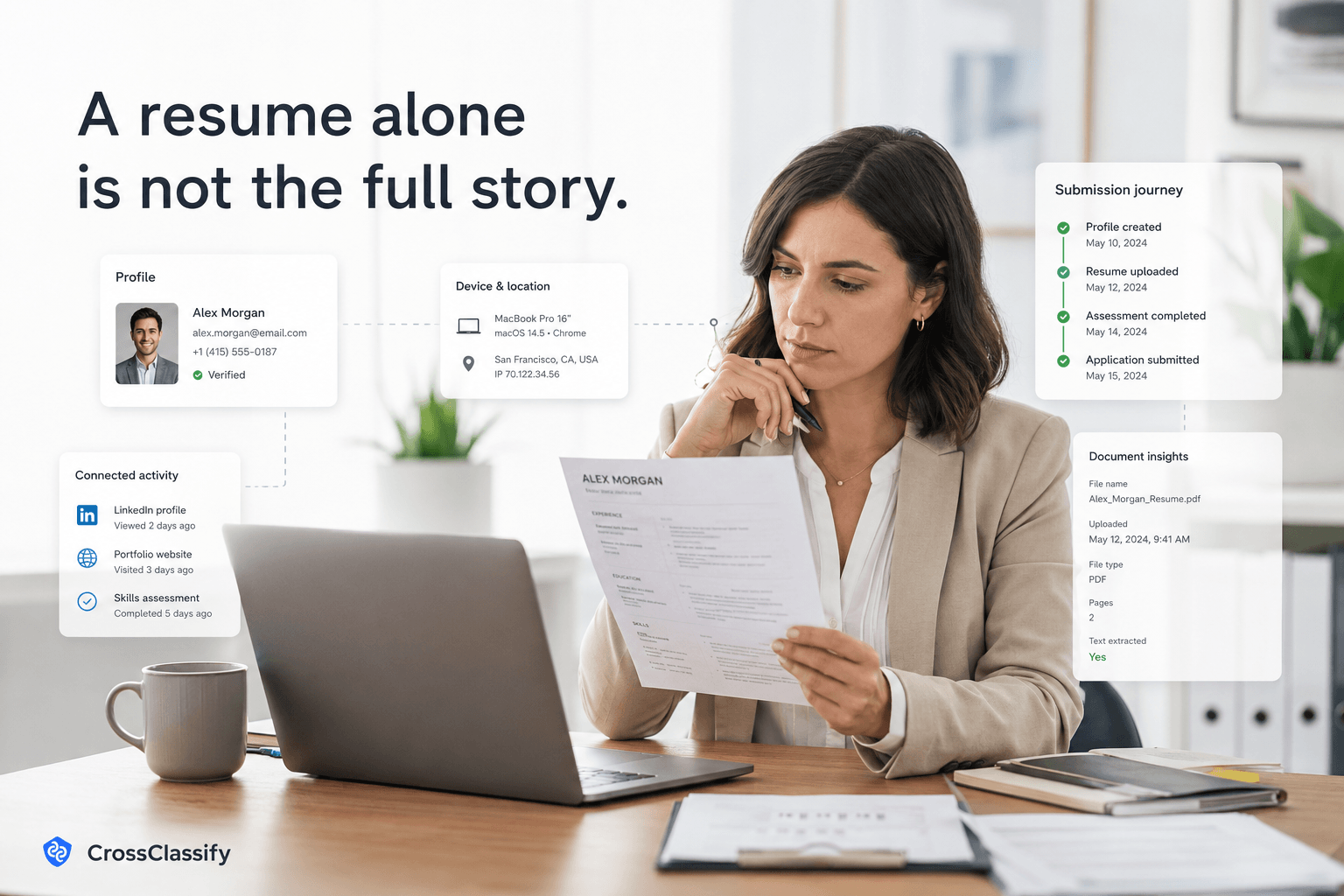
Document analysis has an important boundary: it can only evaluate information contained in or derived from the resume. It cannot independently establish whether the person controlling the candidate account or attending an interview is the same person described in the document. A CV may reveal an identity related inconsistency, but confirming identity requires additional evidence and an appropriate verification process.
That distinction matters because candidate fraud can continue beyond the application document. Gartner reported in 2025 that 6% of surveyed candidates admitted participating in interview fraud by posing as someone else or having another person participate on their behalf, and it warned recruiting leaders about fraudulent documents, concealed location, and identity misrepresentation. The FBI's 2025 IC3 report also described employment related complaints involving voice spoofing or potential voice deepfakes during online interviews, illustrating how integrity risks can shift across stages of the hiring journey. (Gartner) (FBI)
CrossClassify's broader recruitment platform can add account, device, behavioral, network, bot, and relationship context around those journeys. Those platform level capabilities should not be attributed to the CV Risk Checker as though a resume alone could reveal account takeover or device reuse. The document checker helps identify what deserves attention inside the CV, while the wider architecture evaluates risks that exist around the application and user session. Explore CrossClassify's broader Recruitment Fraud Detection approach.
Batch risk scoring should prioritize review without hiding failures
Manual resume verification becomes difficult when every application receives the same depth of investigation. Recruiters rarely have enough time to confirm every job title, credential, employment date, achievement, and identity detail before deciding which candidates deserve further consideration. Batch risk scoring can change the order of work by helping recruiters identify the CVs and claims that justify closer attention while allowing ordinary applications to continue through the standard professional review process.
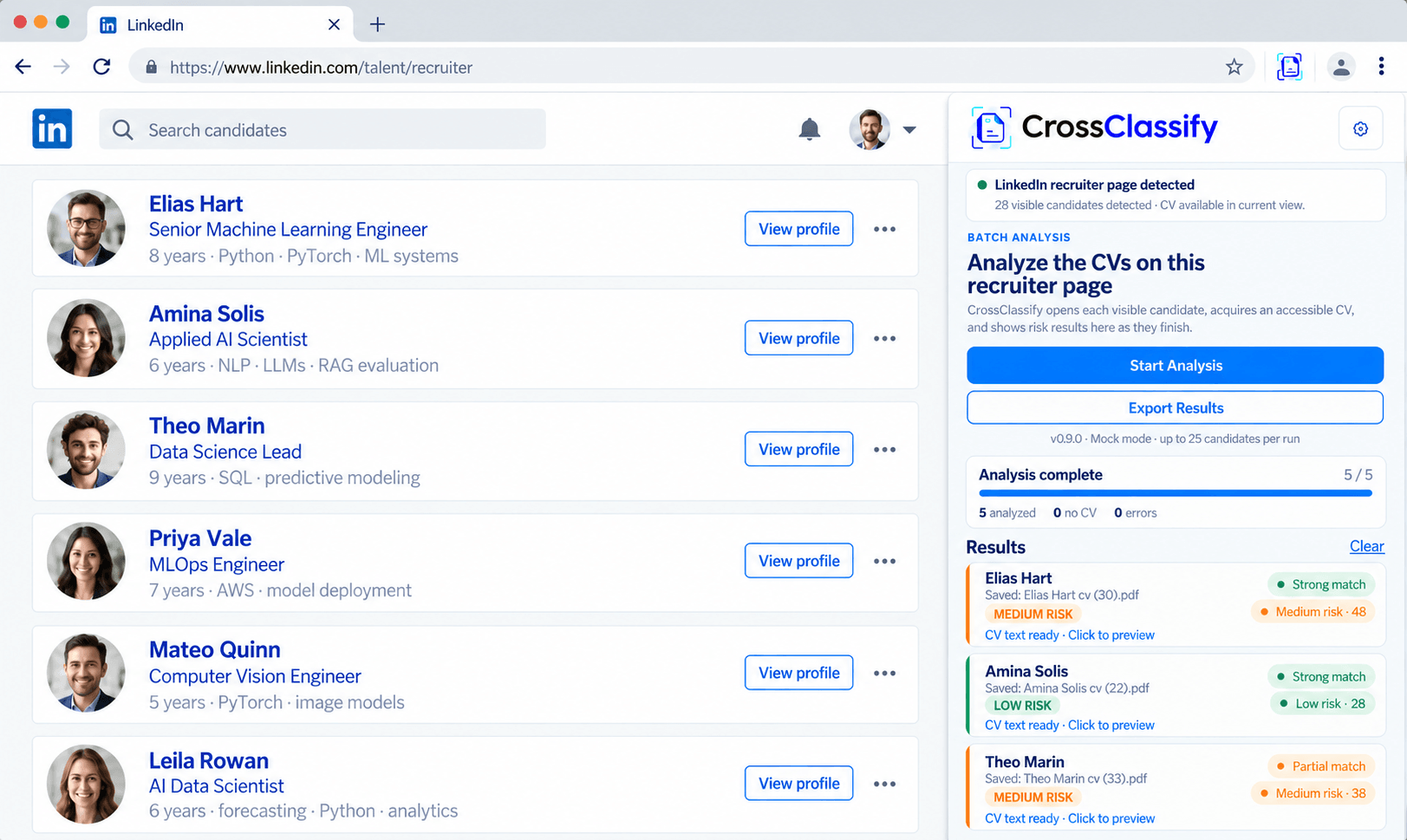
Under the supplied specification, CrossClassify can process visible candidates sequentially and display results progressively. The recruiter can stop a scan when necessary, while candidates with inaccessible CVs or processing errors remain distinguishable from successfully analyzed documents. That distinction is operationally important because “no result” does not mean “low risk,” and an unreadable CV should not be interpreted as a suspicious candidate.
Missing evidence, technical failure, and elevated risk must remain separate states throughout the workflow. If a system collapses them into one result, recruiters may overlook a document that was never analyzed or unfairly treat a technical limitation as an integrity concern. CrossClassify's work on recruiter attention at scale makes the same broader point: fraud controls should reduce repetitive review effort without turning incomplete evidence into an automated hiring decision. (CrossClassify)
Risk results need a usable record after screening
Risk scoring is difficult to govern if the result disappears when the recruiter closes the browser panel. When a CV deserves verification, a team may need to record what was observed, why the item was escalated, which evidence was available, what action was taken, and whether the concern was resolved. Without that record, reviewers can repeat the same work or make inconsistent decisions about similar signals.
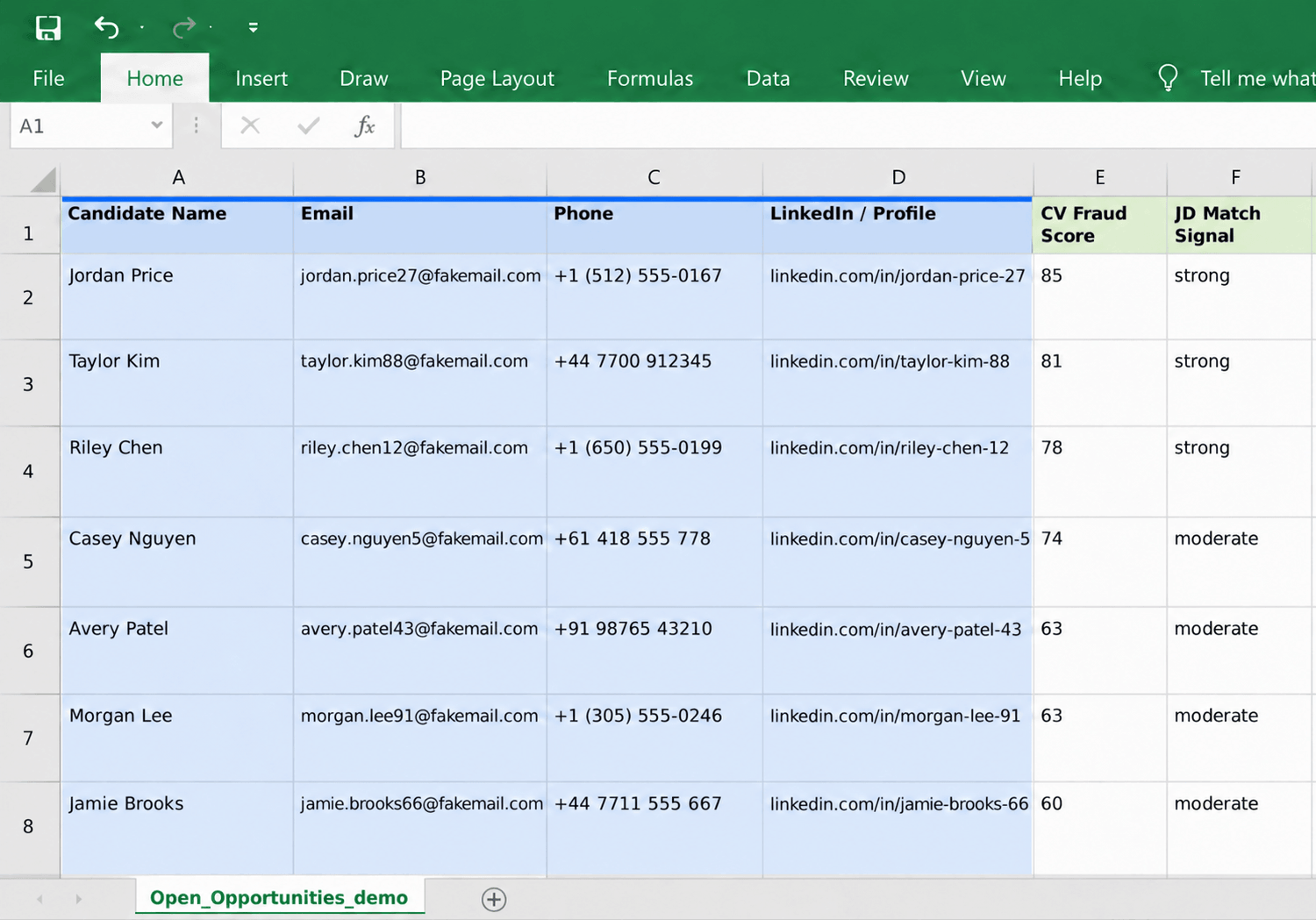
Under the supplied product specification, CrossClassify can export completed, stopped, and partially completed scans to Excel. The workbook can preserve candidate information, Fraud Risk Score, Risk Level, risk related outputs, JD information, CV filename, CV read status, and other structured results generated during the scan. This does not turn the extension into an applicant tracking system or case management platform; the ATS remains responsible for the official candidate record, communication, policy, and final decision.
The export is still valuable because it keeps the review output available outside the side panel. Teams can document follow up, compare recurring signal types, identify signals that create unnecessary work, and refine verification procedures over time. A healthy success metric is therefore not the number of warnings generated, but whether useful evidence reaches reviewers sooner, confirmed problems are investigated more efficiently, and genuine candidates avoid unnecessary friction.
What recruiters should test before adopting a CV risk checker
A realistic evaluation should include more than obviously fraudulent demonstration documents. Recruiters should test genuine CVs from candidates with nontraditional careers, overlapping contract roles, international institutions, career changes, professionally edited resumes, accurate AI assisted writing, and legitimate differences between a CV and an older public profile. These cases help reveal whether the system produces excessive review work when faced with ordinary complexity.
The test set should also contain controlled examples of known integrity problems where the organization has permission to use them. Suitable cases may include deliberately inconsistent dates, fabricated credentials in test data, hidden prompt injection text, unsupported job title changes, repeated identity elements, or other documented anomalies relevant to the employer's hiring environment. The objective is not simply to see whether the tool can produce a high score; it is to determine whether useful signals rise while false or low value reviews remain manageable.
Explanation quality should be assessed separately from detection performance. Teams should ask whether reviewers can understand why each signal appeared, whether two reviewers interpret the evidence similarly, and whether the recommended action is proportionate to the concern. A correct flag that cannot explain itself may still create substantial operational work and can encourage recruiters to rely on the score instead of the evidence.
Technical failure states require the same scrutiny. Scanned or image only resumes, corrupt documents, missing attachments, files without selectable text, unusual PDF layouts, and interrupted scans should produce clear processing states rather than invented risk judgments. CrossClassify's supplied specification does not currently describe the extension as an OCR product, so an image only document may require a separate OCR process instead of being silently classified as low or high risk.
When CV risk scoring is worth adding
A small recruiting team reviewing only a few candidates may be able to investigate questionable claims manually without introducing another tool. The business case becomes stronger when application volume grows, the same verification questions repeatedly consume recruiter time, or AI assisted screening increases exposure to document manipulation. In those environments, recruiters need a consistent way to decide which CVs and claims deserve more attention without performing a full investigation on every applicant.
The strongest use case is therefore operational rather than alarmist. Recruiters have enough volume that they cannot inspect every document equally deeply, but they still need a structured way to identify contradictions, manipulation patterns, or unsupported claims that may affect trust in an application. A risk checker can reduce preparation work by organizing the observations and evidence before the recruiter chooses whether clarification or verification is necessary.
This is a more defensible objective than promising automatic fake resume detection. Fraud is a conclusion that requires evidence about the claim, context, and sometimes intent, whereas risk scoring is a prioritization method for deciding where to gather that evidence. Organizations should adopt the tool when that prioritization improves review quality and consistency, not merely because it can generate more warnings.
Where CrossClassify Fits and Differentiates
CrossClassify CV Risk Checker for LinkedIn is designed for recruiters who already have candidates and accessible resumes in supported LinkedIn Recruiter or LinkedIn Hiring environments. The recruiter opens the Chrome Side Panel, supplies the required job description, and starts a scan for visible candidates. This places CrossClassify after initial sourcing, at the point where the recruiter wants to assess job alignment and decide which document level concerns deserve verification.
For accessible PDF and DOCX documents, readable CV text is extracted locally. In API mode, the extension sends the extracted text, CV filename, and supplied job description to the CrossClassify analysis endpoint rather than using the original document bytes as the analysis payload. Scanned or image only resumes may remain unreadable because the current specification does not include OCR, and the workflow should show that limitation as a read state rather than manufacture a risk result.
The CV Risk Review returns several connected layers of information. The CV Fraud Risk Score and Risk Level support prioritization, while the Risk Summary explains the overall concern. Individual risk signals, signal severity, and supporting evidence help the recruiter see what contributed to the result, and recommended verification steps connect the analysis to an appropriate human action.
The extension also keeps risk review separate from job description matching signals. Recruiters can examine Job Description Matching Signals for professional relevance while using the CV Risk Review to evaluate integrity related questions, preventing a poor match from becoming a fraud label.
These capabilities support review rather than automated rejection. A CrossClassify score does not establish that a candidate committed fraud, and a signal should not determine whether an application continues without appropriate context. That boundary follows CrossClassify's wider guidance on separating candidate assessment from integrity review and applying stronger responses only when stronger evidence supports them. Explore CrossClassify's Recruitment Integrity Guidelines.
Simple cross extension comparison
| FEATURE |  |  |  |  |
|---|---|---|---|---|
| Extract contact info | ||||
| Job description matching signal | ||||
| CV risk checking |
This table compares the extension level workflow, not every capability across each vendor's full platform. ContactOut and SignalHire focus on contact discovery and enrichment, while hireEZ provides ResumeSense within its broader Applicant Review environment. (ContactOut) (SignalHire) (hireEZ). The dash therefore reflects this focused comparison and should not be read as a claim that the wider hireEZ platform lacks resume integrity capabilities.
The CrossClassify CV Risk Checker extension combines contact extraction, job description matching signals, and structured CV risk review in a Chrome Side Panel, with progressive batch results and Excel export.
Conclusion
Effective CV risk scoring supports that task by connecting a prioritization signal to a summary, individual observations, severity, supporting evidence, and a proportionate verification step while preserving the recruiter's responsibility for interpreting context. Verification remains essential because the score identifies uncertainty; it does not prove the underlying claim is false.
The value of the extension should not be measured by how many candidates it labels suspicious. Its value comes from helping recruiters spend verification effort where it is justified, document why a review occurred, and avoid turning an unexplained score into a hiring verdict. Explore the CrossClassify CV Risk Checker extension.
Review More CVs Without Repeating the Same Comparison
Use structured positive and negative job description match signals to move through candidate reviews with less repetitive comparison.
Explore CrossClassify today
Detect and prevent fraud in real time
Protect your accounts with AI-driven security
Try CrossClassify for FREE—3 months
Share in
Related articles


Frequently asked questions
Let's Get Started
Create your free
account today
Discover how to secure your app against fraud using CrossClassify
No credit card required