Last Updated on 22 Sept 2026
CrossClassify CV Checker: Job Description Matching for LinkedIn Recruiters
Share in
Introduction
Recruiters increasingly face a challenge beyond finding candidates: understanding which applicants’ experience is most relevant to a specific role. As application volumes grow, comparing CVs consistently against the requirements of a position becomes harder, especially when candidates describe similar skills and responsibilities in different ways.
Job description matching helps organize this comparison by highlighting relevant experience and areas that may require further review. CrossClassify’s LinkedIn Recruiter extension applies this approach by analyzing accessible CVs against a recruiter-provided job description and presenting structured insights that help recruiters make the initial screening process more efficient.
Why recruiters struggle to compare CVs against job requirements at scale
Comparing a single CV against a role requirement is usually manageable. The challenge appears when recruiters must evaluate many applicants whose experience is presented in different formats. Some candidates emphasize job titles, others highlight projects, and others organize information around skills. Recruiters must interpret these differences and determine how each candidate’s documented experience relates to the role.
For example, a senior software engineer position may require Python, cloud infrastructure, database design, and technical decision-making. One candidate may clearly list technologies but provide limited evidence of architectural responsibility, while another may describe relevant engineering work without using the exact terminology from the role description. Understanding the difference requires more than finding matching keywords; recruiters need context around how skills were applied.
As applicant pools grow, this repeated evaluation becomes a time-consuming process. The challenge is not only reviewing more CVs but maintaining a consistent method for comparing candidates against the same requirements. A structured matching approach can help organize relevant information and highlight areas that deserve further review, allowing recruiters to focus on meaningful differences between applicants.

Why keyword-based resume screening misses relevant candidate experience
AI writing tools have made it easier for candidates to improve the language, structure, and presentation of their CVs. These tools can help applicants communicate genuine experience more clearly, but they can also make applications appear increasingly similar when multiple candidates tailor their documents to the same role. Recruiters may see similar descriptions of skills, responsibilities, and achievements even when the depth of experience behind those descriptions differs.
For example, several candidates applying for a cloud engineering role may mention cloud migration, scalable systems, and infrastructure management. However, one candidate may have led a large migration project, another may have contributed to a smaller implementation, and another may only have supported related tasks. The presence of similar terminology does not necessarily reveal the level of responsibility or practical experience each candidate has gained.
This creates a challenge for job description matching. Recruiters need to understand the difference between relevant words appearing in a CV and the evidence supporting those words. A candidate may have strong experience but describe it using different terminology from the job description, while another candidate may include many matching keywords without providing enough context about how those skills were applied. Effective matching should therefore help recruiters examine relationships between requirements and documented experience rather than relying only on wording similarity.
Keyword searches remain useful for identifying specific requirements, but they have limitations when used as the main evaluation method. A CV that mentions technologies such as Kubernetes, Python, or cloud platforms may not explain how those skills were used, while another candidate may demonstrate equivalent experience through different terminology. Research in resume matching increasingly focuses on understanding these relationships beyond simple lexical comparison, using approaches that better represent the connection between candidate information and job requirements.
CrossClassify’s approach addresses this challenge by helping recruiters compare accessible CV information against a job description through structured matching outputs. The goal is not to replace professional judgment, but to help recruiters identify relevant experience, understand areas requiring review, and reduce the influence of polished wording or keyword overlap during initial screening.
Key capabilities recruiters need when evaluating CV matching tools
A job description match score can help recruiters quickly understand how closely a candidate’s CV aligns with a role, but the result becomes more valuable when recruiters can understand what contributed to that score. Two candidates may receive similar scores while having different strengths. One may demonstrate strong technical experience but provide limited evidence of leadership, while another may show management experience but lack a specific technical requirement.
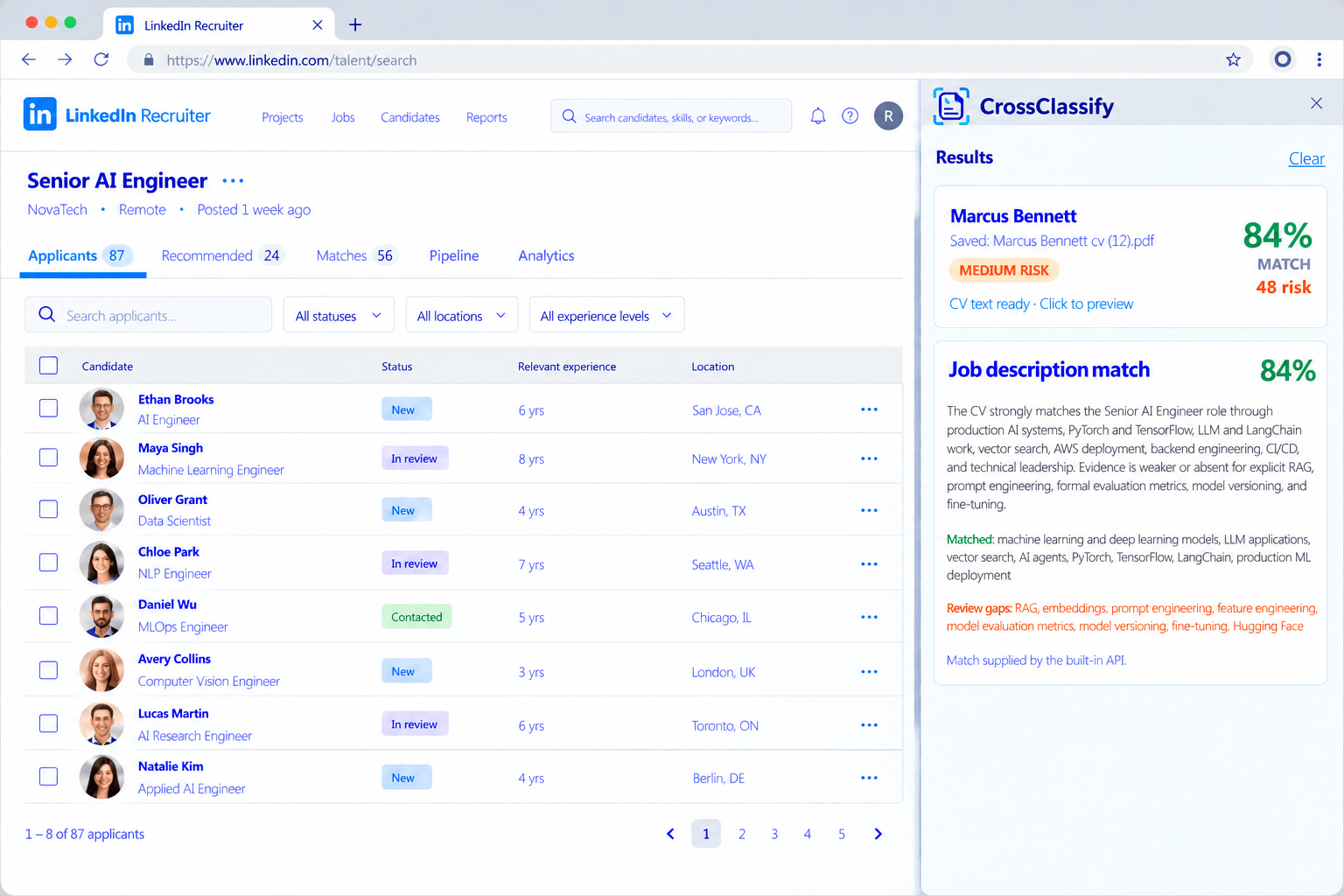
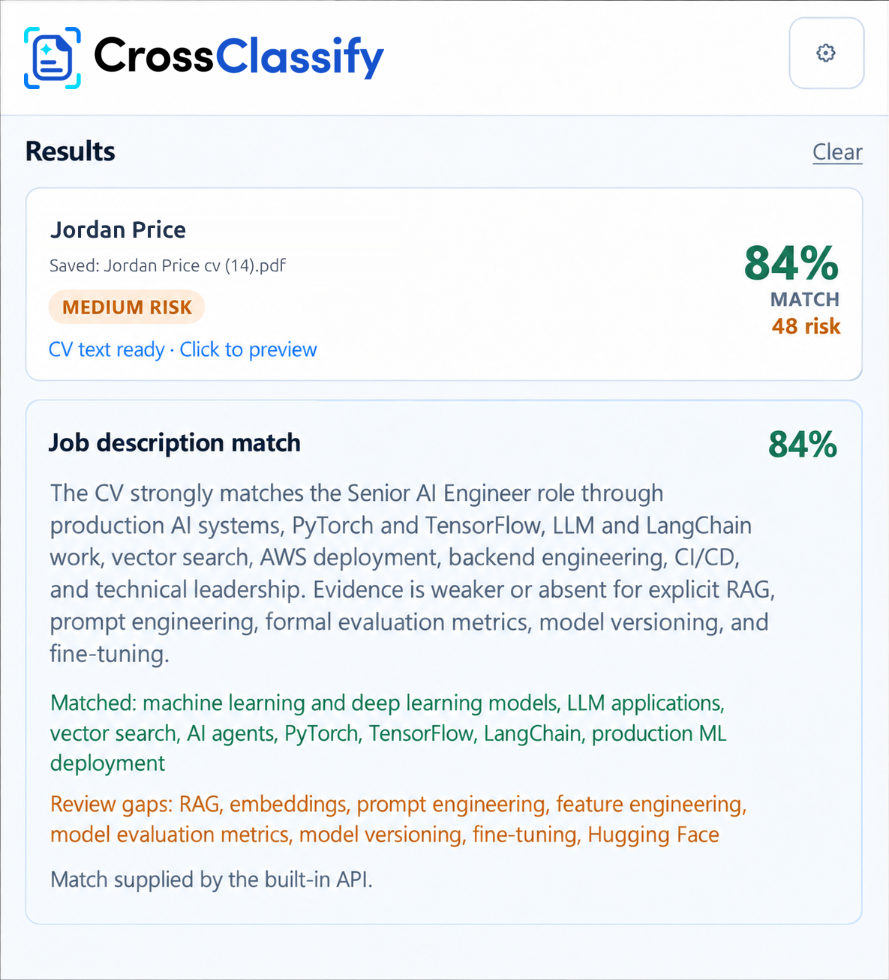
CrossClassify’s workflow provides structured matching outputs to help recruiters investigate these differences. The Job Description Match Score provides an overview of alignment, while the Job Description Match Level categorizes the result. The Job Description Match Summary explains the overall relationship between the CV and the role, matched terms highlight relevant information found in the document, and terms requiring review identify areas where recruiters may need further investigation.
These explanations help recruiters move beyond a simple ranking process and understand why a candidate appears relevant. A strong match may come from clearly demonstrated experience with required technologies, while another candidate may require closer review because the CV does not provide enough evidence for specific responsibilities.
This is especially important in recruitment because a matching result can influence which candidates receive further attention. A score without supporting information makes it harder for recruiters to evaluate whether the result reflects relevant experience, missing information, or limitations in the available CV data.
The purpose of job description matching is not to replace recruiter judgment. Instead, it organizes relevant information so recruiters spend less time searching through documents and more time evaluating the experience that matters for the role.
How recruiter Chrome extensions differ between sourcing and CV matching
Recruiter Chrome extensions may look similar because they operate inside the same browser environment, but they often support different stages of the recruitment process. Some focus on finding candidate contact information, while others help recruiters evaluate applications, match experience against role requirements, or manage recruitment workflows.
For recruiters who already have access to candidate CVs, the challenge is not only finding people but understanding which applicants have the most relevant experience for a specific role. This requires analyzing candidate information against job requirements rather than simply collecting additional profile data.
ContactOut illustrates the sourcing category. Its Chrome extension focuses on finding email addresses and phone numbers, adding prospects to campaigns, and supporting recruiter outreach workflows. These capabilities help recruiters contact identified candidates, but they do not address the separate task of comparing CV content against a job description.
SignalHire serves a similar purpose by helping recruiters retrieve contact details and social information from professional profiles. While this supports candidate outreach, recruiters still need another process to understand how an available CV aligns with a role’s requirements.
hireEZ is a closer comparison because its Applicant Review product supports resume screening and candidate matching. Its broader recruitment platform combines sourcing, applicant matching, relationship management, and analytics. Recruiters comparing solutions should therefore evaluate not only whether matching exists, but also how the workflow, outputs, and product scope fit their existing process.
CrossClassify CV Risk Checker for LinkedIn focuses specifically on job description matching inside the recruiter workflow. The extension allows recruiters to enter a job description, process accessible CVs, and receive structured outputs including matching scores, summaries, matched terms, and terms requiring review. This approach is designed for recruiters who already have candidate documents and need a clearer way to evaluate relevance.
The comparison between these tools is about different recruitment workflows rather than identical features. ContactOut and SignalHire primarily support candidate discovery and outreach, while hireEZ and CrossClassify address candidate evaluation against job requirements. CrossClassify’s contact extraction capability also differs from sourcing platforms because it extracts contact details available inside readable CV documents rather than providing an external contact database.
For recruiters evaluating job description matching tools, the most important factors are how easily the solution works with existing candidate documents, how clearly it explains matching results, and whether the workflow supports the recruiter’s current process. Testing the same job description and candidate documents across solutions provides a more practical comparison than looking at individual features alone.
| FEATURE |  |  |  |  |
|---|---|---|---|---|
| Extract contact info | ||||
| Job description matching | ||||
| CV risk checking |
Where CrossClassify fits and how batch matching changes the workflow
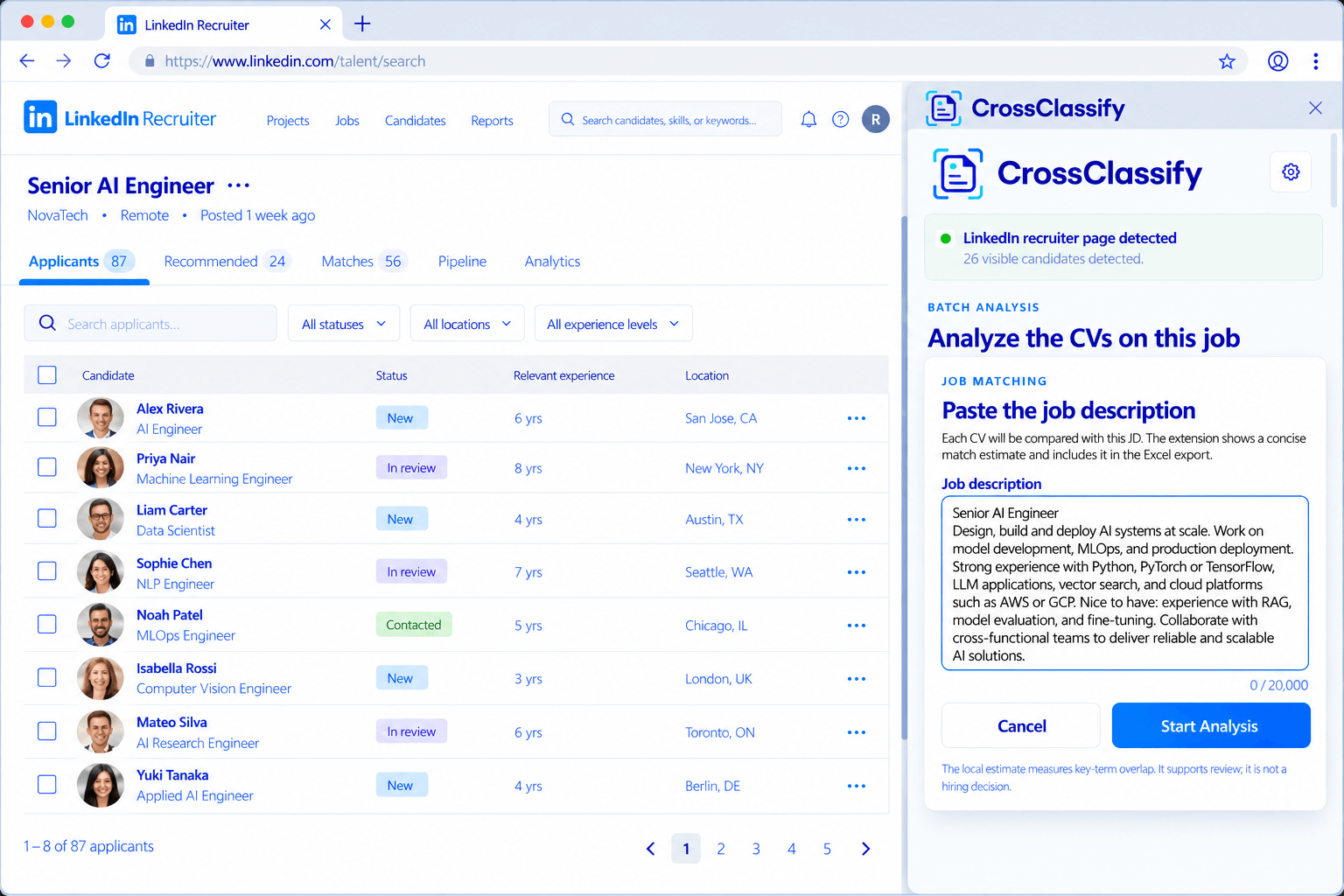
CrossClassify’s extension workflow begins when a recruiter has candidates available in a supported LinkedIn Recruiter or LinkedIn Hiring environment. The recruiter opens the Chrome Side Panel, enters a job description, and starts the scan. The extension processes visible candidate profiles sequentially and, when an accessible PDF or DOCX CV is available, extracts readable document text locally before matching and analysis take place.
Document accessibility is an important part of this workflow. Some candidates may have readable CVs, while others may have files that cannot be accessed or processed successfully. CrossClassify distinguishes between candidates whose documents were analyzed and those requiring manual attention because their CVs were unavailable or unreadable. This prevents an unavailable document from being interpreted as a candidate mismatch.
Batch processing helps recruiters handle larger applicant pools by making results available progressively rather than requiring every candidate to finish before review begins. Completed results can be examined while the scan continues, and recruiters can stop processing when priorities change. The workflow also tracks candidates whose documents could not be processed, helping recruiters understand which applications still require manual review.
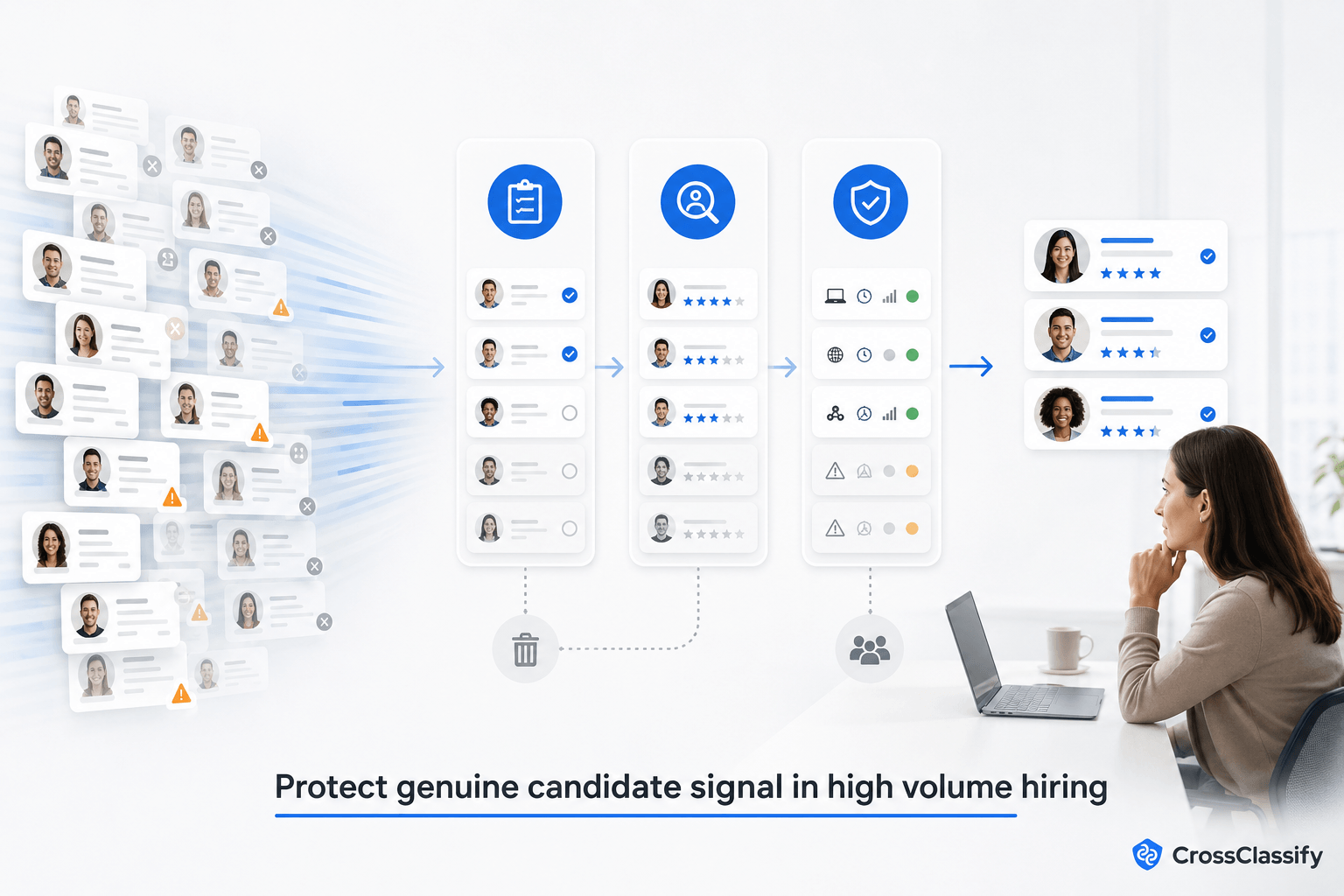
CrossClassify’s article on reviewing high volume applications without losing candidate signal provides additional context on maintaining useful applicant information as recruitment volumes increase. For job description matching, the value of batch processing is not only handling more CVs but preserving meaningful candidate-level information instead of producing a large collection of unexplained results. (crossclassify.com)
The extension’s scope should also be understood clearly. Matching CV information against a job description is different from verifying employment history, validating credentials, or determining whether an application is fraudulent. CrossClassify provides separate CV risk information for integrity-related concerns, as discussed in its Practical Recruitment Integrity Guidelines. The matching workflow focuses on helping recruiters understand how available CV information relates to role requirements and where additional professional review may be needed. (crossclassify.com)
What to test before choosing a job description matching extension
A recruitment team should evaluate matching technology using representative job descriptions and candidate documents rather than relying only on vendor demonstrations. Different roles create different matching challenges: a software engineering position may depend on specific technical skills, while a management role may require interpreting broader responsibilities. Testing multiple role types helps recruiters understand whether the system provides useful results across their hiring needs.
Recruiters should also test how changes to the job description influence matching results. Comparing the same CVs against a broad description and a more focused version can reveal whether the system reflects the actual priorities of the role. For example, a backend engineering position may mention Python, cloud infrastructure, database design, frontend development, project management, and customer support, even if the primary responsibility is backend development. A candidate with strong backend experience could appear less aligned if the description includes unrelated requirements.
The quality of matching depends partly on the quality of the job description used as the reference point. Recruiters should ensure that descriptions clearly communicate essential capabilities, expected responsibilities, and role priorities. Reusing generic descriptions across similar positions can reduce the usefulness of results because two roles may share technical requirements while differing in seniority, leadership expectations, or project scope.
Testing should include different types of candidate documents, such as applicants who describe similar skills using different terminology, candidates with unconventional career paths, and CVs with strong keyword overlap but limited supporting evidence. These examples help determine whether the matching output identifies meaningful relationships between experience and requirements rather than simply rewarding repeated keywords.
Recruitment teams should also measure the practical impact of the workflow. A matching tool may produce results quickly, but its value depends on whether recruiters still need to manually rebuild the comparison process afterward. Teams can compare the effort required to review candidates with and without the extension, focusing on whether the tool reduces repetitive searching while providing information that supports human evaluation.
Finally, recruiters should examine how the system handles unclear situations, including unavailable documents, uncertain requirements, and unexpected results. The interface should distinguish between a CV that cannot be processed and a candidate whose experience appears less aligned. Results should also be easy to retain and review within the team’s existing recruitment process. Evaluating these factors helps determine whether the extension supports real hiring workflows rather than only producing automated scores.
Why CV matching and candidate risk analysis require separate evaluation
A candidate can appear highly relevant for a role while still requiring additional verification of the information provided. Conversely, a candidate may submit a genuine application that simply does not match the role requirements. These situations represent different evaluation questions, so professional relevance and application integrity should not be combined into a single score.
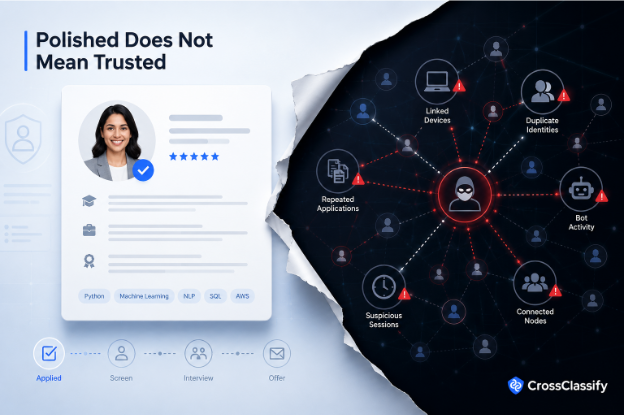
CrossClassify treats job description matching and CV risk review as separate capabilities. Matching focuses on how a candidate’s readable CV information relates to the supplied job description, while risk analysis examines different signals that may require verification. CrossClassify’s AI candidate fraud detection guidance discusses broader recruitment integrity concerns involving accounts, devices, sessions, networks, behavior, and application activity.
Keeping these capabilities separate helps recruiters interpret results correctly. A lower match score does not indicate fraud, and a strong match does not confirm that every CV claim is accurate. Each capability addresses a different recruitment challenge and should be evaluated according to the evidence and outputs relevant to that purpose.
How recruiters can use job matching results after screening
Matching becomes more useful when recruiters can continue working with the results after the browser session ends. Recruitment teams may need to compare candidates, prepare discussions with hiring managers, and retain information from the initial review process. Without an exportable record, recruiters may need to manually copy scores, summaries, and observations into another system.
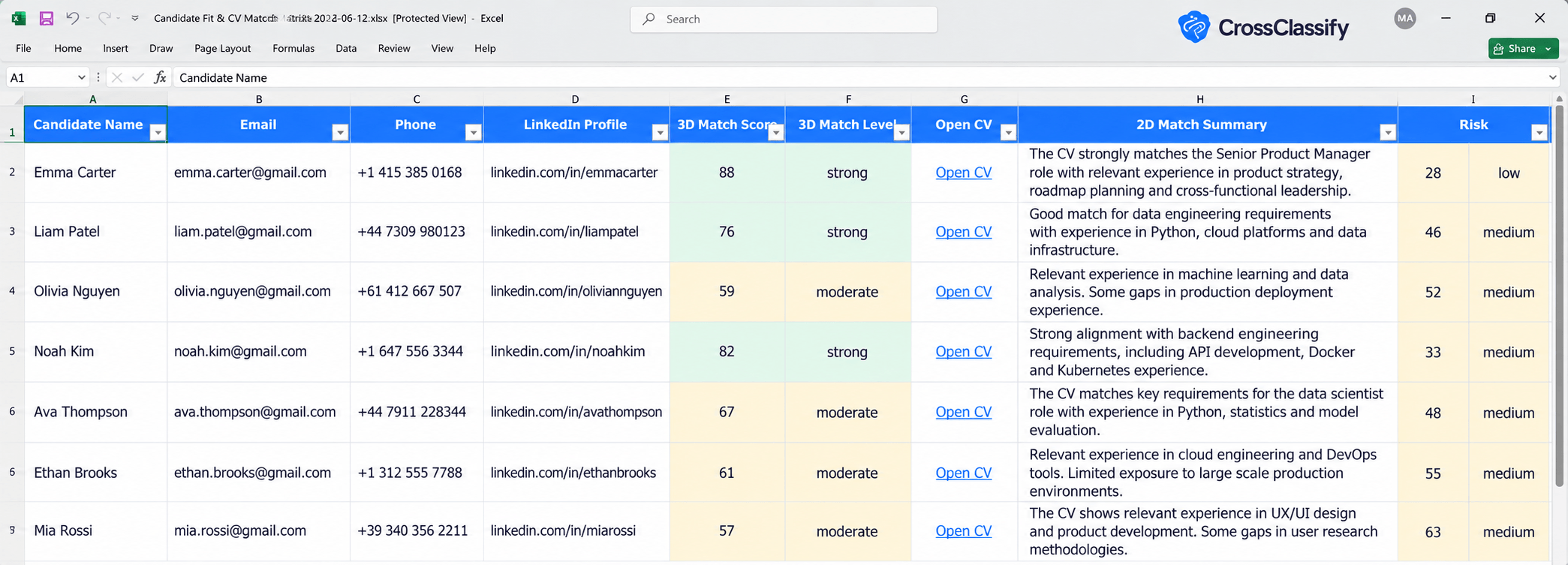
CrossClassify’s supplied workflow supports exporting completed, stopped, and partially completed scans to Excel. The export can include candidate names, Job Description Match Score, Job Description Match Level, Job Description Match Summary, matched terms, terms requiring review, CV filename, and CV read status. Separate contact and risk information may also be included, but those capabilities address different recruitment needs. For matching, the main benefit is preserving structured comparison information for later review.
For example, a recruiter preparing a hiring manager discussion can use exported results to examine which candidates appear aligned with the role and which requirements require further investigation. This creates a shared reference point for discussing candidates without repeating the initial comparison process.
The export also supports recruitment workflows that continue across multiple sessions. Recruiters can identify which candidates have already been processed and which documents still require attention. However, Excel export should not be described as a direct ATS or CRM integration. Within the supplied extension workflow, it is the method for taking structured results beyond the browser panel.
Teams interested in broader recruitment security capabilities can separately review the CrossClassify recruitment solution. These capabilities address concerns such as suspicious accounts, fake candidates, device information, behavioral signals, and recruitment platform integrity. The matching workflow should be assessed independently based on how effectively it helps recruiters compare accessible CVs with role requirements.
When automated CV matching adds value to recruitment workflows
Not every recruitment process requires a matching extension. When recruiters review a small number of highly specialized candidates, manual evaluation may remain practical because each application can receive detailed attention.
The value of matching technology becomes clearer when teams regularly compare large applicant pools against the same role requirements. Organizations should evaluate whether the workflow reduces review effort, improves consistency, and helps recruiters find relevant experience faster.
The practical benefit is not replacing recruiter judgment or making final hiring decisions. It is organizing candidate information so recruiters can focus their time on evaluating differences that matter.
Conclusion
Job description matching helps recruiters address a growing challenge: comparing large numbers of differently structured CVs against role requirements while keeping relevant experience visible. AI writing tools can make CVs more polished and similar in appearance, increasing the need for structured comparison methods that help recruiters examine the information behind the wording.
CrossClassify approaches this challenge through a LinkedIn Recruiter extension that analyzes accessible CVs against a recruiter-provided job description and returns structured matching information. Scores, summaries, matched terms, review indicators, batch processing, and export capabilities help recruiters organize initial screening while keeping professional judgment at the center of the process.
For teams that frequently compare candidate CVs with job requirements, the main benefit is a more organized review workflow. Recruiters can spend less time reconstructing comparisons and more time examining the differences that matter between candidates.
Review More CVs Without Repeating the Same Comparison
Use structured job description match scores and summaries to move through candidate reviews with less repetitive comparison.
Explore CrossClassify today
Detect and prevent fraud in real time
Protect your accounts with AI-driven security
Try CrossClassify for FREE—3 months
Share in
Related articles

Frequently asked questions
Let's Get Started
Create your free
account today
Discover how to secure your app against fraud using CrossClassify
No credit card required