Last Updated on 27 Aug 2026
Practical Recruitment Integrity Guidelines: A Stage by Stage Playbook for Safer Hiring Workflows
Share in
Introduction
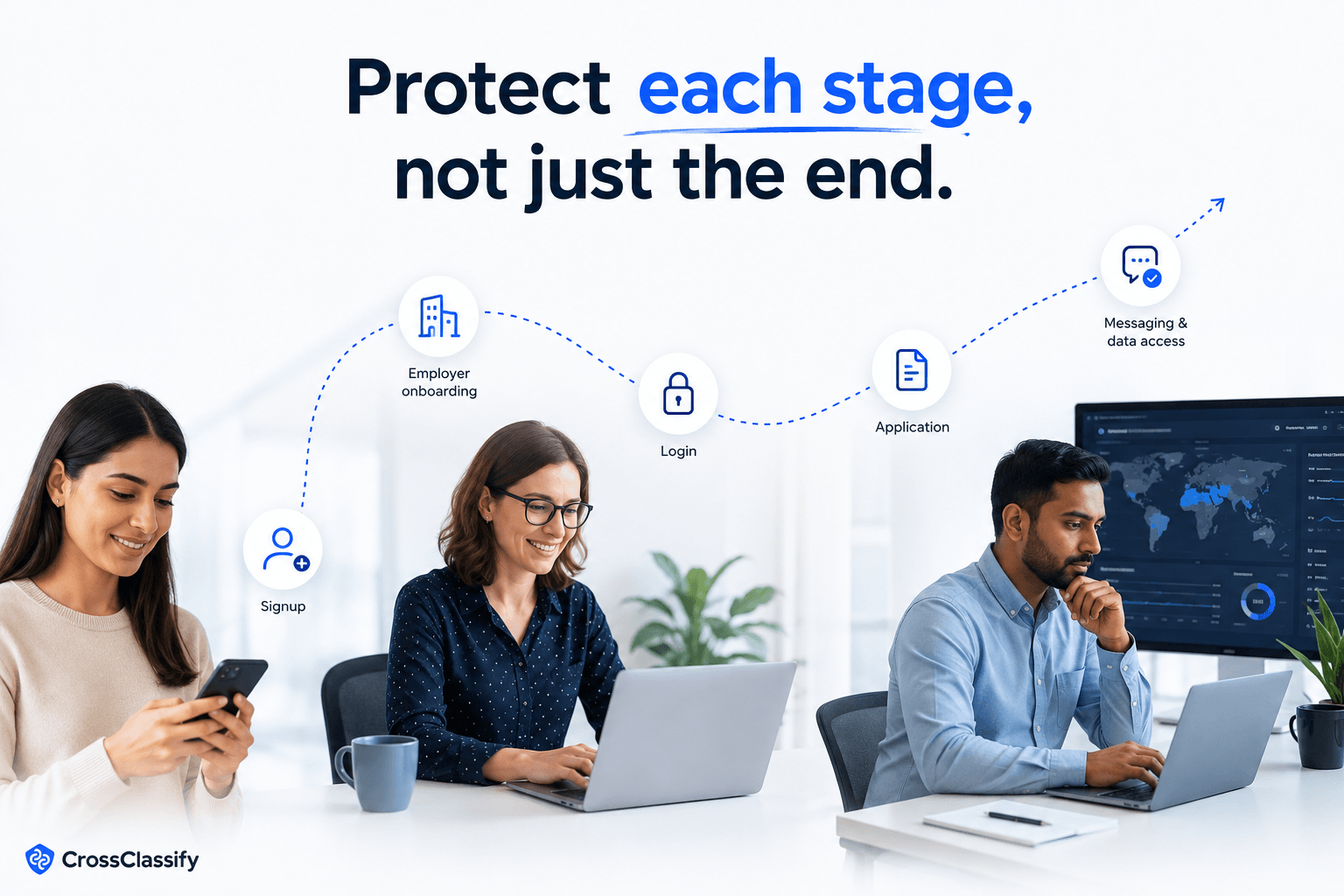
Recruitment integrity cannot be protected through one check at the end of the hiring journey. Risk can enter during employer onboarding, candidate registration, login, account recovery, resume submission, application activity, assessments, interviews, messaging, and candidate data access. Each stage provides different permissions and creates different potential harm for candidates, recruiters, employers, and the platform.
A practical guideline should define what the platform checks, which team owns the decision, and what response is proportionate. It should also identify what fraud and security systems are not allowed to decide. Recruitment integrity controls should protect accounts, sessions, identities, data, and workflows without ranking candidate quality or replacing recruiters.
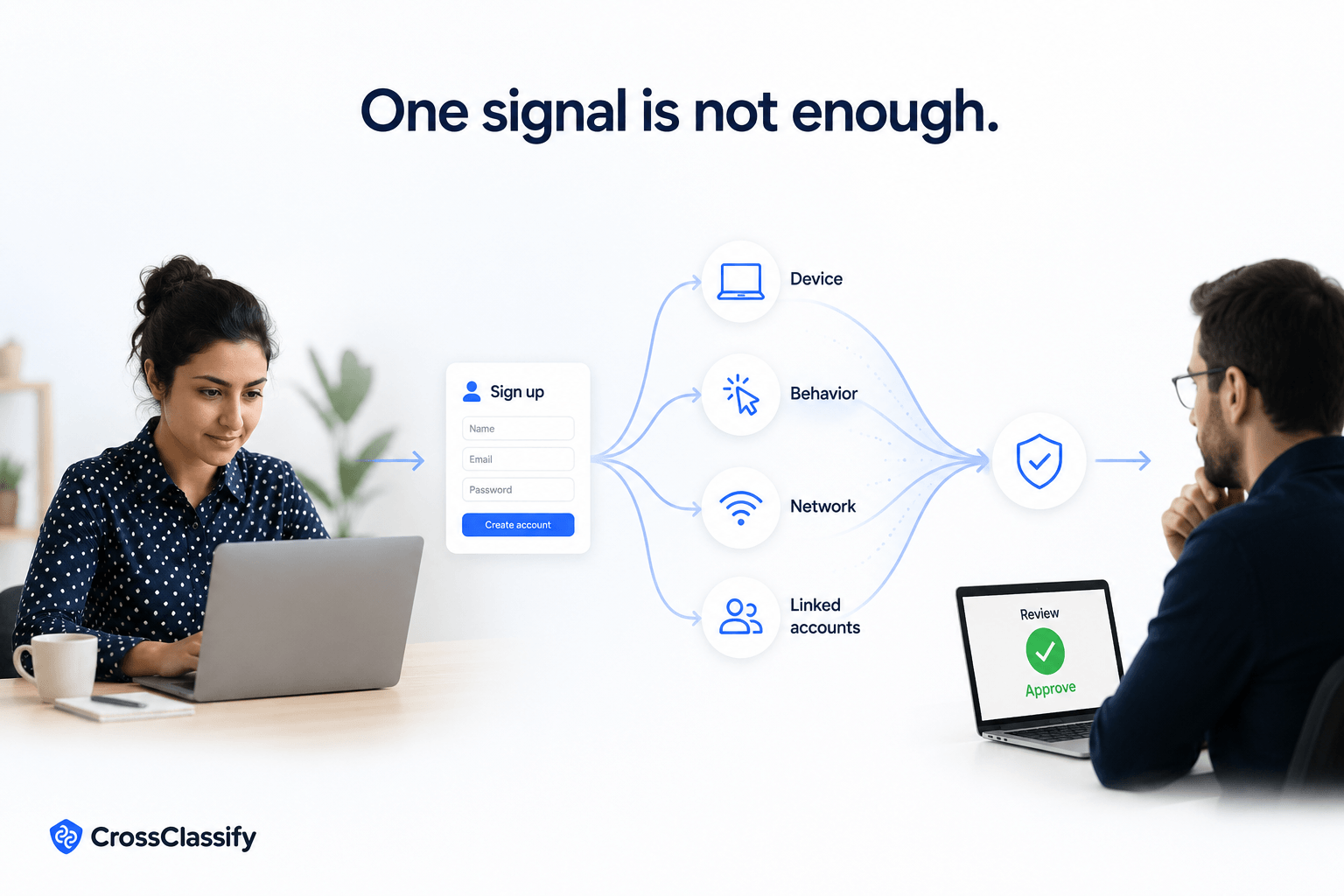
A layered approach is important because no single signal explains the entire candidate or recruiter journey. Device information can reveal returning environments but cannot confirm who is present. Behavioral signals can reveal automation or discontinuity but cannot determine candidate ability. Identity verification can confirm selected information but may not detect later account misuse.
CrossClassify helps recruitment platforms create a shared risk intelligence layer across web and mobile journeys. Device fingerprinting, behavioral biometrics , account opening protection, account takeover monitoring, bot detection, network intelligence, and link analysis can support each stage. The recruitment platform retains control of verification, review, escalation, communication, and final decisions.
What a practical recruitment integrity guideline should achieve
The guideline should turn broad fraud concerns into specific operating steps. Every stage should identify the action being protected, the evidence available, the responsible team, and the possible response. This creates a workflow that product, fraud, trust, security, support, and recruitment teams can understand and apply consistently.
The guideline should also preserve proportionality. A new device viewing a job creates less potential harm than a new device recovering an employer account or exporting candidate data. The strength of the response should reflect both the quality of the evidence and the sensitivity of the action.
Human judgment must remain visible. Technical systems can identify patterns, connect related activity, and prioritize cases. Human teams should review uncertainty, consider legitimate explanations, and decide whether platform policy requires additional verification or another response.
The final result should be measurable. Teams should know whether controls reduce repeated incidents, protect candidate and recruiter accounts, improve review speed, and avoid unnecessary friction. A guideline without outcomes eventually becomes a list of rules that no longer reflects actual platform behavior.
Guideline 1: Map the complete recruitment journey
Begin by listing the major user journeys in the platform. These normally include candidate signup, employer signup, login, account recovery, profile creation, resume upload, job posting, application submission, messaging, assessment access, interview scheduling, and candidate data access. Additional stages may exist depending on the product and business model.
For each stage, identify the user, action, data involved, and potential impact. Candidate signup creates a new identity record. Employer signup can lead to job posting and messaging permissions. Account recovery can transfer control of an established account. Assessment access can affect employer confidence in later hiring stages.
Record the evidence available at each point. This may include account history, device information, network context, interaction behavior, document data, permissions, organization records, and user reports. Also document where the evidence is stored and which teams can access it.
Finally, record the current response. Determine whether the event continues automatically, enters review, triggers verification, or creates an alert. Gaps become visible when high impact actions have little context or when several systems detect risk without sharing information.
Recruitment journey mapping table
| Stage | Protected action | Potential impact | Primary owner |
|---|---|---|---|
| Candidate signup | Creation of a new candidate identity | Fake accounts, automation, or repeated profiles | Fraud or trust team |
| Employer signup | Creation of employer access | Unauthorized posting, messaging, or candidate access | Trust or employer operations |
| Login and recovery | Account access and control | Account takeover or identity transfer | Security or fraud team |
| Application submission | Entry into recruiter workflows | Application noise, bots, or identity misuse | Recruitment operations and fraud team |
| Assessment | Candidate performance event | Proxy participation, automation, or account sharing | Assessment integrity team |
| Messaging | Direct communication between users | Spam, impersonation, phishing, or account misuse | Trust and safety |
| Candidate data access | Search, profile viewing, and export | Scraping, unauthorized collection, or compromised access | Security, privacy, and fraud teams |
Do this now
List every recruitment stage in your product and mark the three actions that could create the greatest candidate, employer, or data impact.
Guideline 2: Protect candidate account creation
Candidate signup should remain simple enough for genuine users to complete. Collect only the information required to establish the account and begin the candidate journey. Excessive questions increase abandonment without necessarily improving account trust.
Evaluate the signup context passively where possible. Device history, network conditions, field timing, repeated registration behavior, and relationships with previous accounts can reveal suspicious patterns. One new device or fast form completion is not enough to establish abuse.
Link new accounts with earlier activity. A device may have created several profiles, returned after a restriction, or appeared across candidate and recruiter roles. Shared devices can be legitimate in households, public environments, education centers, or employment services. The platform should consider this context before escalating.
CrossClassify can add account, device, behavior, and network context during registration. Teams can apply the account opening fraud detection solution to identify repeated devices, coordinated registrations, suspicious infrastructure, and abnormal signup behavior. The platform can then continue, monitor, request confirmation, or open a specialist review.
Candidate signup checklist
| Check | What to review | Normal explanation | Possible response |
|---|---|---|---|
| Required information | Contact fields and basic profile information | Minor errors or incomplete data | Request a correction |
| Device relationship | Returning device and connected accounts | Shared household or public device | Combine with wider evidence |
| Signup behavior | Field timing, navigation, and repetition | Saved information or accessibility tools | Monitor or review when signals align |
| Network context | Location, infrastructure, and rapid changes | Travel, privacy tools, or network routing | Do not act on location alone |
| Account velocity | Number and timing of related registrations | Legitimate shared environment | Group repeated patterns for review |
Practical scenario
A new candidate account is created from a device shared with one family member. The signup behavior is natural, profile details are distinct, and the account applies to related roles.
Recommended response: Continue normal onboarding. The shared device alone does not justify additional friction.
Ten new accounts are created from the same device and follow nearly identical field timing. The profiles reuse contact patterns and begin high volume applications shortly after registration.
Recommended response: Group the accounts into one platform integrity case. Review the shared device, behavior, network, and account relationships together.
Do this now
Review the last twenty candidate accounts escalated during signup. Identify how many were escalated because of one signal and how many contained several independent indicators.
Guideline 3: Protect employer and recruiter onboarding
Employer accounts can receive permissions that affect many candidates. Organization creation, recruiter invitations, job posting, candidate search, and messaging should receive stronger context than ordinary browsing. The potential impact is wider because one employer account can reach many users and access valuable information.
Verify visible organization information, but do not rely on company names and domains alone. Public information can be copied, and legitimate business accounts can be compromised. The platform also needs account, device, behavior, network, and organization relationship evidence.
Pay attention to permission transitions. A new employer account may appear normal until it publishes a listing, searches candidate profiles, or begins sending messages. Risk should be evaluated again when account permissions and potential impact increase.
CrossClassify can support employer onboarding through device intelligence, account opening protection, and link analysis. The platform remains responsible for organization verification, recruiter authorization, access policies, and communication with legitimate employers.
| Stage | Practical check | Potential concern | Possible response |
|---|---|---|---|
| Organization creation | Compare the declared organization with platform records | Unverified or inconsistent relationship | Request employer confirmation |
| Recruiter invitation | Review who is adding users and from which device | Unexpected permission expansion | Require administrator approval |
| First job post | Review account history, device, and application destination | Copied listing or suspicious destination | Hold the post for review |
| Candidate search | Compare activity with the organization role and plan | Broad profile access from a new account | Apply adaptive limits or review |
| First messaging | Review recipient volume and account context | High volume outreach from a new environment | Monitor, verify, or temporarily limit |
Practical employer review sequence
The first check should confirm whether the person has a plausible relationship with the organization. This may involve business contact information, existing administrators, organization records, or another approved method.
The second check should review account creation and device context. A recruiter creating several accounts for one verified organization may be legitimate. The same device creating accounts for unrelated organizations requires more context.
The third check should focus on the first sensitive action. Publishing a listing, searching candidate profiles, or beginning outreach increases the account’s potential impact and may justify a stronger review.
The final check should examine whether later activity remains consistent with the approved employer relationship. A trusted onboarding event does not guarantee that every future session is trustworthy.
Do this now
List every permission an employer account can receive. Add stronger account and device context around the three permissions with the greatest candidate impact.
Guideline 4: Monitor login, recovery, and sensitive account changes
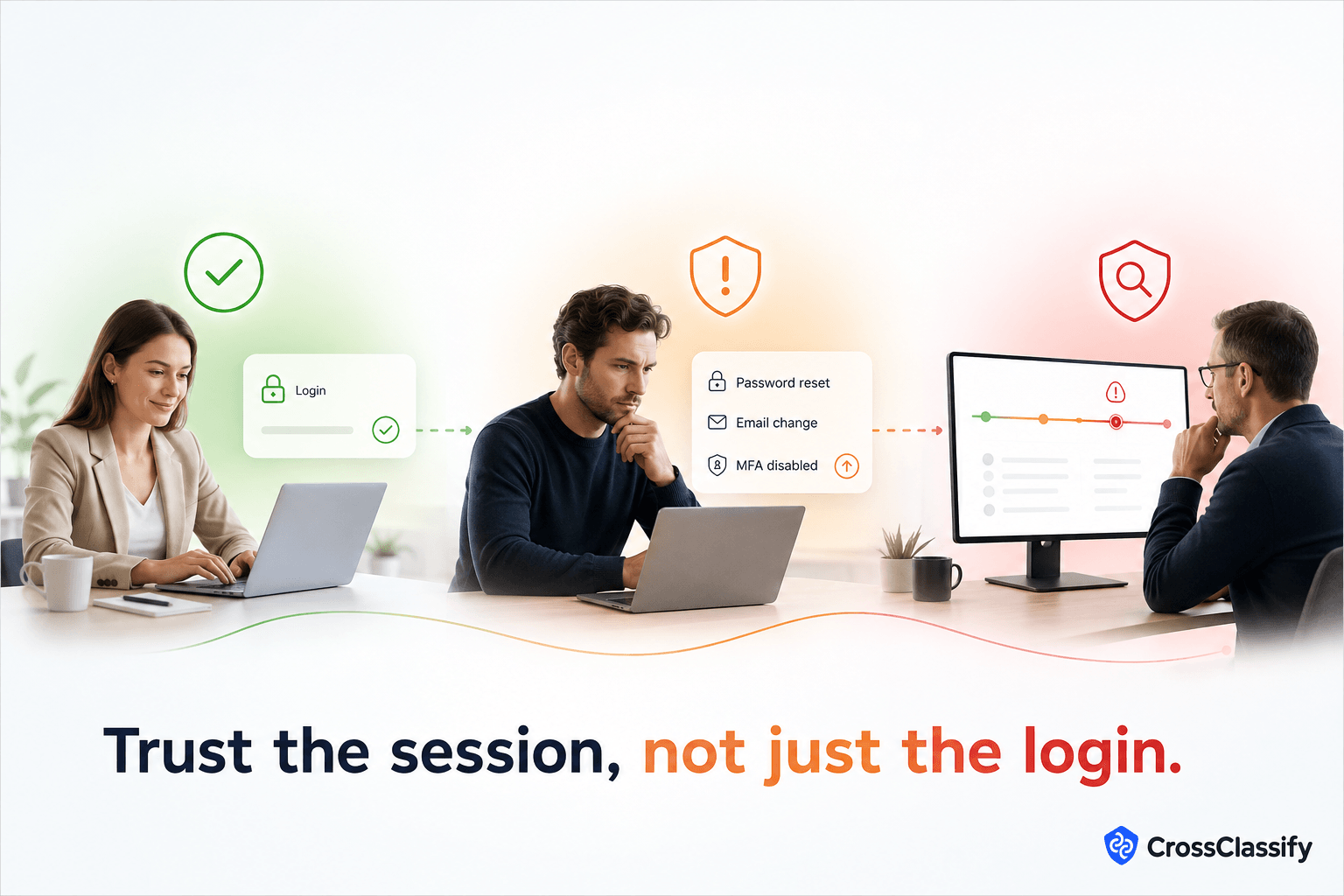
Login is not the end of account security. A session may begin with valid credentials and later perform unusual actions. Continuous monitoring is especially important around contact changes, recruiter permissions, candidate data access, messaging, and account recovery.
Establish a normal account history over time. Familiar devices, regions, behavior, and session patterns can support trust. Changes should be evaluated according to the action. A new device viewing a job creates less concern than a new device recovering an employer account.
Account recovery deserves special protection because it can transfer control. Compare the recovery device, network, behavior, and contact changes with earlier account history. Continue monitoring after recovery because misuse may begin only after access has been restored.
CrossClassify can add continuous context through its account takeover protection solution. Device familiarity, behavior changes, network context, session history, and connected account evidence can help the platform decide whether to continue, verify, restrict, or investigate.
Sensitive account action table
| Action | Risk context to review | Lower concern example | Higher concern example |
|---|---|---|---|
| Login | Device, network, behavior, and account history | New device with otherwise consistent activity | New device connected with other risky accounts |
| Account recovery | Recovery device, contact change, and previous access | Known device and expected contact recovery | Unfamiliar device replacing all identity fields |
| Contact update | Timing, device, and later actions | One phone number update | Email, phone, and name replaced before messaging |
| Permission change | Administrator, organization, device, and session | Approved internal administrator action | New session granting broad candidate access |
| Data export | Account role, device, velocity, and previous use | Expected employer workflow | Large export after unusual account access |
Practical account protection sequence
First, define which actions are sensitive for candidates, recruiters, and employers. Account recovery, identity changes, recruiter invitations, job publishing, contact reveals, and exports may require stronger context.
Second, compare the current event with account history. Determine whether the device, behavior, and network are familiar and whether the change fits the user’s previous activity.
Third, select a proportionate response. Low risk may require no visible interruption. Moderate risk may require account confirmation. Stronger connected evidence may require specialist review.
Fourth, continue monitoring after the event. A successful login or recovery does not prove that later actions are safe.
Guideline 5: Protect resume and application submission
Resume review should begin with internal consistency, profile comparison, and specific clarification questions. Writing quality and AI assisted language should not be treated as proof of fraud. Document concerns become more useful when connected with account and submission evidence.
Evaluate application velocity in context. Genuine candidates may apply actively, especially during a focused search. Concern increases when connected accounts follow mechanical sessions across unrelated roles or reuse the same devices, contact patterns, and identity elements.
Keep professional relevance separate from integrity. Recruiters evaluate skills and experience. Platform teams evaluate automation, identity continuity, devices, and account relationships. An integrity review should not silently change candidate ranking or interview selection.
CrossClassify can add device, behavior, network, bot, and relationship context around applications through its recruitment fraud detection solution. Human teams remain responsible for clarification, review, and hiring outcomes.
Application review checklist
| Check | Practical question | Owner | Possible action |
|---|---|---|---|
| Document completeness | Is the resume readable and complete? | Recruitment operations | Request a correction |
| Profile consistency | Do identity and career details align? | Recruiter or operations | Ask for clarification |
| Application pattern | Does the activity fit a plausible candidate journey? | Fraud or trust team | Monitor or review |
| Device relationships | Are accounts connected through shared environments? | Fraud or security team | Group connected cases |
| Hiring relevance | Does the candidate meet the role requirements? | Recruiter or employer | Continue the hiring process |
Practical scenario
A candidate submits five applications for closely related roles over one week. The account uses a familiar device and shows natural variation between sessions.
Recommended response: Continue normal recruiter review.
Another candidate account submits applications to many unrelated occupations in a short period. The same device is connected with several accounts using similar resumes and repeated behavior.
Recommended response: Group the accounts into one platform integrity case while keeping professional evaluation separate.
Do this now
Compare your current application volume rules with device, behavior, and role diversity evidence. Remove any rule that treats volume alone as proof of abuse.

Guideline 6: Protect assessments and interviews
Assessment integrity asks whether the expected account holder controlled the session. It does not ask whether the candidate performed well. Integrity evidence must remain separate from scores and professional evaluation.
Review device continuity, account changes, network context, and behavior around assessment access. A new device may be legitimate, especially when specific software or equipment is required. The complete sequence determines whether additional confirmation is appropriate.
Interviewers should understand common impersonation and undisclosed assistance risks. They can ask detailed follow up questions, compare answers with earlier stages, and report inconsistencies. They should not be expected to interpret device or behavior models during the interview.
A layered approach combines account context, identity confirmation where appropriate, interviewer observation, device information, and human review. No single camera, document, device, or behavior signal should decide whether the candidate is genuine.
| Stage | Practical action | What it protects | Owner |
|---|---|---|---|
| Before assessment | Review account recovery, identity changes, and device context | Session continuity | Assessment integrity team |
| Assessment start | Record the device, network, and account event | Expected access | Platform security |
| During assessment | Monitor automation and major session changes | Assessment integrity | Fraud or assessment team |
| Interview | Ask role specific follow up questions | Consistency across stages | Interviewer |
| After assessment | Keep integrity review separate from performance scoring | Candidate fairness | Recruitment and trust teams |
Practical review questions
Did the assessment begin from a familiar or explainable device?
Did the account change identity or recovery information shortly before the assessment?
Does the interaction pattern differ significantly from previous account activity?
Are other candidate accounts connected with the same device or session pattern?
Is there a legitimate technical, accessibility, or environmental explanation?
Do this now
Check whether assessment integrity findings are stored separately from candidate performance scores. Separate them when reviewers cannot tell which signal influenced which decision.
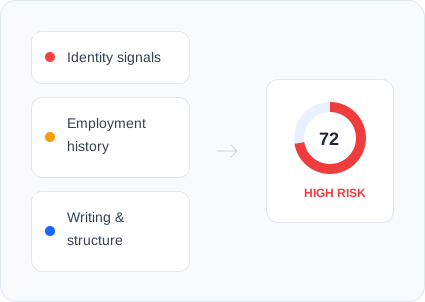
Turn CV Red Flags Into a Documented Risk Score
A checklist tells you what to look for. CV Risk Checker scans any resume in seconds and shows you exactly where the fraud signals are before you book the interview.
Guideline 7: Protect recruiter messaging and candidate communication
Messaging carries inherited trust. Candidates often assume that recruiter and employer accounts have been reviewed by the platform. A compromised or fake account can exploit that confidence even when the message content appears professional.
Evaluate the sender account, device, session, recipient velocity, profile changes, links, and related accounts. Repeated templates can be legitimate, while varied content can still come from automation. Content should be considered together with account and behavior context.
Separate content moderation from account security. A genuine account may send a prohibited message, while a compromised account may send completely normal text. These incidents require different evidence, ownership, and responses.
CrossClassify can connect messaging activity with account takeover, device, behavior, and bot signals. Recruitment platforms can use the evidence to monitor, verify, limit, or review suspicious communication while legitimate recruiters continue working.
| Signal | Possible normal explanation | Condition that increases concern | Practical response |
|---|---|---|---|
| High message volume | Active sourcing campaign | New account, unfamiliar device, and repeated recipients | Review account context |
| Repeated template | Approved recruiter outreach | Connected accounts and mechanical sending | Review automation signals |
| New device | Recruiter changed equipment | Profile changes followed by unusual outreach | Request account confirmation |
| External link | Approved employer application page | Unverified destination or payment request | Limit the activity and investigate |
| Candidate report | Misunderstanding or irrelevant outreach | Several reports tied to one account cluster | Open a specialist case |
Practical scenario
An established recruiter begins a new sourcing campaign from a familiar device and sends an approved message template to candidates with related experience.
Recommended response: Continue normal activity.
A recently accessed recruiter account changes its profile details and sends messages to many unrelated candidates from an unfamiliar device. Several messages include an unverified external destination.
Recommended response: Temporarily limit the sensitive messaging activity and open an account review.
Guideline 8: Protect candidate data access
Recruiter search and candidate profile access are necessary platform functions. They also create opportunities for scraping, unauthorized export, and compromised account activity. High activity should be evaluated according to recruiter role, organization, permissions, and hiring workflow.
Monitor mechanical navigation, broad profile coverage, unusual export activity, device sharing, account takeover indicators, and API use. A verified employer campaign may create legitimate volume, while a new account systematically opening every profile creates a different pattern.
Apply stronger controls around sensitive fields and bulk actions. Viewing a public profile summary may carry less risk than accessing contact details, downloading resumes, or exporting candidate information. Adaptive controls protect the most important data boundaries.
CrossClassify can help identify automated access and suspicious extraction through its bot attack protection solution. The recruitment platform retains responsibility for permissions, privacy policy, customer agreements, and final restrictions.
Candidate data access checklist
| Access event | Context to review | Potential concern | Possible response |
|---|---|---|---|
| Profile search | Account role, query variation, and navigation | Systematic coverage of every result | Monitor behavior |
| Contact reveal | Account history and recipient volume | Broad contact collection | Apply adaptive limits |
| Resume download | Organization, device, and velocity | Repeated bulk collection | Verify or review |
| Data export | Permissions, device, and previous usage | Unusual export after account changes | Temporarily restrict and investigate |
| API activity | Token, organization, network, and requested resources | Systematic extraction outside approved use | Review the token and access policy |
Practical access review
Begin by confirming what the account is authorized to access. Subscription level, organization role, and approved integrations should define normal boundaries.
Compare current activity with historical use. A sudden change in profile coverage, exports, or contact reveals may deserve review.
Review the device and session context. An unusual access pattern after account recovery or a device change creates greater concern than the same activity inside an established workflow.
Apply the least disruptive effective response. Monitoring, reduced velocity, account confirmation, or temporary restrictions may be appropriate depending on the evidence.
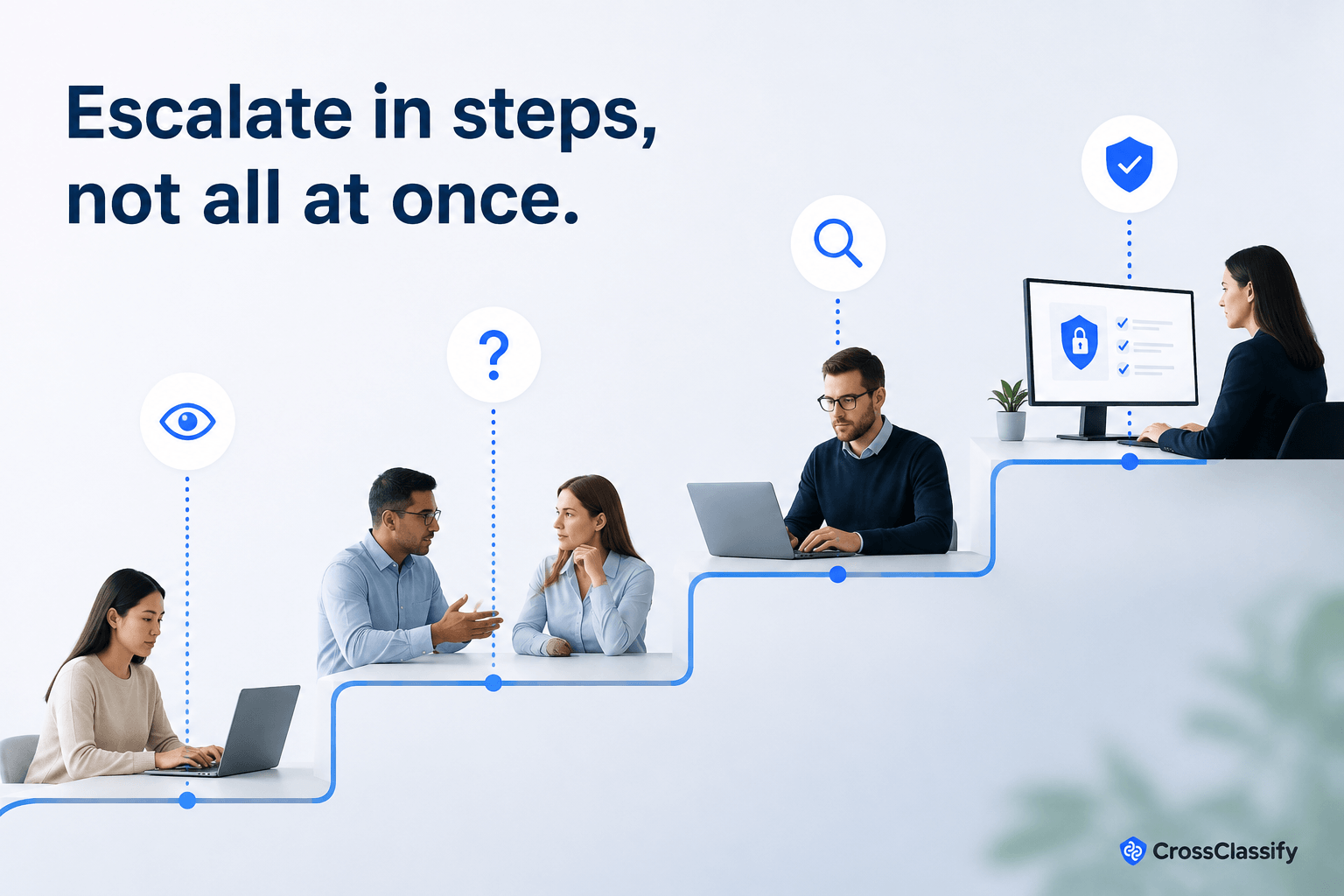
Guideline 9: Create a clear escalation model
The first level should be observation. Use it when one weak or explainable signal appears. Continue monitoring without interrupting the user. Observation should have a review condition so cases do not remain open indefinitely.
The second level should be clarification or account confirmation. Use it when the user can reasonably explain the condition or confirm control. Provide a clear request and avoid accusatory language.
The third level should be specialist review. Use it when several independent signals support concern or when the action creates greater potential impact. Group related accounts, devices, and events into one case.
The fourth level should be controlled response. Use temporary limits, permission changes, session revocation, or other actions defined by platform policy. Stronger and more permanent actions require stronger evidence and documented human review.
| Level | When to use it | Example | Response |
|---|---|---|---|
| Observe | One weak or explainable signal | One new device with normal activity | Continue monitoring |
| Clarify | A specific issue can be resolved by the user | Recent contact change or conflicting date | Ask one clear question |
| Review | Several independent signals align | Shared device, repeated behavior, and connected accounts | Open a specialist case |
| Control | Human review confirms a policy issue | Coordinated account misuse or compromised access | Apply the documented platform action |
Recommended status language
| Avoid | Use instead |
|---|---|
| Fraudulent candidate | Platform action completed |
| Suspicious employer | Employer account review in progress |
| Invalid application | Clarification required |
| Dangerous device | Device activity under review |
| Confirmed identity | Account verification completed |
Do this now
Review your strongest automated action. Confirm that the evidence requirement, approval process, user communication, and recovery path are documented.
Guideline 10: Establish daily, weekly, and monthly routines
The daily routine should focus on active risk. Review high impact cases, queue delays, new connected clusters, account takeover alerts, suspicious listings, and candidate reports. Group related events before assigning investigation.
The weekly routine should focus on quality. Sample cleared and confirmed cases, compare reviewer decisions, examine candidate friction, and review recruiter feedback. Update guidance when teams interpret similar evidence differently.
The monthly routine should focus on trends and governance. Review recurring devices, bot methods, account creation patterns, messaging incidents, assessment cases, and data access concerns. Confirm that each signal still serves its approved purpose.
Every routine should produce an operational action. Teams may update thresholds, revise reviewer guidance, improve user communication, close product gaps, or add monitoring around a vulnerable stage. Reporting without change creates limited value.
| Frequency | Main focus | Key activities | Expected result |
|---|---|---|---|
| Daily | Active risk and delays | Triage cases, group activity, and resolve urgent exposure | Faster protection and queue movement |
| Weekly | Decision quality | Sample cases, compare reviewers, and examine friction | More consistent outcomes |
| Monthly | Trends and governance | Review recurring methods, signal quality, and policy | Updated controls and priorities |
| Quarterly | Program effectiveness | Review ownership, integrations, metrics, and user impact | Strategic improvement |
| Daily check | Purpose |
|---|---|
| Review overdue integrity cases | Prevent unnecessary candidate and recruiter delays |
| Group connected accounts and devices | Reduce duplicated investigation |
| Prioritize sensitive actions | Focus attention on the greatest potential impact |
| Update recruiter and support statuses | Keep operational teams informed |
| Record confirmed and cleared outcomes | Improve future rules and models |
Integrating the guideline into existing systems
Begin with the events that create the greatest potential impact. Employer signup, candidate signup, account recovery, application submission, first messaging, assessment access, and candidate data export are practical starting points. Teams do not need to monitor every event immediately.
Collect device and behavior context through the appropriate web or mobile integration. Send account and business events through APIs so the risk layer understands what action is occurring. Return risk reasons and operational context rather than exposing raw technical attributes to every team.
Route the result according to the risk type. Account takeover can enter a security workflow. Candidate or employer onboarding concerns can enter trust review. Bot activity can enter fraud operations, while recruiters receive only the status information relevant to their work.
CrossClassify supports web JavaScript, iOS, Android, Flutter, and API based integration. Teams can review how CrossClassify integrates with web and mobile applications when deciding how risk events should connect with existing applicant, recruiter, support, and security systems.
Integration planning table
| Implementation stage | Event to connect | Risk context needed | Destination workflow |
|---|---|---|---|
| Stage 1 | Candidate and employer signup | Device, behavior, network, and relationships | Account opening review |
| Stage 2 | Login and recovery | Device continuity, behavior change, and session risk | Security or account protection |
| Stage 3 | Application and messaging | Velocity, automation, account relationships, and communication context | Fraud and trust review |
| Stage 4 | Assessment and data access | Continuity, automation, permissions, and export activity | Assessment, security, or privacy workflow |
Practical integration sequence
First, select one high impact event, such as employer signup or account recovery.
Second, define the signals required to evaluate that event and the team that owns the outcome.
Third, connect the event with the risk layer and return an explainable status or reason code.
Fourth, route the result into the existing review system rather than creating an isolated dashboard.
Fifth, measure false reviews, response time, and user friction before adding more events.
Measuring recruitment integrity
Measure confirmed outcomes rather than the number of alerts. Useful measures include confirmed fake accounts, account takeover cases, automated submission clusters, review time, verification completion, and repeated incident reduction. High alert volume may also indicate noisy controls.
Measure user friction. Track candidate abandonment, employer onboarding delays, recruiter restrictions, support contacts, and false reviews. Strong integrity controls should reduce harm without making the platform difficult for trusted users.
Measure operational consistency. Similar evidence should lead to similar outcomes unless the business context differs. Review disagreements can reveal unclear policy, missing evidence, or training gaps.
Measure marketplace value. Determine whether recruiters spend less time on repeated suspicious activity, candidates receive safer communication, and employers experience fewer impersonation or access incidents. CrossClassify supplies risk context, while the recruitment platform records operational and business outcomes.
| Metric | What it measures | Desired direction |
|---|---|---|
| Confirmed account abuse rate | Precision of account review | Maintain useful precision |
| Time to contain high impact incidents | Operational response speed | Decrease |
| False review rate | Unnecessary friction for trusted users | Decrease |
| Repeated device or account cluster rate | Recurrence of coordinated activity | Decrease |
| Candidate and employer support contacts | Clarity and friction in review workflows | Decrease |
| Recruiter time spent on low trust activity | Operational impact on hiring teams | Decrease |
Measurement review questions
Are controls reducing repeated incidents or only creating more alerts?
Are genuine candidates or employers experiencing unnecessary delay?
Do reviewers understand why each event was escalated?
Are connected accounts grouped into operational cases?
Are recruiters spending less time on platform integrity concerns?
A thirty day implementation plan
During the first five days, map the full recruitment journey and identify the actions with the greatest potential impact. Record current evidence, owners, and response processes for each stage.
During days six through ten, define the risk categories and escalation levels. Create clear distinctions between observation, clarification, specialist review, and controlled action. Assign decision owners and document the required evidence.
During days eleven through twenty, test the guideline with historical cases. Include legitimate shared devices, fake account networks, account recovery incidents, automated applications, messaging abuse, and candidate data access concerns. Compare decisions across teams.
During days twenty one through thirty, connect a limited set of events and launch a controlled pilot. Begin with signup, login, recovery, application submission, and one sensitive employer action. Measure review speed, false reviews, user friction, and confirmed outcomes before expanding.
| Period | Main activity | Expected output |
|---|---|---|
| Days 1 to 5 | Map stages, impact, evidence, and owners | Complete recruitment integrity map |
| Days 6 to 10 | Define categories and escalation | Shared operational policy |
| Days 11 to 20 | Test historical cases | Consistent decisions and improved guidance |
| Days 21 to 30 | Launch a limited pilot | Measured outcomes and expansion priorities |
Conclusion
Recruitment integrity is a continuous workflow rather than one verification event. Risk can enter through account creation, access, applications, assessments, messaging, listings, and data use. Each stage needs controls that match its permissions and potential impact.
The practical approach is to map the journey, define available evidence, assign ownership, and use proportionate escalation. Device, behavior, network, bot, identity, and relationship signals become useful when reviewers understand what happened and which action is appropriate.
CrossClassify helps recruitment platforms create a shared fraud intelligence layer across these stages. Its SDKs, APIs, account protection, bot detection, device fingerprinting, behavioral biometrics, and link analysis can support existing operational workflows.
Human judgment remains central. Recruiters decide candidate suitability, specialist teams review integrity concerns, and the platform controls verification and final actions. This creates safer recruitment workflows without turning fraud detection into an automated hiring authority.
See How CrossClassify Protects Recruitment Platforms
Detect fake recruiters, fraudulent resumes, and job scams instantly

Check a CV for Fraud Signals in 60 Seconds
Upload any resume and get an instant risk score, flagged signals, and a recruiter-ready action checklist.
Try the CV Risk CheckerNo credit card required
Share in
Related articles


Frequently asked questions
Let's Get Started
Create your free
account today
Discover how to secure your app against fraud using CrossClassify
No credit card required