Last Updated on 27 Sept 2026
CV Contact Extraction for LinkedIn Recruiters: What It Actually Solves
Share in

Introduction
Candidate contact details are often easy to recognize but inefficient to process at scale. An individual recruiter can open one resume, locate an email address or phone number, and copy it into a spreadsheet or recruiting system within seconds. When the same actions must be repeated across dozens or hundreds of CVs, however, the workflow becomes a recurring administrative burden that takes time away from qualification review, candidate communication, and hiring decisions.
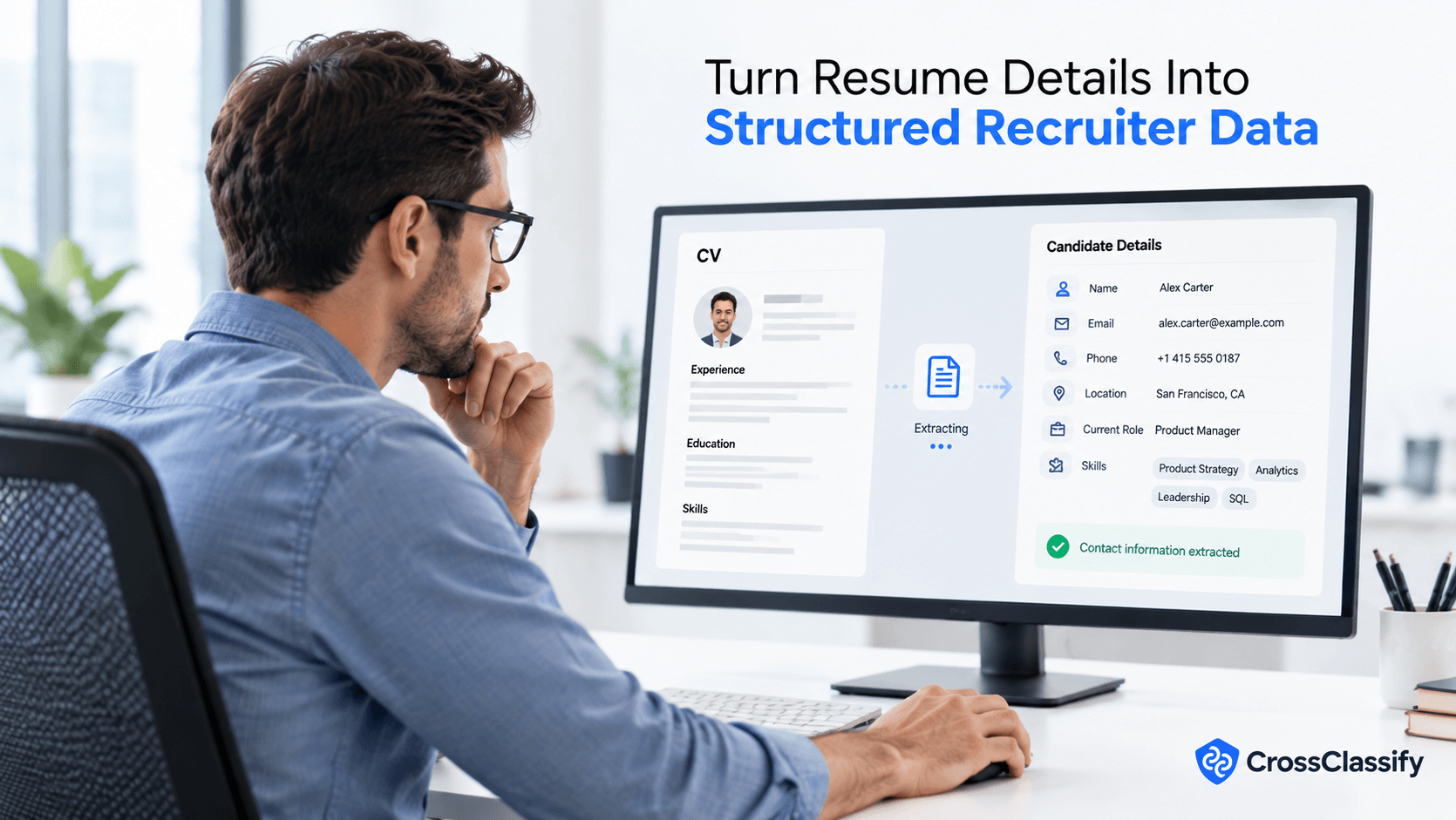
CV contact extraction addresses this problem by identifying information already written in a candidate's resume and converting it into structured fields. The source may be a PDF or DOCX file, while the output may include an email address, phone number, LinkedIn URL, or another professional profile link. The purpose is not simply to display text that a recruiter could eventually find manually; it is to make candidate-provided information easier to review, associate with the correct person, and export for later use.
This workflow should not be confused with contact enrichment. During sourcing, a recruiter may identify a professional on LinkedIn but lack an email address or phone number for outreach. Contact-enrichment products such as ContactOut and SignalHire are designed to help retrieve additional information from external sources. Resume contact extraction begins from a different point: the candidate has already provided a CV, and the recruiter needs to structure the details contained within it.
CrossClassify CV Risk Checker for LinkedIn focuses on this document-processing stage. When readable resume text contains contact details, the extension can extract those details while the recruiter reviews candidates and can include them in a structured Excel export. This article explains the operational problem that resume contact extraction solves, how the CrossClassify extension supports the workflow, where its limitations begin, and how it differs from tools built primarily for external candidate discovery.
What Is CV Contact Extraction for Recruiters?
CV contact extraction is the process of identifying contact information within a candidate's resume and converting it into structured recruiter data. Rather than leaving every detail embedded in a document, an extraction workflow separates useful fields such as email addresses, phone numbers, LinkedIn URLs, and portfolio links so that recruiters can review or export them more efficiently. The process is sometimes included within broader resume parsing, but its immediate purpose is narrower: making candidate contact information usable without repeated manual copying.
This matters because resumes are written for human readers rather than organized like databases. Candidates choose different templates, column structures, labels, fonts, and positions for their contact details. One person may place an email address and phone number below their name, another may use a narrow sidebar, and another may group LinkedIn, GitHub, and portfolio links in a footer. Recruiters understand these variations visually, but software must still identify which strings represent contact fields and connect them to the correct candidate record.
The value of extraction becomes clearer when recruiters process applications in volume. Opening a document is not difficult, and neither is recognizing a familiar email format. The cost comes from repeating the sequence across an entire candidate pipeline: opening each CV, locating the relevant details, copying them accurately, placing them in the correct record, and checking that the information was not assigned to another candidate. Recruitment tools increasingly aim to reduce this kind of manual transfer; for example, BrightMove describes parsing resume information into structured recruiting data.
Successful extraction should preserve the meaning of the source document. If a candidate supplied an email address but no phone number, the structured output should show the available email and leave the phone field empty. It should not silently add a value from another database, because that would turn document extraction into enrichment and make the origin of the information unclear.
Why Recruiters Still Copy Contact Information From CVs Manually
Many recruiting environments already contain candidate details in an application form, applicant tracking system, or LinkedIn Recruiter workflow, but the information is not always complete or consistently connected to the resume under review. In some cases, the CV is the most direct source of the candidate's preferred contact details. Recruiters therefore return to the document to confirm an email address, find an international phone number, or locate a professional link that was not captured elsewhere.
Document variation is one reason the task remains manual. A resume can contain multiple numbers, email-like strings, or URLs that do not all belong to the candidate. A previous employer's address may appear in work history, a referee's email may appear near the end of the document, and project descriptions may contain external links. Reliable contact extraction must consider context instead of assuming that the first matching string is the correct field.
Workflow fragmentation creates another problem. Recruiters may review a candidate in one interface, open the CV in another view, keep shortlists in a spreadsheet, and record progress in an ATS or CRM. Even when the contact details are easy to find, switching between these surfaces and transferring fields creates opportunities for omissions, duplicates, and candidate-record mismatches. Manual extraction therefore affects more than speed; it can also reduce the consistency of the information used throughout the hiring process.
Contact extraction is most useful when it removes this repeated movement of data. The goal is not to replace recruiter judgment about whether a candidate should progress. It is to handle a predictable administrative step so that recruiters can spend more time evaluating experience, reviewing job relevance, communicating with applicants, and making decisions that require human context.
CV Contact Extraction vs Contact Enrichment: What Is the Difference?
CV contact extraction and contact enrichment can both produce an email address or phone number, but they solve different problems and use different sources. Extraction starts with a candidate document that already contains information. Enrichment starts with an incomplete person or profile record and searches for additional information that the recruiter does not currently have. Evaluating the two categories only by their final output can therefore lead recruiters to select a tool that does not match the stage of their workflow.
Contact enrichment supports candidate sourcing
Contact enrichment is useful when a recruiter has identified a potential candidate but does not yet have a direct communication channel. The person may not have applied, submitted a CV, or provided contact details to the hiring organization. In this situation, the recruiter's task is discovery: finding professional contact information that can support initial outreach.
Platforms in this category rely on profile information and external data sources rather than candidate-submitted resumes. ContactOut, describes its Chrome extension as a way to find emails and phone numbers while browsing LinkedIn whereas SignalHire provides contact lookup across supported professional and social profiles. These capabilities are suited to passive sourcing, outbound recruiting, and talent-pipeline development because they help a recruiter move from identifying a person to contacting that person.
ContactOut is primarily associated with revealing contact details during LinkedIn sourcing and moving sourced records into outreach, ATS, or CRM workflows. SignalHire similarly retrieves available emails, phone numbers, and social links from supported professional profiles. hireEZ represents a broader recruiting platform category that can span sourcing, engagement, screening, and workflow management. These tools may coexist in a recruiting stack, but their starting point is different from processing contact details inside a CV that the recruiter already has.
CV contact extraction supports applicant processing
Resume contact extraction becomes relevant after a candidate document is available. The recruiter is not trying to discover an unknown person or create a new communication route from external data. Instead, the task is to locate and structure what the applicant has already submitted, even when those details appear in different positions or formats across multiple resumes.
The source distinction affects how recruiters interpret and manage the result. A phone number extracted from a submitted CV is candidate-provided application data, while a phone number returned by an enrichment provider comes from another source. Both may be operationally useful, but they should not be treated as interchangeable because their provenance, intended use, and data-management considerations differ.
Resume extraction is the stronger fit when candidates have entered the hiring process and their CVs are accessible. This is especially useful in high-volume review, where contact fields vary in placement and completeness but still need to remain connected to the correct candidate. The CrossClassify CV Checker extension supports this stage by structuring available CV contact details alongside other candidate-review results and export fields.
Contact enrichment is the better fit when no CV exists and the recruiter needs to discover a communication route for a passive candidate. The categories can be used in sequence: enrichment may support initial outreach, while extraction becomes useful after a resume is submitted. The source of each contact field should remain distinguishable throughout that journey.
Practical Limitations of CV Contact Extraction
CV contact extraction depends on the document content being accessible and readable. A digitally generated PDF or supported DOCX file may expose text that can be analyzed, while a scanned or image-only resume may not. If the system cannot access meaningful text, it cannot reliably determine whether a contact field is missing or simply hidden inside an unreadable image.
Document layout and content can also create ambiguity. A resume may include multiple email addresses, telephone numbers associated with referees, URLs within project descriptions, or decorative elements that interfere with text order. Extraction results should therefore be reviewed when the source document is unusual or when several possible values appear. Automation can reduce repetitive work, but it should not encourage recruiters to assume that every detected string is correct without regard to context.
Missing fields must be handled transparently. When readable CV text contains an email address but no phone number, an empty phone field is an accurate result. Filling that space with a value from an external database would change the source of the data and could mislead recruiters about what the candidate actually submitted.
A CV contact extraction extension should consequently be evaluated as a document-processing workflow rather than an OCR recovery system or external contact-discovery service. Its value comes from organizing fields found in readable resume content, preserving missing information, and making the result easier to use during candidate review.
Why Export Matters After Contact Extraction
Displaying an extracted email address inside an extension solves only part of the recruiter's problem. If the recruiter must still copy every value into a spreadsheet or another candidate record, the manual workload has merely moved from the resume to the extension panel. Structured export is what allows extraction to produce a lasting operational benefit beyond the initial document review.
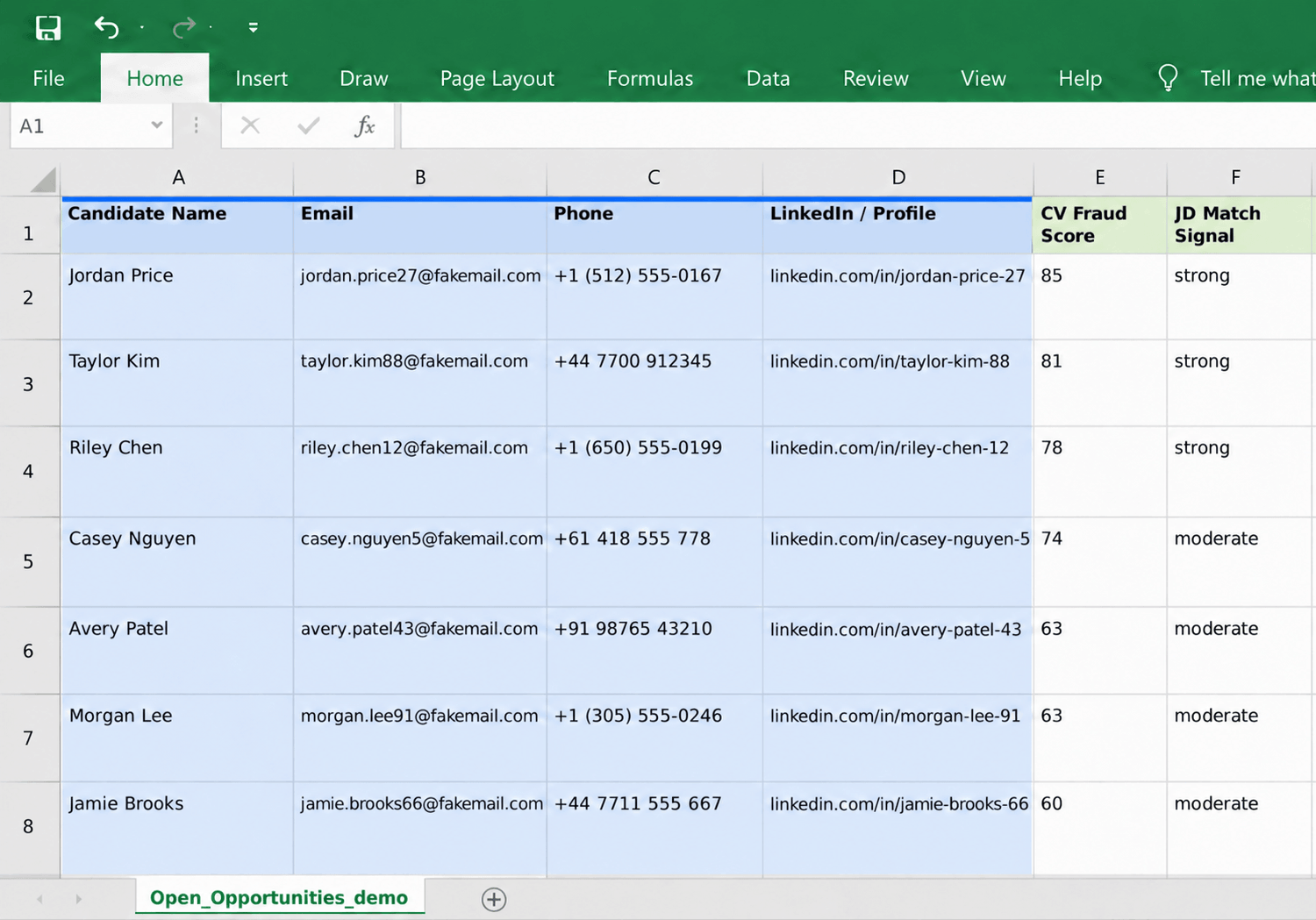
A useful extension should export extracted contact information with the candidate identifiers and review fields needed to interpret it. Keeping those outputs together reduces the risk that a phone number or email address becomes detached from the candidate to whom it belongs. It also gives recruiters a structured file that can support shortlisting, review, or transfer into an approved recruiting process.
Export does not remove the need for appropriate data governance or integration planning. Organizations should decide where the spreadsheet will be stored, who can access it, whether the fields need to be transferred into an ATS, and how duplicate records will be handled. Nevertheless, an exportable result is more practical than a temporary display because it allows the extraction step to connect with the recruiter's actual working process.
Candidate Contact Information Is Personal Data
Names, email addresses, phone numbers, and profile links are personal information, even when extracting them is technically straightforward. Recruitment organizations process this information throughout applications, interviews, communication, and candidate-record management. Automating one step does not remove the organization's responsibility to use, secure, retain, and share the data appropriately.
The UK Information Commissioner's Office explains that employers, recruiters, headhunters, consultancies, and similar organizations process candidate information during recruitment and selection and must consider their data-protection responsibilities. Its recruitment and selection guidance provides a useful regulatory reference for organizations reviewing these practices. Requirements vary by jurisdiction and organizational context, so recruiting teams should apply the policies and legal guidance relevant to their operations.
Data source should remain visible because it affects how a contact field is understood. A number taken from a submitted resume represents information the candidate included in the application, whereas a number returned through enrichment was obtained from another source. Recruiters should know where each value came from, why it is being processed, and whether it is necessary for the relevant recruitment purpose.
The same principle applies to exports. A spreadsheet containing extracted candidate contact information should be treated as a recruitment data asset rather than a casual working file. Access control, storage location, retention, deletion, and onward sharing should follow the organization's candidate-data policies.
What Recruiters Should Test Before Adopting a CV Contact Extraction Extension
Recruiters should test contact extraction with realistic resume samples rather than relying only on clean demonstration documents. A representative evaluation set should cover single-column and multi-column layouts, international phone formats, several types of profile URLs, missing contact fields, and documents containing more than one possible email address or phone number. Testing different supported formats also helps reveal whether the workflow behaves consistently across the files the organization receives most often.
Accuracy should be evaluated at the candidate-record level, not only by counting detected strings. A tool may recognize an email format correctly while still selecting a referee's address or associating the result with the wrong candidate. Recruiters should verify whether the extension identifies the candidate's own contact details, preserves their relationship to the source CV, and presents ambiguous or absent information transparently.
The next measure is operational impact. A technically accurate extraction feature provides limited value if recruiters must rebuild the output manually in another tool. Teams should examine whether the extension fits their actual review process, whether its Excel export contains the fields they need, and whether the result reduces document opening, copying, and record-matching work across a realistic batch of candidates.
Finally, recruiters should test failure states. Image-only documents, inaccessible files, malformed text, or resumes without contact information should not produce misleading values. A useful extension should make the difference between a missing field, an unreadable document, and a processing failure understandable so that recruiters know when manual review is required.
How CrossClassify Extracts Candidate Contact Information From CVs
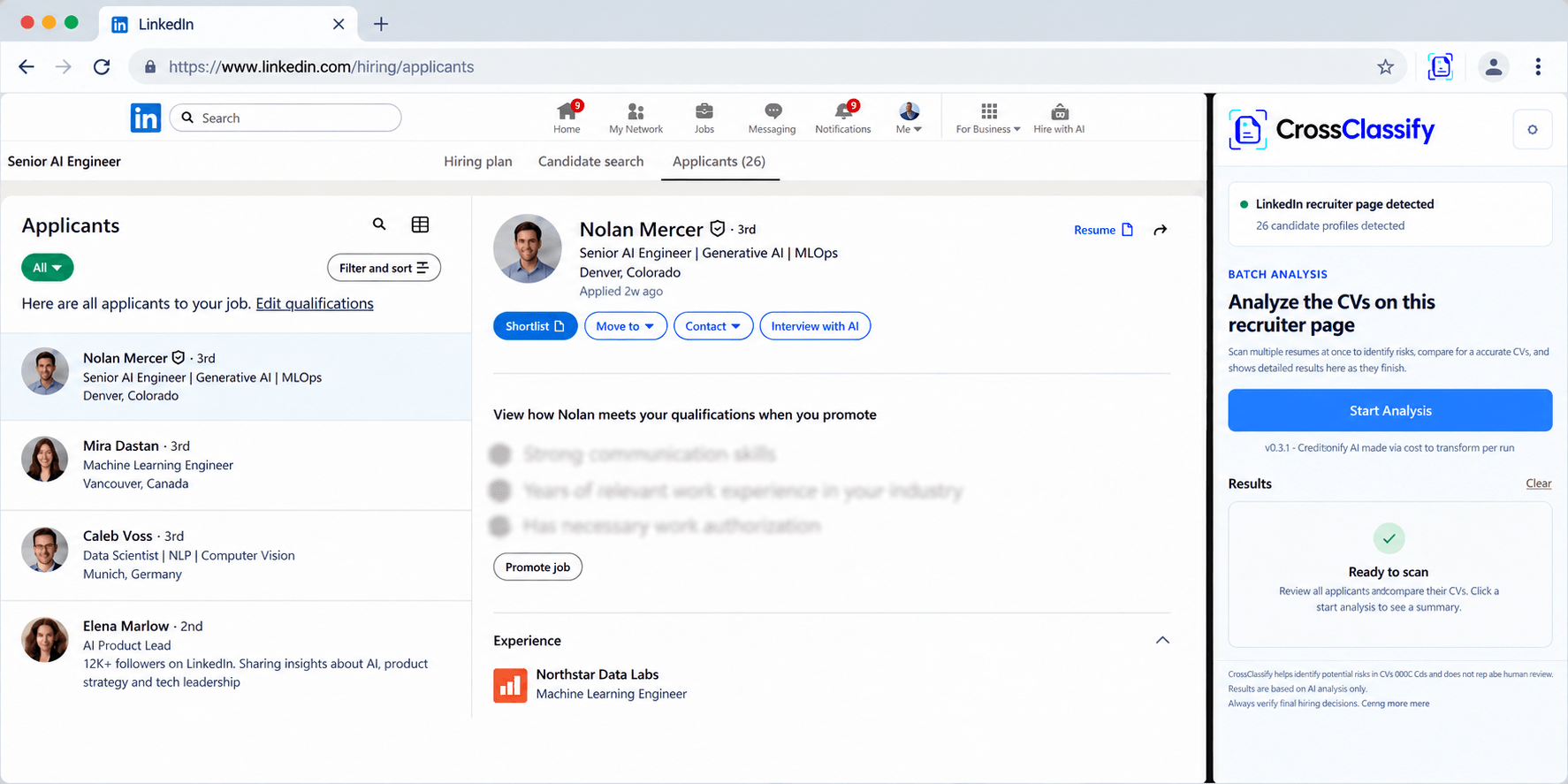
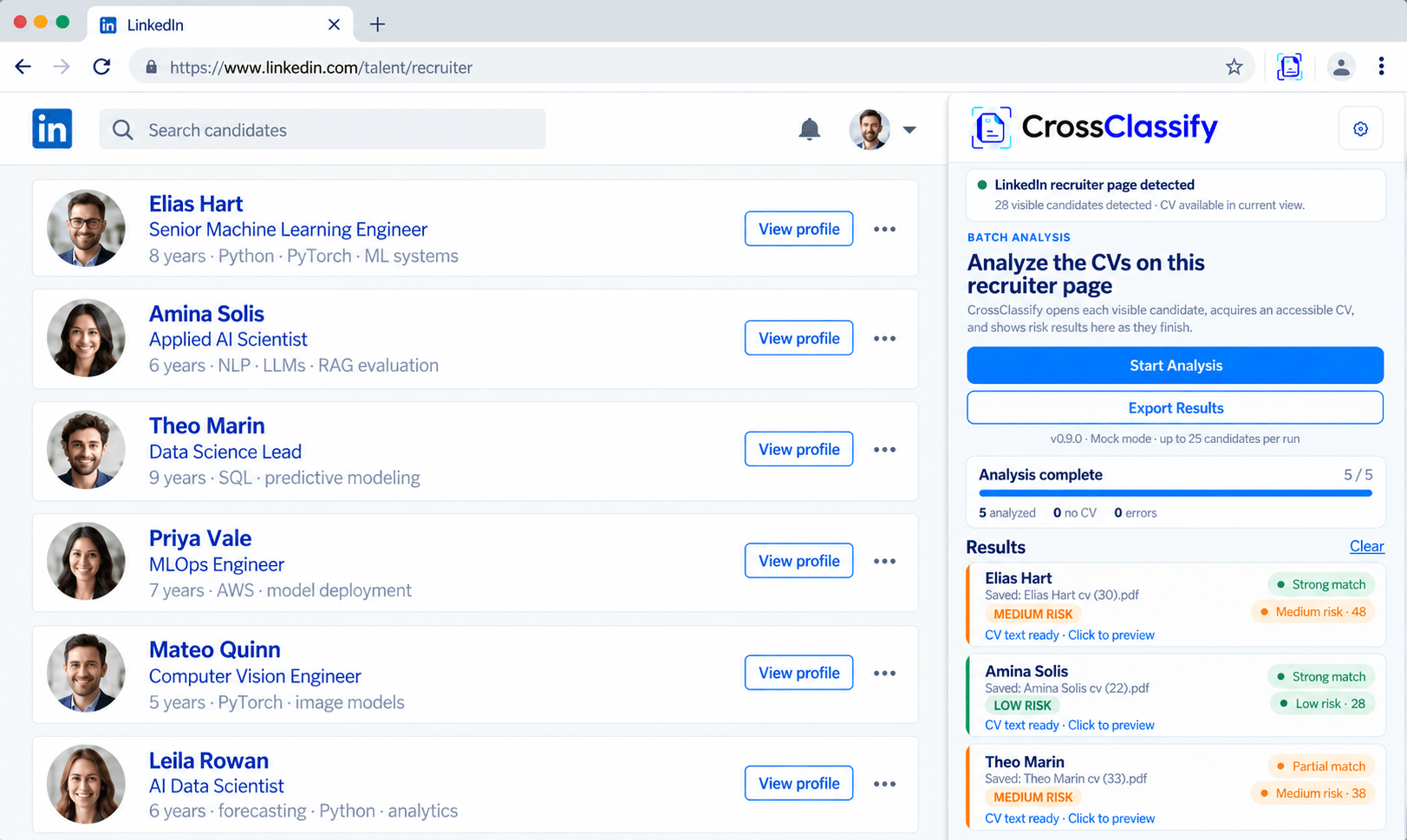
CrossClassify CV Checker for LinkedIn is designed for the applicant-review stage, where recruiters already have access to candidate profiles and resumes. It operates through a persistent Chrome side panel and works with accessible PDF or DOCX resumes exposed through the rendered recruiting interface. The extension does not rely on private LinkedIn APIs or attempt to discover contact information from an external database.
When the CV contains readable text, the extension can identify candidate-provided contact fields such as email addresses and phone numbers. The extraction begins with the resume itself, so the source of each value remains clear. If a contact field is absent, the extension keeps it missing instead of inserting an externally discovered value and presenting it as though the candidate supplied it.
The workflow also distinguishes between an absent field and an unreadable document. Text extraction is limited to readable content, with support for up to 12 PDF pages and 60,000 characters in the current workflow. Image-only PDFs are not treated as readable resumes because the extension is not an OCR recovery tool, while inaccessible files and processing failures are presented as separate states so recruiters know when manual review is required.
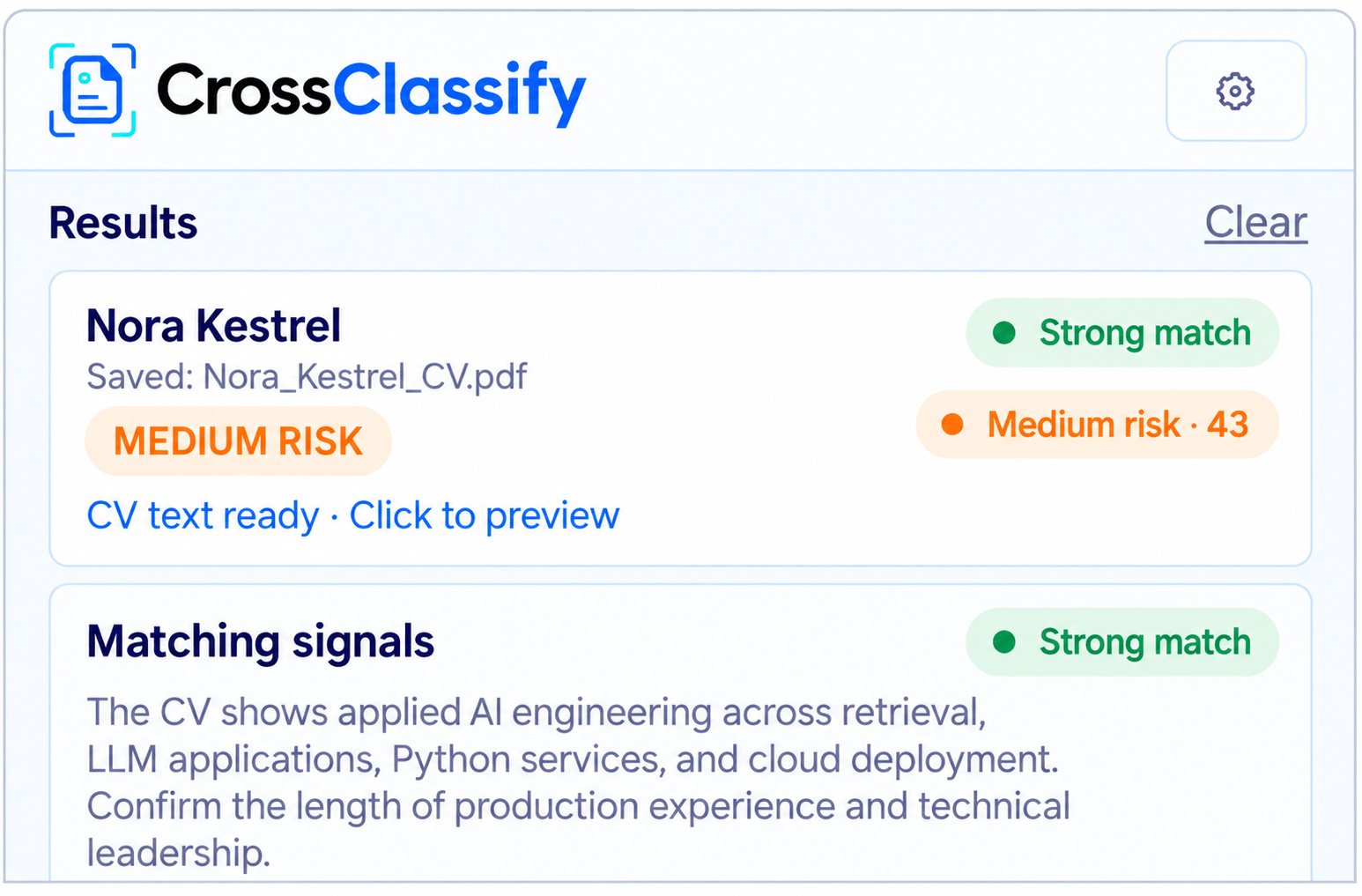
Contact extraction is part of a broader candidate-review process rather than an isolated lookup. The extension can combine extracted contact information with job description and resume match signals and CV risk analysis, allowing recruiters to review several types of candidate information without repeatedly reopening the same documents. This is where CrossClassify differs most clearly from extensions that primarily reveal external contact details during passive sourcing.
For higher-volume review, recruiters can process candidates sequentially, view progressive results, stop a scan when needed, and retain completed or partial results. The current workflow supports batches of up to 50 candidates and exports processed records to Excel. The export keeps candidate names and contact details with job description and resume match signals, risk results, CV filenames, document-read status, and local links for reopening the relevant CV, reducing the need to reconstruct candidate records manually after extraction.
CrossClassify should therefore be evaluated as a focused resume-processing extension rather than a replacement for a sourcing database, CRM, or applicant tracking system. Its purpose is to turn readable candidate documents into more usable review data while preserving the distinction between candidate-provided information and externally enriched information.
Simple Cross Extension Comparison
| FEATURE |  |  |  |  |
|---|---|---|---|---|
| Extract contact info | ||||
| Job description and resume match signals | ||||
| CV risk checking |
The “Extract contact info” row needs to be read in context because the same label covers different mechanisms. ContactOut and SignalHire generally use external contact-enrichment workflows when recruiters browse professional profiles and need information that is not visible in the current record. Their Chrome extensions are described as tools for finding or retrieving contact information from supported profiles and websites.
CrossClassify uses the label differently. Its extension extracts contact details from readable resume text when those details are present in the candidate's CV. The table therefore shows that all four products can help recruiters work with contact information, but it should not be interpreted as evidence that their data sources, recruitment stages, or surrounding capabilities are the same.
The additional rows show why workflow scope also matters. CrossClassify combines resume contact extraction with job description and resume match signals and CV risk checking, allowing recruiters to collect several types of candidate-review output from the same document-processing flow. A recruiter evaluating the products should consider the complete task they need to perform rather than choosing solely on whether a tool can return an email address.
Conclusion
CV contact extraction solves a specific but common recruiting problem: candidate contact information exists inside resumes, yet recruiters still spend time locating, copying, checking, and restructuring it. The benefit becomes significant when applications are processed at scale, because small repetitive actions accumulate across the hiring pipeline. A useful extraction workflow turns candidate-provided details into structured fields while preserving their connection to the original resume.
CrossClassify CV Risk Checker supports this use case by extracting available contact details from readable CV text and including them in a broader candidate-review workflow. Recruiters can work with email addresses, phone numbers, and profile links alongside other outputs such as job description and resume match signals and CV risk checking, then export processed results to Excel. The extension's role is to reduce document-handling work after a resume is available, not to function as an external contact database.
ContactOut, SignalHire, and other enrichment tools remain relevant when recruiters need to reach passive candidates who have not submitted applications. Their purpose is contact discovery during sourcing, whereas CrossClassify's contact extraction capability organizes information already present in a candidate's CV. Understanding this difference helps recruiting teams select the appropriate tool for each stage instead of treating every product that displays an email address as though it solves the same problem. Recruitment teams can explore the CrossClassify CV Checker extension to understand how the extension's document-review capabilities fit within a wider recruitment-security approach.
Review More CVs Without Repeating the Same Comparison
Use structured positive and negative job description match signals to move through candidate reviews with less repetitive comparison.
Explore CrossClassify today
Detect and prevent fraud in real time
Protect your accounts with AI-driven security
Try CrossClassify for FREE—3 months
Share in
Related articles


Frequently asked questions
Let's Get Started
Create your free
account today
Discover how to secure your app against fraud using CrossClassify
No credit card required