Last Updated on 28 Jun 2026
Bonus Abuse Best Practice Checklist: Fraud Risks to Plan Before Campaign Launch
Share in
Introduction
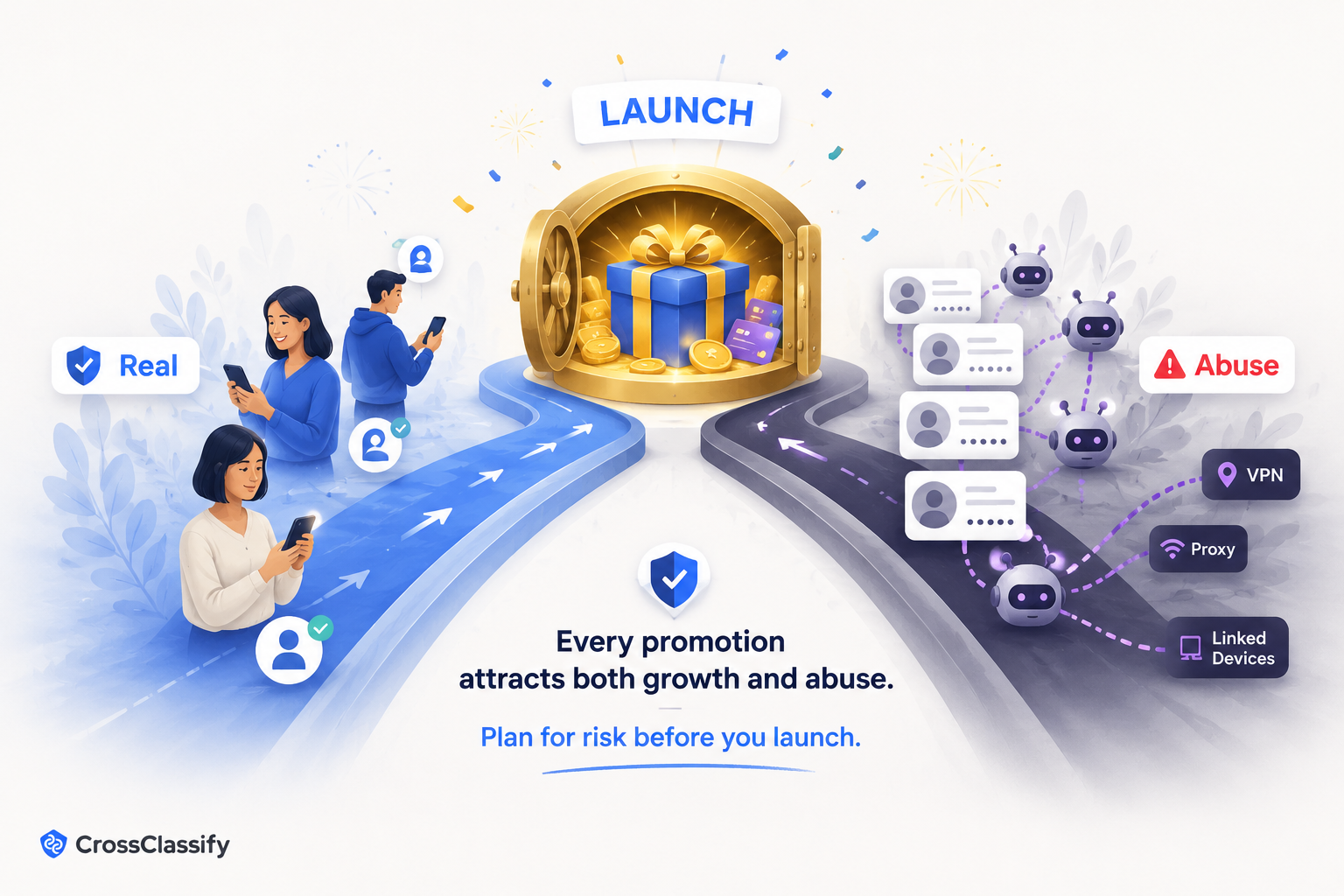
Bonus abuse prevention works best before the campaign goes live.
Many companies launch signup bonuses, referral rewards, promo codes, free credits, cashback offers, or loyalty incentives with clear marketing rules. They know the audience, the offer, the budget, and the expected conversion path.
But they may not have clear fraud rules.
That gap creates risk. A campaign can attract real users and abusive users at the same time. Some users may create fake accounts. Some may refer themselves. Some may use bots, VPNs, proxies, emulators, or repeated devices. Some may claim value quickly, withdraw it, refund it, transfer it, or disappear.
A bonus abuse best practice checklist helps growth, fraud, product, finance, support, and operations teams prepare before promotional value is exposed. The goal is not to block every suspicious user automatically. The goal is to understand risk before campaign spend becomes loss.
Why Bonus Abuse Best Practices Matter Before Launch
Promotional campaigns are designed to remove hesitation. A new user is more likely to try a product when there is a welcome credit. A customer is more likely to invite others when there is a referral reward. A shopper is more likely to complete checkout when there is a promo code.
That is the business value.
The risk is that incentives create a reason for abuse. Fraudsters do not need to break the product. They only need to exploit the rules of the campaign.
For business leaders, bonus abuse is not only a fraud problem. It affects customer acquisition quality, campaign ROI, finance planning, customer support, product trust, and the accuracy of growth reporting.
A campaign may look successful if signups increase. But if many of those signups are fake, repeated, automated, or connected, the company is paying for activity that does not represent real demand.
Bonus abuse best practices help teams ask better questions before launch:
- Who is eligible for the reward?
- When should the reward be released?
- Which actions should increase risk?
- Which accounts should be reviewed first?
- What evidence should support teams see?
- What happens if suspicious users dispute the decision?
- How will the team detect connected accounts?
- How will the team monitor abuse after the reward is claimed?
These questions should be answered before the campaign scales.
The Main Fraud Risks to Plan For
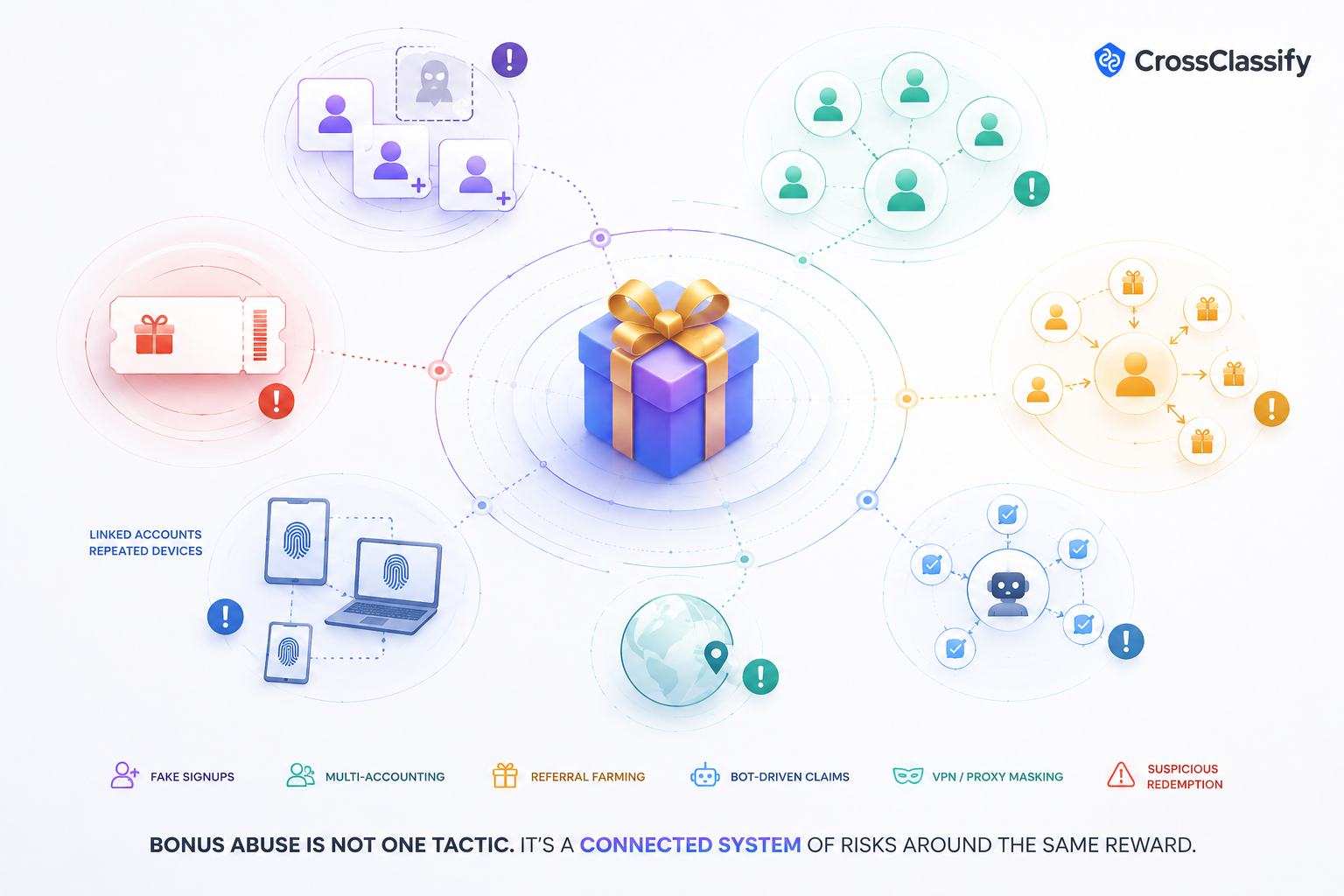
Bonus abuse can appear in different forms depending on the business model, reward type, user journey, and payout method.
Fake signup abuse
Fake signup abuse happens when users create new accounts only to claim a bonus, free credit, coupon, or first action reward. These accounts may never become real customers.
This is especially risky when the reward can be used quickly or converted into financial value.
Multi accounting
Multi accounting happens when one person or group controls many accounts. Each account may use a different email, phone number, name, or network, but the accounts may still share device, behavior, referral, or timing patterns.
Static rules often miss multi accounting because each account can look different in isolation.
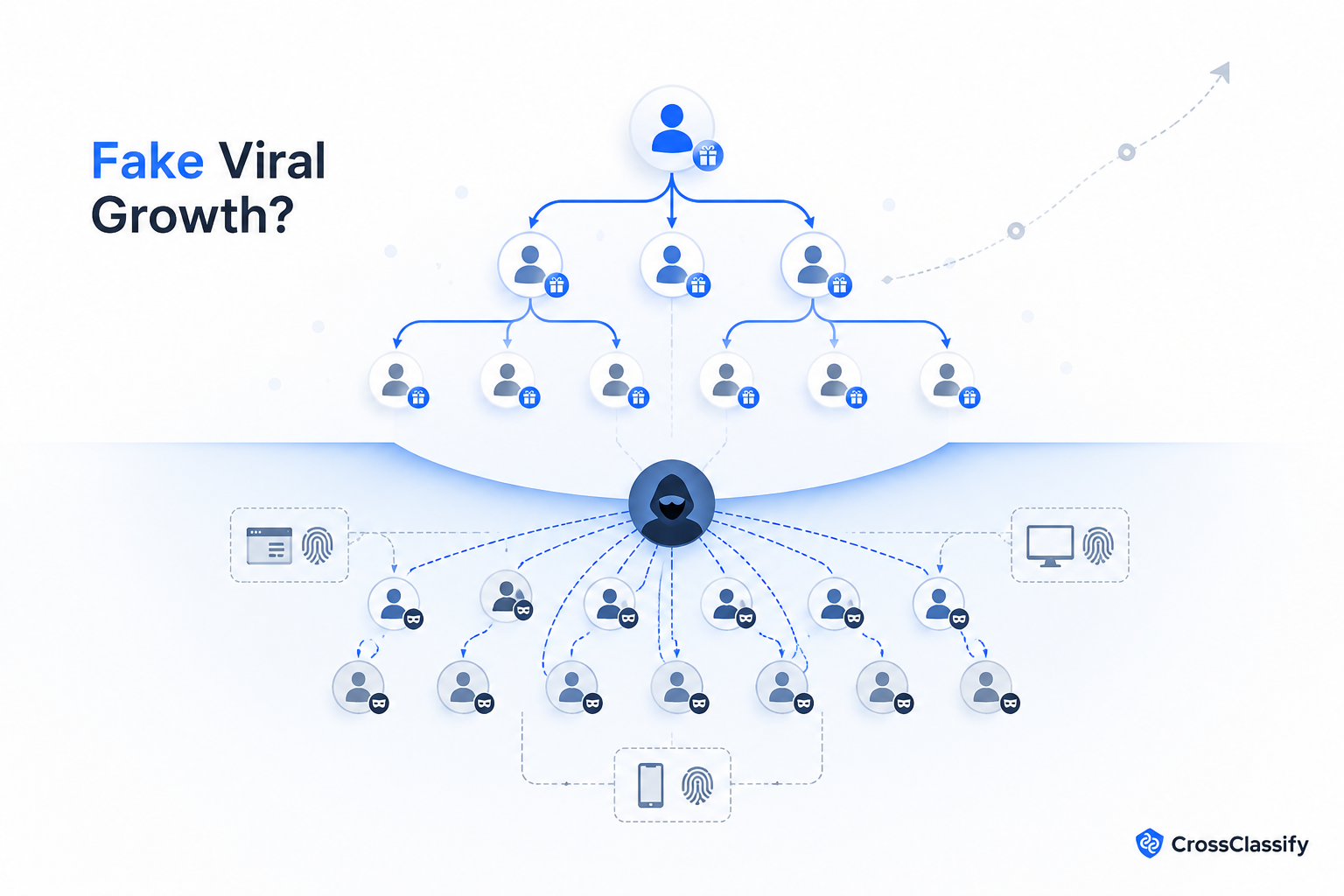
Referral farming
Referral farming happens when users create or control account networks to manufacture referral rewards. The campaign dashboard may show growth, but the business is paying for artificial relationships.
Referral abuse is usually a connected account problem, not only a single user problem.
Bot driven bonus abuse
Bots can create accounts, test promo codes, submit forms, claim rewards, and move through simple workflows faster than manual teams can review.
Bot driven abuse is especially dangerous when campaigns are public, high value, or easy to repeat.
VPN and proxy abuse
VPNs, proxies, hosting networks, and region changes can hide repeated users or make users appear eligible for offers they should not receive.
Network signals alone are not enough, but they can become useful when combined with device, behavior, and account relationship signals.
Device reuse
Repeated device patterns are often a strong clue that many accounts may be controlled by the same person or group.
Device intelligence can help reveal abuse even when emails, phone numbers, names, and IP addresses change.
Suspicious reward redemption
A reward claim may not look suspicious until the user redeems value. Fast redemption, immediate withdrawal, quick transfer, refund requests, or no meaningful product use can all be warning signs.
Refund or withdrawal abuse
Some users claim a reward, place an order, request a refund, withdraw value, or move funds out quickly. This turns bonus abuse into a direct financial loss.
Teams should monitor what happens after the claim, not only before it.
Bonus Abuse Best Practice Checklist
1. Define the protected value
Start by defining what the business is protecting.
A small discount may need light monitoring. A withdrawable credit, high value referral reward, cashback offer, wallet bonus, or loyalty payout may need stronger review.
Ask:
- What is the reward worth?
- Can it be withdrawn, transferred, refunded, resold, or converted into cash value?
- Can one user claim it more than once?
- Can the reward be abused before the team notices?
The higher the value and the easier the reward is to monetize, the stronger the fraud controls should be.
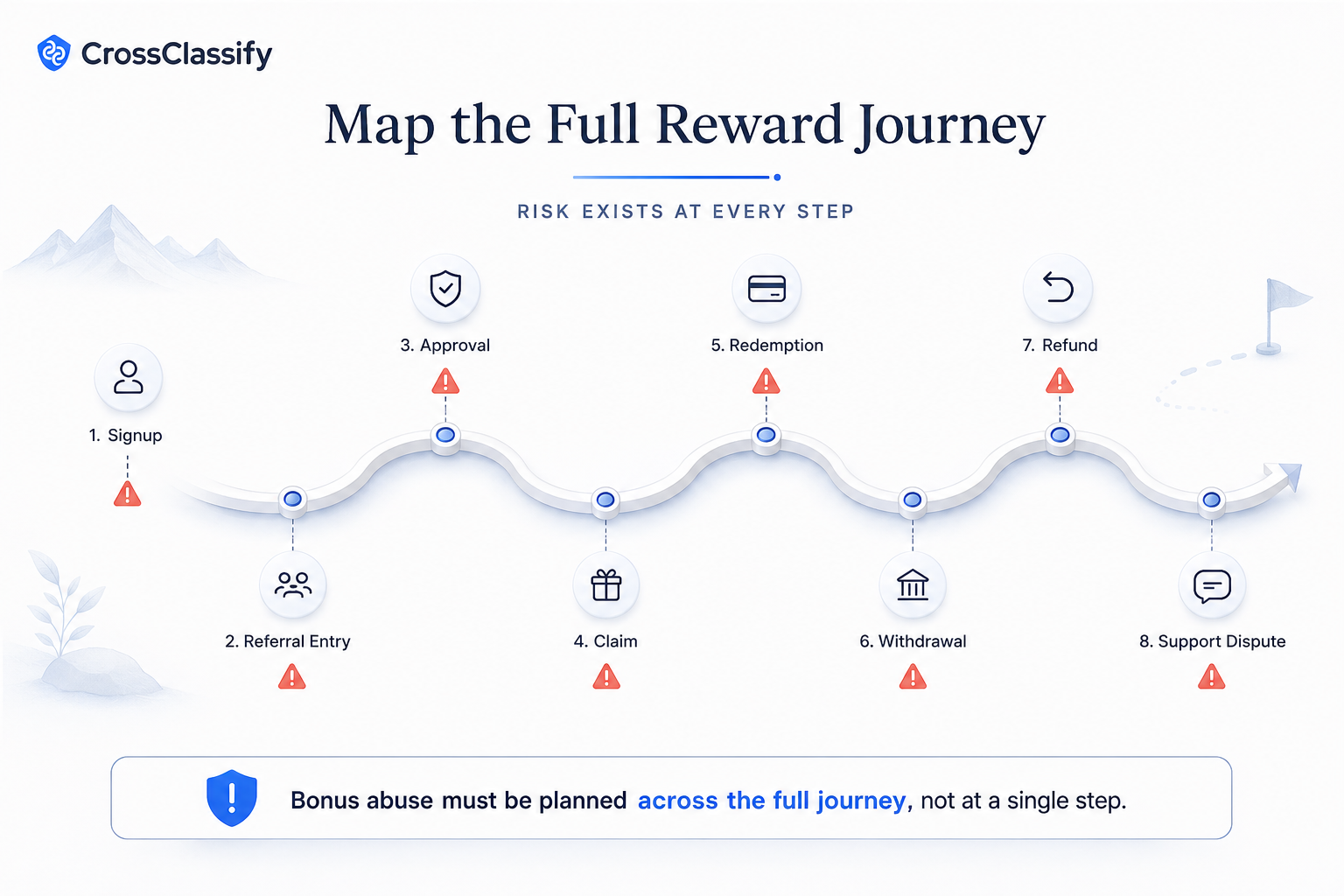
2. Map the full reward journey
Bonus abuse does not happen at one moment.
It can start at signup, continue through login, appear during eligibility checks, and become visible after redemption.
Map the full journey:
- Signup
- Login
- Referral code entry
- Promo code entry
- Eligibility check
- Reward approval
- Reward claim
- Redemption
- Order placement
- Withdrawal
- Transfer
- Refund
- Support request
- Post claim account activity
This helps teams understand where risk should be measured and where action should happen.
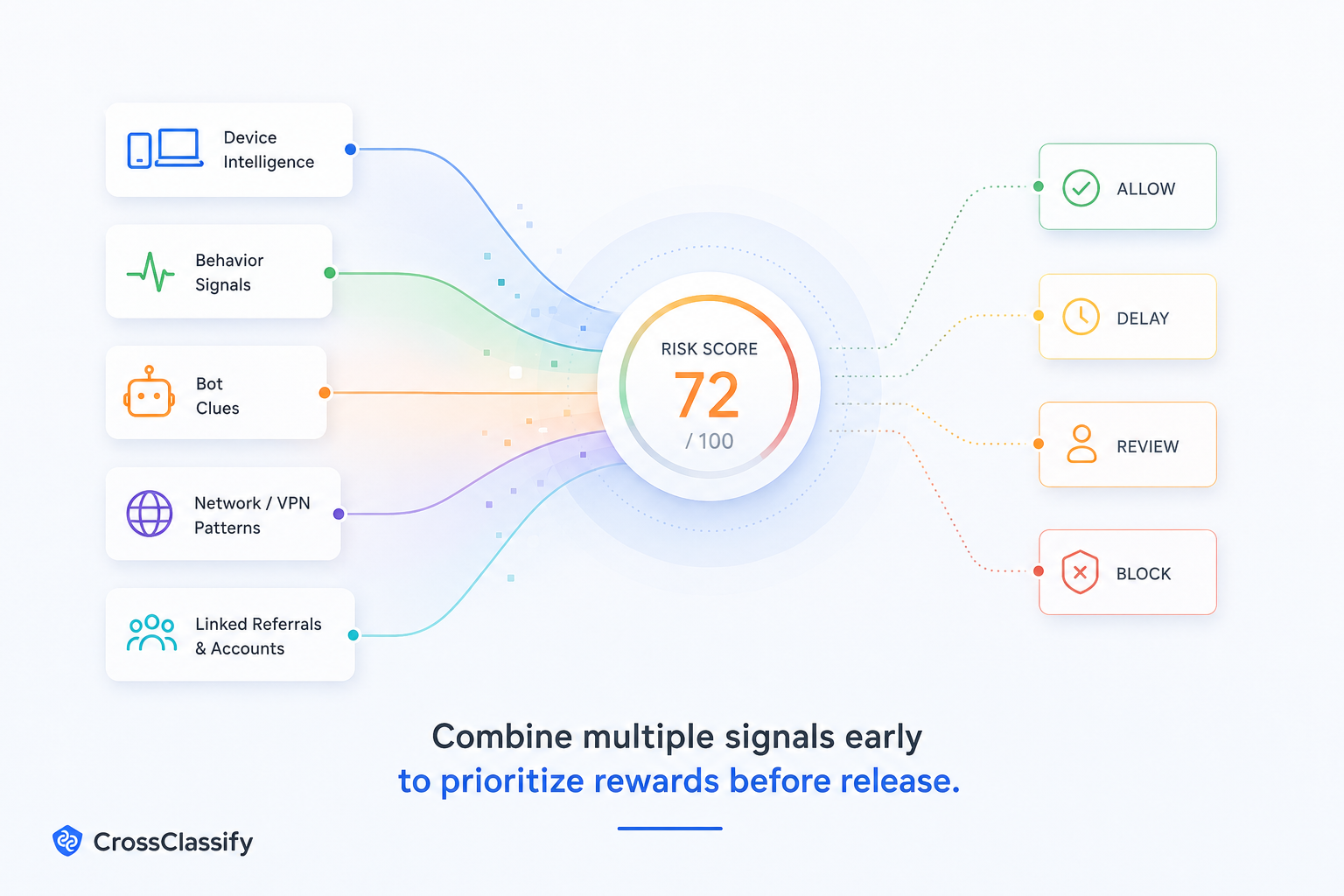
3. Collect device and behavior signals early
Many teams wait until checkout, withdrawal, or refund to investigate abuse. By then, the campaign may already be leaking value.
Collecting device and behavior signals early helps teams identify suspicious accounts before rewards are approved.
Useful signals can include device consistency, browser patterns, session behavior, form completion speed, repeated environments, unusual interaction patterns, and suspicious journey timing.
When repeated devices or suspicious browser patterns matter, device fingerprinting can help teams connect activity across accounts and sessions. This gives fraud teams better context before deciding whether a claim should be trusted, reviewed, delayed, or escalated.
4. Detect bots before reward approval
Bots can create fake accounts, test coupon logic, submit referral forms, and claim rewards at scale.
A campaign should not wait until after redemption to ask whether the user looked automated.
Teams should monitor unusual speed, repeated form behavior, scripted patterns, abnormal session flows, and automated traffic clues before approving value.
When scripted activity is part of the risk, bot attack detection can help teams identify high risk automation around signup, claim, and redemption journeys. This matters because bot activity can turn a small campaign weakness into a large scale loss.
5. Watch referral relationships, not only single accounts
Referral abuse is often missed because teams review one account at a time.
A single account may look normal. A group of accounts may reveal the abuse.
Teams should monitor relationships between inviter and invitee accounts, shared devices, repeated behavior, similar signup timing, unusual reward paths, and clusters of accounts that claim value quickly.
The goal is to detect referral farming before the campaign rewards artificial growth.
6. Set risk based review thresholds
Not every suspicious signal should trigger the same action.
Teams should define review thresholds before launch. For example:
- Low risk accounts continue normally.
- Medium risk accounts may receive delayed rewards.
- High risk accounts may require review before reward approval.
- Very high risk accounts may be blocked, challenged, or escalated.
This approach protects trusted users from unnecessary friction while giving fraud teams a clear queue of accounts that deserve attention.
7. Delay or review high risk rewards before release
Many bonus abuse losses happen because value is released too quickly.
If an account shows multiple risk signals, the reward can be delayed until review. This is often better than approving instantly and trying to recover value later.
Delay rules should be clear, fair, and explainable. Support teams should understand why a reward was delayed and what evidence supports the decision.
8. Prepare support evidence for disputed rewards
Bonus abuse decisions often create support pressure.
A user may ask why a reward was delayed, rejected, or removed. Support teams need more than a vague fraud label.
Useful evidence can include repeated device patterns, connected accounts, abnormal behavior, suspicious referral relationships, bot signals, risky network patterns, or fast redemption behavior.
Clear evidence helps support teams respond consistently and reduces confusion between fraud, product, marketing, and operations teams.
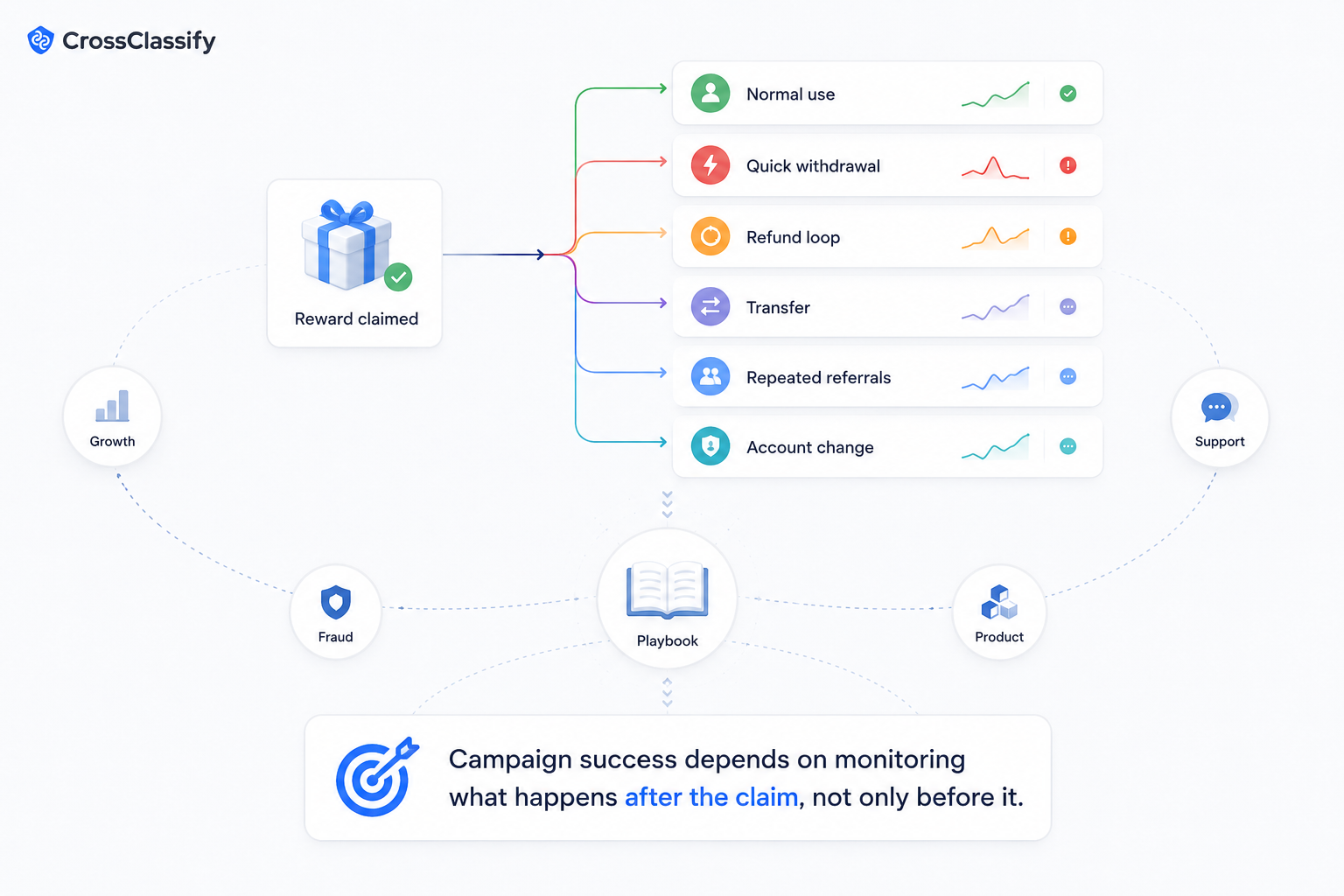
9. Monitor post claim behavior
A user may look safe at signup but become risky after receiving value.
Teams should monitor what happens after the reward is approved:
- Does the user immediately withdraw value?
- Do they request a refund quickly?
- Do they abandon the account?
- Do they refer more accounts with similar patterns?
- Do they change account details after reward approval?
- Do they use the reward in a way that does not match normal customers?
For sensitive post login actions, account takeover protection can support a broader risk layer around account access, account changes, and high value actions. This matters because bonus abuse can continue after the first claim.
10. Review campaign quality after launch
Bonus abuse prevention does not end at launch.
Teams should review campaign quality after the first wave of users arrives. Look at suspicious signup rates, referral clusters, device repetition, claim speed, redemption patterns, refund behavior, support disputes, and long term customer quality.
This helps growth teams understand whether the campaign is producing real users or attracting abuse.
The best campaigns are not only high volume. They produce users who continue to engage, transact, and behave like legitimate customers.
What Usually Goes Wrong Without Bonus Abuse Best Practices
The most common mistake is launching with marketing logic but not risk logic.
The team knows the offer.
The team knows the budget.
The team knows the landing page.
The team knows the target audience.
The team knows the conversion goal.
But the team may not know what a suspicious claim looks like.
That creates several problems.
Fraud teams react after the loss. Growth teams may count fake users as success. Finance teams may see campaign cost rise without understanding why. Support teams may handle disputes without clear evidence. Product teams may add broad friction that hurts trusted users.
Without bonus abuse best practices, companies often move from excitement to investigation too late.
A stronger approach is proactive. Define the journey, collect the signals, set thresholds, prepare review workflows, and monitor post claim behavior before campaign value is exposed.
What a Better Campaign Launch Path Looks Like
A better path starts with shared ownership.
Growth teams define the campaign goal.
Product teams map the user journey.
Fraud teams define suspicious behavior.
Security teams consider automation and account risk.
Finance teams define protected value.
Support teams prepare dispute handling.
Leadership defines the acceptable balance between growth and risk.
This creates a more stable campaign operating model.
Instead of asking, “Did the campaign increase signups?” the business can ask better questions:
- Did the campaign attract real users?
- Which traffic sources produced the most risk?
- Which users claimed value too quickly?
- Which accounts appear connected?
- Which suspicious users should be reviewed before rewards are released?
- Which rules created unnecessary friction for trusted users?
That is the difference between launching a campaign and scaling a campaign safely.
Where CrossClassify Fits Naturally
CrossClassify can support bonus abuse best practices by helping teams analyze identity, behavior, device, bot, geo, and relationship signals around signup, referral, claim, redemption, login, account change, and post claim activity.
It can help teams prioritize suspicious users, detect repeated devices, identify bot driven activity, connect account relationships, and assign risk scores for review workflows.
When teams need to connect fraud signals with existing signup, reward, and review journeys, CrossClassify integrations can support a practical risk layer around campaign workflows. This helps companies improve bonus abuse visibility without positioning CrossClassify as a coupon system, referral platform, payment product, or marketing automation tool.
CrossClassify fits best as a digital trust layer around promotional journeys where identity, device, behavior, automation, and account relationship risk matter.
Practical Example
A fintech wallet plans to launch a welcome credit for new users.
Without a checklist, the team may approve the campaign based only on budget, landing page, eligibility rule, and activation target.
With a bonus abuse best practice checklist, the team adds risk planning before launch.
They define the protected value. They decide that repeated devices, suspicious signup speed, proxy activity, referral loops, and immediate withdrawal attempts should increase risk. They create a review queue for high risk claims. They prepare support evidence for delayed rewards. They monitor post claim transfers and account changes.
The campaign still launches. Genuine users still move forward. But risky accounts are easier to detect before value leaves the business.
Conclusion
Bonus abuse prevention should not begin after campaign losses appear.
The strongest teams plan before launch. They define protected value, map the reward journey, collect device and behavior signals, detect bots, watch referral relationships, set review thresholds, prepare support evidence, and monitor post claim behavior.
A bonus abuse best practice checklist helps growth, fraud, finance, product, support, and operations teams work from the same playbook.
Promotions should create real growth, not reward fake accounts, bots, referral farms, and repeated abuse.
See How to Stop Bonus Abuse Before It Drains Your Growth Budget
CrossClassify detects suspicious reward claims before promotions turn into losses

Explore CrossClassify today
Detect and prevent fraud in real time
Protect your accounts with AI-driven security
Try CrossClassify for FREE—3 months
Share in
Related articles

Frequently asked questions
Let's Get Started
Create your free
account today
Discover how to secure your app against fraud using CrossClassify
No credit card required