Last Updated on 20 Jul 2026
The AI Application Arms Race: Restoring Authenticity Without Penalizing Genuine Candidates
Share in
Introduction
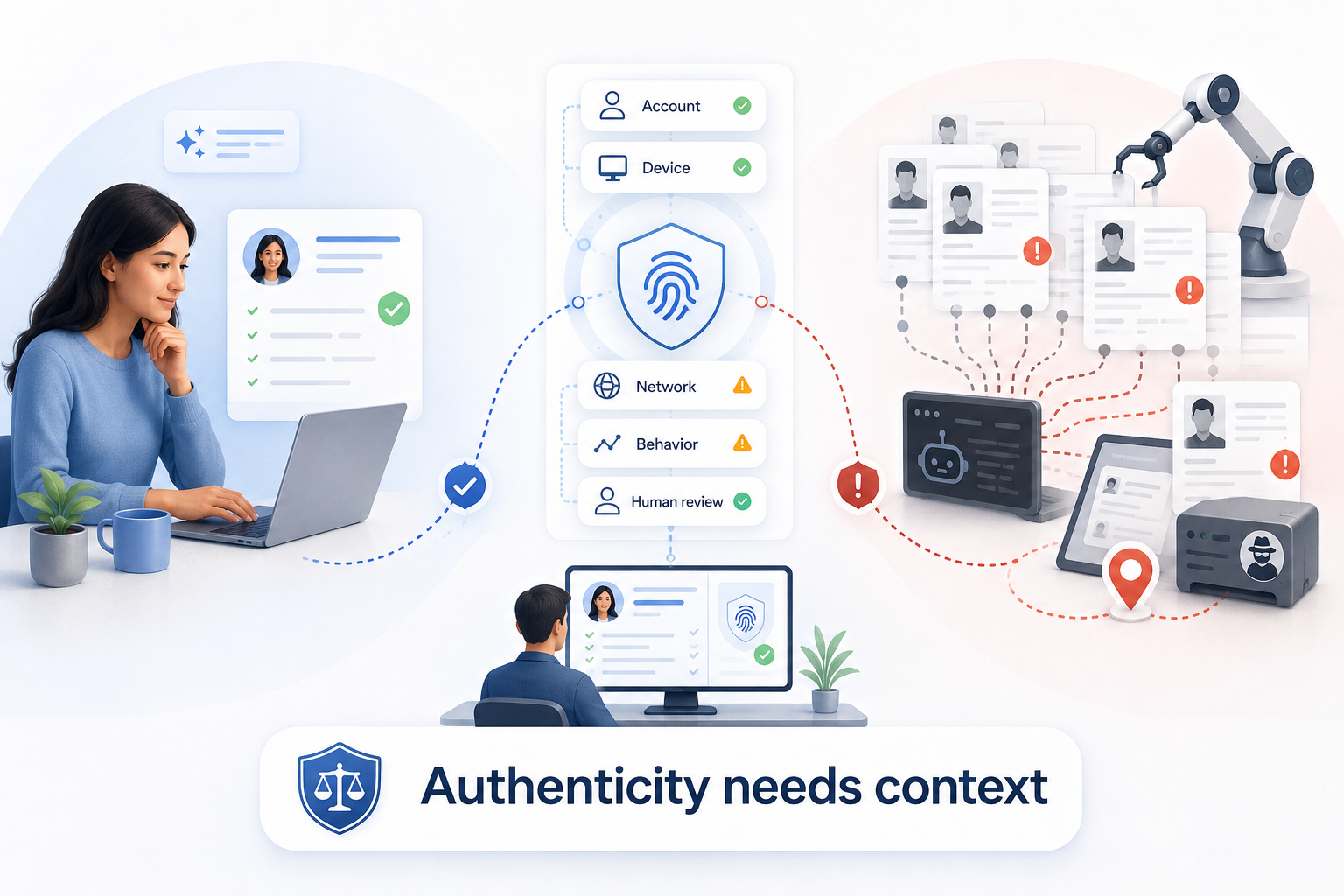
AI has reduced the effort required to write resumes, tailor cover letters, answer application questions, and prepare professional looking profiles. For genuine candidates, these tools can improve clarity, accessibility, grammar, and confidence, especially when a person is writing in a second language or returning to the job market after a long absence. Recruitment platforms should not assume that a polished application is deceptive simply because technology helped produce it. Modern hiring journeys already contain many forms of assistance, including templates, resume builders, translation tools, writing support, and career coaching.
The same technology can also be used to remove genuine candidate involvement from the process. An automated tool may select jobs, rewrite experience for each description, generate screening answers, and submit applications at a scale that would be difficult for a person to manage manually. A coordinated operator may create several profiles that look different on the surface but share devices, interaction patterns, networks, or identity information. The content may appear more professional at the same time that the activity behind it becomes less trustworthy.
This creates an authenticity problem rather than a simple AI detection problem. Recruitment platforms need to distinguish candidates who use technology to communicate real experience from accounts that use automation to manufacture volume, conceal identity relationships, or misrepresent engagement. Current research from Dice describes a wider trust gap in which many technology professionals distrust fully automated hiring and prefer processes that preserve meaningful human involvement. The same principle should guide fraud controls, which should support review rather than silently determine a person’s opportunity.
CrossClassify helps platforms evaluate the account, device, network, session, behavior, and relationship signals surrounding each application. It does not treat normal AI use as proof of fraud and does not decide whether a person deserves an interview. Instead, it helps platform teams understand whether the application journey contains automation patterns, identity inconsistencies, device reuse, or coordinated activity that deserves closer review. This broader approach reflects CrossClassify’s recruitment positioning, which combines application context with device fingerprinting, behavioral analysis, bot detection, and link analysis.
Why content detection alone produces weak answers
A resume can contain generic language for many legitimate reasons. Candidates often use common industry terminology because employers describe similar responsibilities with the same words. A person may begin with a standard template, receive professional editing, translate experience from another language, or use a writing assistant to improve readability. None of these conditions establishes that the experience is false or that the candidate is acting deceptively.
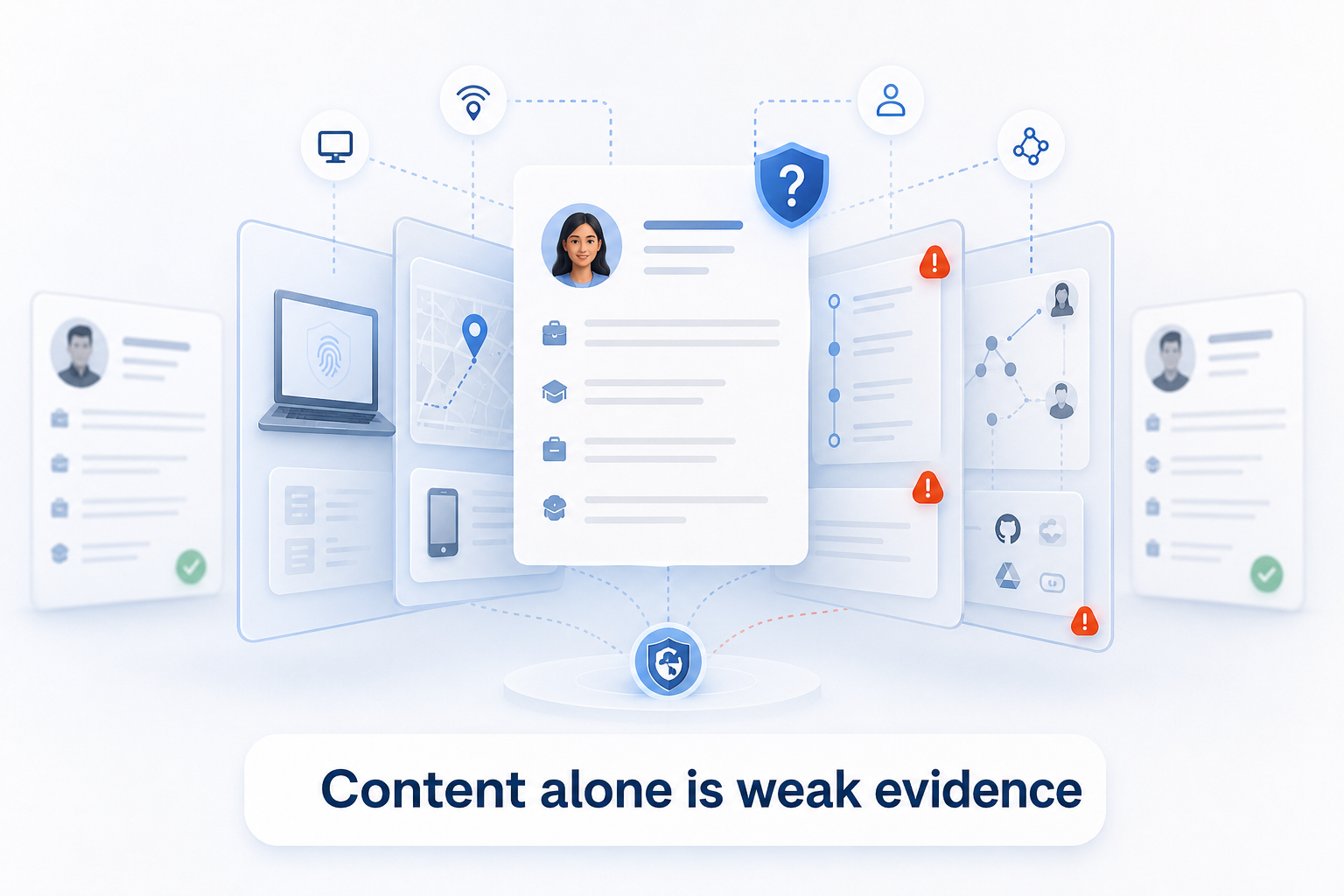
Trying to identify fraud from writing style alone creates uncertainty for both candidates and platform teams. Genuine applications may be flagged because they sound polished, structured, or similar to a job description. Sophisticated abuse can avoid simple content rules by changing sentence order, replacing words, or generating a new version for every application. A content score may therefore create confidence without providing strong evidence about who controls the account or how the application was submitted.
Content analysis remains useful when it identifies repeated claims, inconsistent dates, unusual contact information, or suspicious similarities between documents. Its value becomes much stronger when those findings are connected with surrounding activity. A repeated resume structure is more meaningful when several accounts also share devices, network infrastructure, submission timing, or profile changes. The platform can then investigate a pattern rather than make a conclusion from wording alone.
CrossClassify adds this account and session context through its recruitment fraud detection solution. The platform can combine document concerns with device intelligence, account history, behavior, and connected activity before choosing a response. This makes content one source of evidence inside a wider review process, rather than allowing language analysis to become a hidden judgment about the candidate.
The difference between assistance and abuse
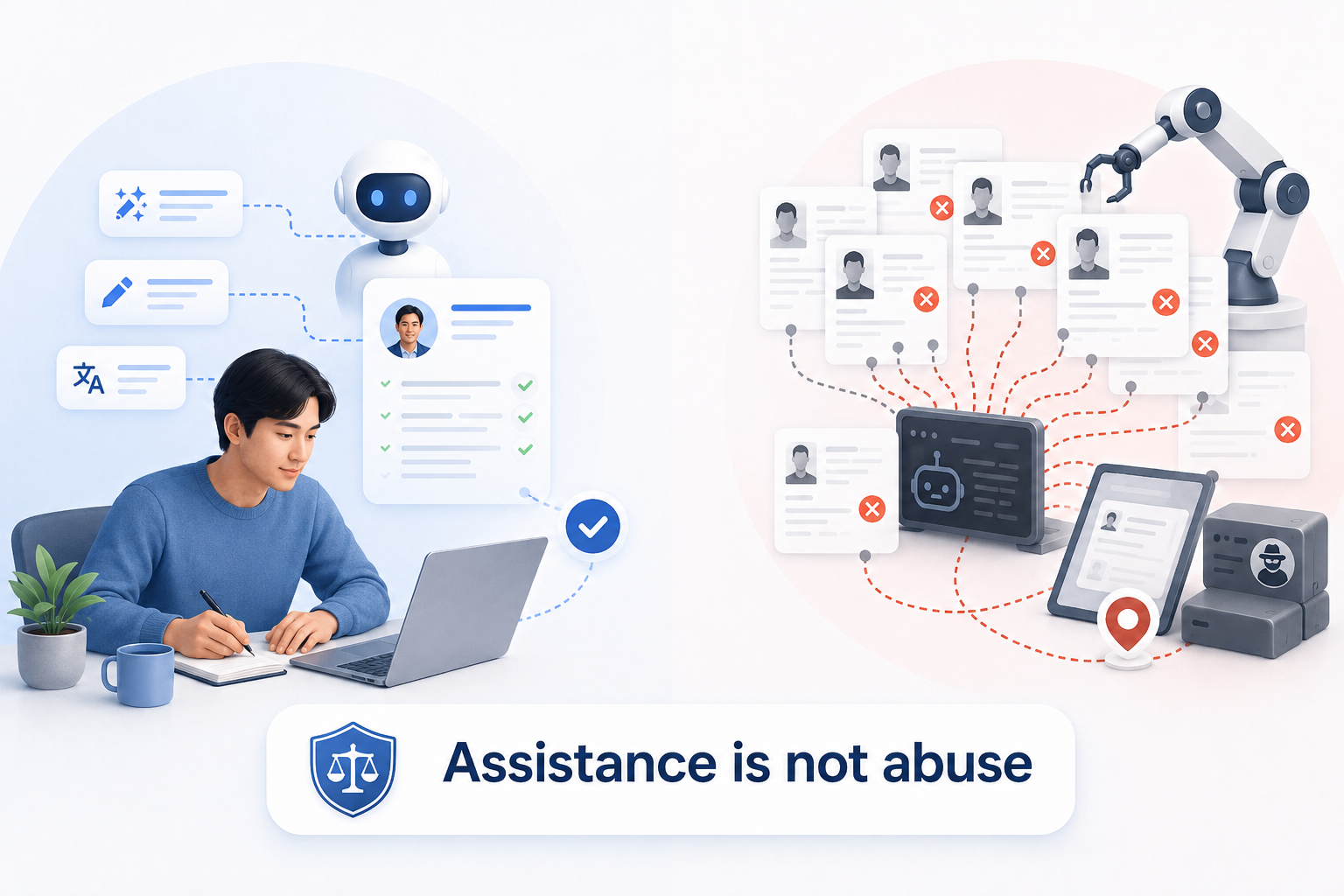
AI assistance supports a person who remains meaningfully involved in the application. The candidate chooses which roles deserve attention, checks whether the opportunity fits their experience, reviews generated wording, and takes responsibility for the information submitted. Technology reduces effort, but it does not replace the person’s awareness of the role or understanding of the claims made in the application. This type of use can make recruitment more accessible without weakening authenticity.
Application abuse removes, disguises, or greatly reduces that genuine involvement. A tool may search for roles, generate answers, alter resumes, and submit applications with minimal supervision. The account may apply across unrelated occupations, regions, or experience levels because the objective is maximum volume rather than meaningful consideration. In more coordinated cases, several accounts may be operated by the same person, service, device group, or automation framework.
The safest distinction comes from observable activity rather than assumptions about writing. Relevant signals include submission frequency, role diversity, navigation behavior, account age, device history, session timing, repeated answers, profile changes, and relationships with other accounts. No individual signal proves abuse, because genuine candidates can apply quickly, travel, share devices, or explore several types of work. The complete pattern provides the context needed for proportionate review.
CrossClassify helps platforms combine these signals into explainable risk context. A platform might learn that an account submitted to many unrelated roles through nearly identical sessions, or that several profiles share a persistent device and repeated behavior sequence. The platform can then decide whether to continue monitoring, request verification, or send the activity to review. This approach is safer than attempting to penalize every candidate who uses modern productivity tools.
How the application arms race damages trust
Candidates often believe that applications must be optimized aggressively to survive automated screening. They may add more keywords, apply to more positions, rewrite materials repeatedly, and use AI tools to make every submission appear closely aligned. Even when the underlying experience is genuine, the resulting applications can become increasingly similar to each other and to the job descriptions they target. Recruiters then receive more polished content but less distinctive information.
Recruitment teams respond to this volume with more automation. They may add faster screening, more filters, additional scoring, or stricter application questions. Candidates see those controls and adapt again by increasing optimization, applying more widely, or using tools that promise to bypass filters. Each side increases automation because it believes the other side has already done so.
The result is an application arms race in which efficiency rises while confidence falls. Recruiters become less certain that applications represent genuine interest, while candidates become less certain that a human will ever review their work. Dice’s trust research found strong concern about fully automated hiring and much greater confidence in processes that combine technology with human participation. That finding supports a model in which automation improves workflow but does not hide the reasoning behind important decisions.
Fraud controls should not intensify this cycle. A black box risk score that silently suppresses applications can create the same distrust as unexplained screening. Platforms need indicators that describe observable account and session activity, show the evidence behind concern, and remain separate from candidate qualification. CrossClassify supports this distinction by providing fraud context while the recruitment platform retains control of review, verification, communication, and final action.
Detecting automation through interaction patterns
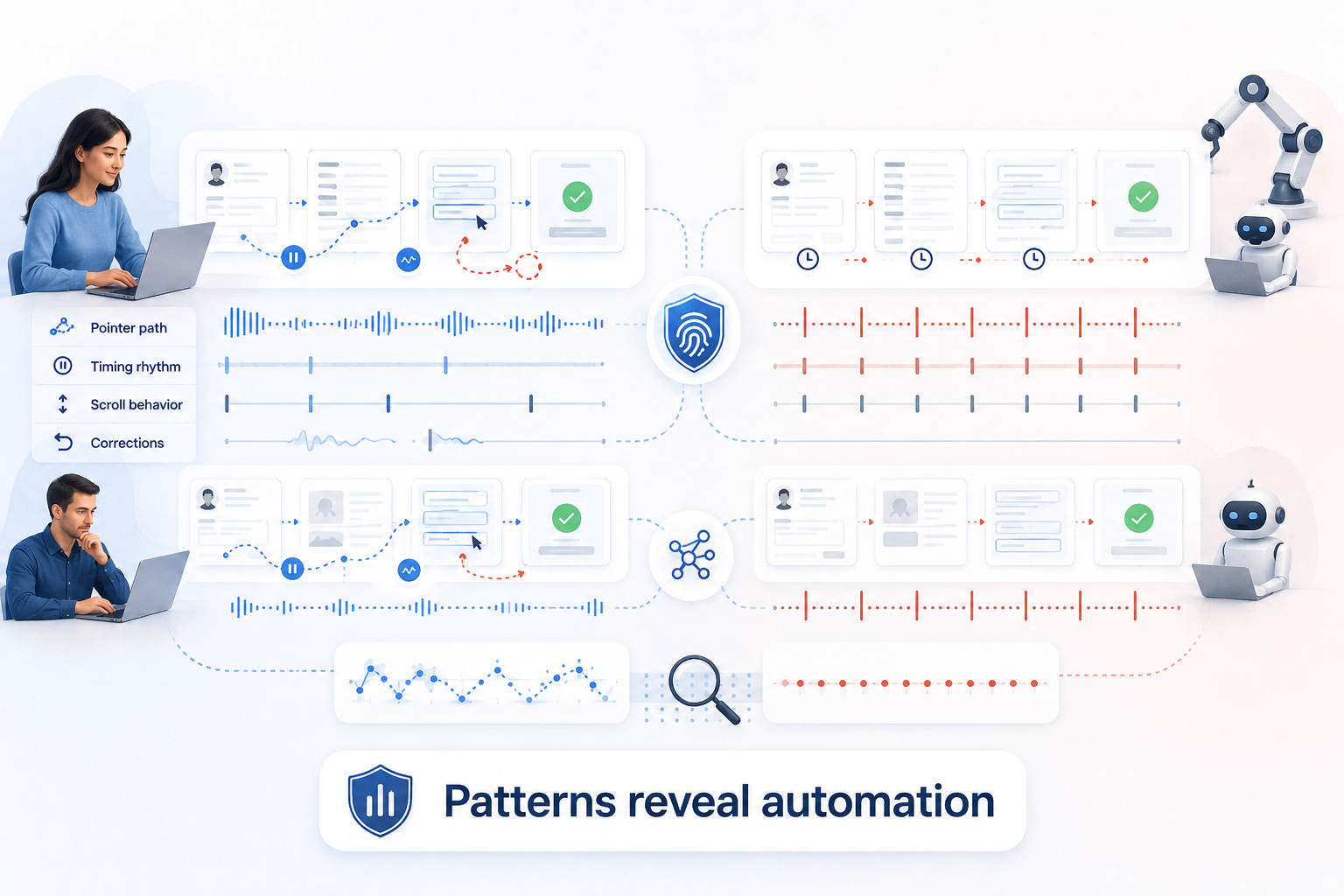
Automated application tools often reveal themselves through the way sessions move through the product. They may complete forms at repeated speeds, follow identical navigation sequences, skip normal reading behavior, or submit across many roles with very limited variation. Multiple sessions may begin and end at regular intervals, suggesting that activity is being scheduled or generated rather than driven by individual candidate decisions. These patterns can remain visible even when the resume content changes every time.
Human activity usually contains natural variation. A person pauses to read unfamiliar questions, returns to earlier fields, corrects information, scrolls unevenly, and spends different amounts of time on different roles. A highly efficient candidate may still move quickly, but each application typically creates some change in rhythm because the content and decisions are not identical. Behavioral analysis looks for this variation rather than relying only on how long a submission takes.
Behavioral biometrics can evaluate typing cadence, pointer movement, scrolling, touch behavior, navigation order, and session timing. These signals should be used carefully because behavior can change for legitimate reasons, including a new device, an accessibility tool, fatigue, or a different working environment. They are most useful when combined with device history, account age, velocity, and relationships with other sessions. CrossClassify combines behavioral biometrics with device fingerprinting and risk scoring to identify scripted or abnormal flows while allowing trusted activity to continue smoothly.
Before applying behavioral analysis, the platform should define what the signal is allowed to influence. It may inform internal review, additional verification, temporary limits, or continued monitoring. It should not infer candidate intelligence, motivation, personality, communication ability, or job suitability. This boundary keeps fraud detection focused on platform integrity rather than allowing interaction patterns to become an indirect hiring assessment.
Connecting accounts that appear unrelated
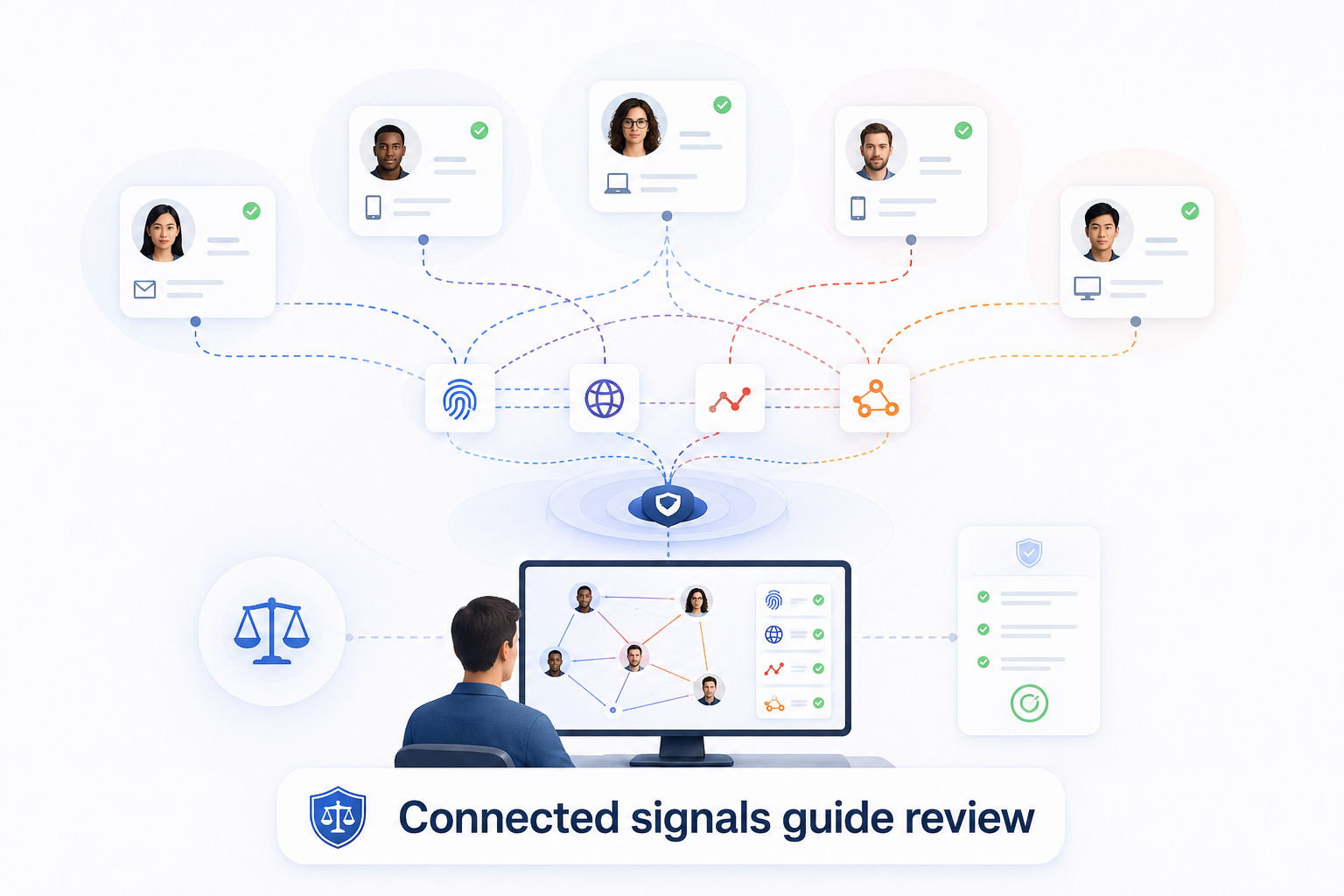
Application automation may be distributed across many candidate accounts. Visible information can change quickly because operators can create new email addresses, use different names, alter resume wording, and rotate network connections. Reviewing each profile separately may therefore make coordinated activity look like a series of isolated events. The platform needs a way to identify the operational relationships that remain consistent behind those changing details.
Device fingerprinting can reveal when multiple accounts originate from the same or closely related environment. Network intelligence can identify proxy use, hosting infrastructure, repeated regions, and unusual location changes. Account data may reveal shared contact patterns, while behavior analysis may show nearly identical application sequences. Link analysis connects these signals so reviewers can understand whether several profiles are part of a wider cluster.
Shared infrastructure does not automatically establish abuse. Families may share computers, employment centers may provide public devices, and staffing professionals may operate within a common office network. The risk becomes stronger when device reuse appears alongside repeated content, mechanical behavior, unusual velocity, or coordinated account creation. Platforms should therefore evaluate relationships in context rather than applying a simple shared device rule.
CrossClassify provides persistent device context through its device fingerprinting solution. The technology is designed to detect returning devices, configuration changes, spoofing attempts, and activity connected across sessions. When combined with application events and link analysis, this context helps platforms identify coordinated patterns that resume analysis alone would miss.
The role of network intelligence in application authenticity
Network information adds another layer of context to application activity. A platform can examine whether sessions come from expected consumer networks, data center infrastructure, proxy services, or rapidly changing regions. These details do not determine whether a candidate is genuine, but they can help explain why several otherwise separate accounts appear connected. Network context becomes especially useful when visible account information changes frequently.
A legitimate candidate may use a virtual private network, travel between locations, or connect through a company network. For that reason, an unusual IP address or location should not produce an automatic conclusion. The platform should consider whether the network change aligns with device history, account activity, application timing, and other available signals. A location shift that occurs during normal use may be harmless, while repeated shifts across many connected accounts may deserve review.
Network intelligence can also help identify infrastructure used to manage large numbers of sessions. Automated systems may rotate IP addresses while retaining similar devices, browser configurations, or interaction patterns. A platform that evaluates only the visible IP may treat every session as new. Combining network evidence with persistent device and behavior signals makes that evasion more difficult.
CrossClassify brings network, device, behavior, and account information into a wider risk picture. This gives the recruitment platform a stronger basis for investigation without treating network location as proof of identity or candidate intent. The platform can decide which network conditions contribute to risk and how much weight they receive within the application workflow.
Turn CV Red Flags Into a
Documented Risk Score
A checklist tells you what to look for. CV Risk Checker scans any resume in seconds and shows you exactly where the fraud signals are — before you book the interview.
Protecting genuine candidates from false conclusions
A safe fraud workflow should begin with the assumption that unusual activity requires context, not immediate judgment. A candidate may use a shared device, complete forms quickly because profile information is saved, or access the platform while traveling. Someone may apply to different types of roles because they are changing careers or urgently seeking work. Each of these behaviors can look unusual without being abusive.
False conclusions create practical harm. A genuine candidate may face unnecessary delays, repeated verification, or unexplained restrictions. Recruiters may lose access to credible applicants, and support teams may spend time resolving avoidable disputes. The platform can also damage trust if candidates believe invisible technical signals determine whether their applications are seen.
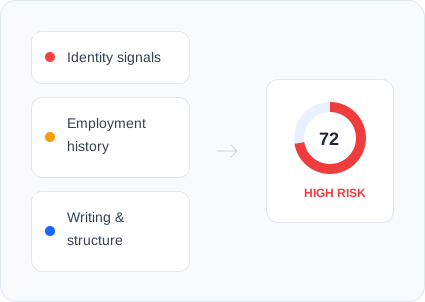
Combining independent signals reduces this risk. A fast submission becomes more meaningful when it also shares a device with several new accounts and follows an identical behavior sequence. A location change becomes more relevant when it appears with account information changes and proxy infrastructure. CrossClassify can provide the contributing reasons behind elevated risk, allowing the platform to understand why the activity was flagged.
The response should remain proportional to the evidence. Low confidence risk may justify continued observation. Medium confidence risk may justify account verification or temporary limits. Strong connected evidence may justify specialist review. This model separates legitimate AI assistance from coordinated application abuse while preserving a path for genuine users to continue.
Designing a proportional response model
Recruitment platforms do not need one universal response for every suspicious application. Different signals describe different risks, and the potential impact varies by workflow. A new account applying quickly may create limited concern, while a cluster of connected accounts submitting at scale may create a broader platform integrity issue. The response should reflect both confidence and operational impact.
A proportional model can begin with passive monitoring. The platform continues collecting signals without interrupting the candidate, allowing more context to develop over time. When risk increases, it can request additional account verification, place selected applications into platform review, or temporarily limit unusually high submission activity. Stronger restrictions should require stronger evidence.
The model should also explain what caused escalation. Reviewers should see whether risk came from device reuse, bot like interaction, network anomalies, account relationships, or a combination of factors. This prevents one vague score from controlling every case. It also helps operations teams apply consistent policies and identify legitimate exceptions.
CrossClassify supplies the signal layer, while the recruitment platform defines thresholds, workflows, and candidate communication. Teams can connect risk events through APIs, SDKs, and other application integrations described on the CrossClassify how it works page. This allows the platform to begin with a few sensitive events and expand monitoring as its policies mature.
Human review must remain meaningful
Human review is only useful when reviewers receive understandable evidence. A vague alert such as suspicious applicant does not explain what happened or what action is appropriate. It may encourage inconsistent decisions because each reviewer interprets the label differently. Useful review begins with observable facts and a clear timeline.
An alert might explain that several candidate accounts share a persistent device, that applications occurred at unusual velocity, or that the interaction sequence closely repeats across sessions. It might show when each account was created, which roles received applications, and what network or behavior relationships connect them. The reviewer can then compare that evidence with platform policy.
Human review should also recognize uncertainty. A shared device may be legitimate, and a behavior change may reflect an accessibility need or environmental change. Reviewers need a way to clear activity, document the explanation, and prevent the same harmless condition from generating repeated friction. Their feedback should improve future thresholds rather than disappearing after the case closes.
CrossClassify acts as a risk intelligence and decision support layer. It does not rank candidate quality, recommend who should be interviewed, or replace recruiter judgment. This distinction supports platform safety while preserving the human involvement that candidates increasingly expect from hiring processes.
Measuring whether authenticity controls work
A fraud program should not be judged only by how many applications it flags. A high alert count may indicate strong detection, but it may also indicate noisy rules that burden reviewers and genuine candidates. The better question is whether the controls improve trust, reduce repeated abuse, and preserve useful application activity. Measurement should connect detection with operational outcomes.
Useful measures include confirmed automation rate, review time, repeated device clusters, false alert rate, verification completion, and recurrence after intervention. Platforms can also examine whether recruiters spend less time encountering repeated low trust patterns and whether genuine applicants experience fewer unnecessary challenges. These outcomes provide a more balanced view than the number of blocked sessions.
Product teams should review where suspicious activity enters the journey. It may concentrate during account creation, resume upload, application submission, or a particular integration endpoint. That knowledge helps teams improve vulnerable workflows rather than adding friction everywhere. Reviewer feedback can also reveal which reason codes are useful and which signals require better context.
CrossClassify can supply risk events and supporting evidence, while the platform records its own review and business outcomes. Over time, this feedback helps tune thresholds around the platform’s real user behavior. The result is an authenticity program that adapts as candidate tools and abuse methods evolve.
Conclusion
The rise of AI assisted applications does not mean every polished resume is suspicious. Many candidates use modern tools to communicate genuine experience more clearly, improve accessibility, and reduce the burden of repetitive forms. Recruitment platforms should protect that legitimate use while recognizing that the same technology can also support automated, coordinated, or misleading activity.
The distinction cannot be made reliably through writing style alone. Platforms need context from account history, device intelligence, network information, submission velocity, behavior, and relationships between accounts. These signals help explain whether a person remains engaged in the journey or whether automation has removed meaningful candidate participation.
CrossClassify connects these layers into explainable risk context. It helps platform teams identify suspicious application behavior, device reuse, bot patterns, and linked accounts while keeping candidate qualification outside the fraud model. Recruitment platforms remain responsible for review, verification, communication, and final action.
A balanced approach can reduce application abuse without punishing genuine candidates for using technology. It can also restore confidence by keeping human review visible and fraud decisions explainable. The objective is not to eliminate AI from recruitment, but to preserve authenticity and accountability as AI becomes a normal part of the application journey.
See How CrossClassify Protects Recruitment Platforms
Detect fake recruiters, fraudulent resumes, and job scams instantly

Check a CV for Fraud Signals in 60 Seconds
Upload any resume and get an instant risk score, flagged signals, and a recruiter-ready action checklist.
Try the CV Risk CheckerNo credit card required
Share in
Related articles


Frequently asked questions
Let's Get Started
Create your free
account today
Discover how to secure your app against fraud using CrossClassify
No credit card required