Last Updated on 26 Apr 2026
The Smart Hiring ROI Protection System for Indeed Style Paid Job Postings
Share in

Introduction
Employers search for “how much does Indeed cost,” “how much does it cost to post a job on Indeed,” “Indeed pricing,” and “how much does Indeed charge employers” because recruitment advertising is a direct business expense. They do not only want to know the price of visibility. They want to know whether paid job traffic will produce real, qualified, trustworthy candidates.
This article discusses Indeed related search behavior and similar paid job posting concerns, not a partnership with Indeed. The central issue is that hiring ROI depends on trust, not only traffic. A campaign with many clicks and applications can still waste money if fake applicants, bots, duplicate identities, and low trust candidates fill the pipeline.
CrossClassify helps protect hiring ROI by adding fraud detection to recruitment advertising workflows. The CrossClassify recruitment solution helps platforms and employers detect fake applicants, suspicious devices, bot behavior, and recruitment fraud risk. This allows teams to measure job advertising performance by trusted hiring outcomes instead of raw application volume.
Why “How Much Does Indeed Cost?” Is Really a Trust Question
When employers ask how much a job posting costs, they are also asking whether the spend will be worth it. A low cost per application looks attractive only if the applications are real, relevant, and trustworthy. If many applications come from bots, fake candidates, duplicate identities, or low intent users, the campaign can look successful in dashboards while failing in hiring outcomes.
This is why “Indeed pricing” and “how to track ROI of Indeed job postings” are connected to recruitment fraud detection. Cost is easy to calculate, but trust adjusted value is harder. Employers need to know how much they are paying for qualified, genuine candidates, not just how much they are paying for activity.
CrossClassify helps answer this by separating trusted applicant signals from suspicious traffic. The bot and abuse protection solution can help detect automated job application fraud and suspicious candidate activity. This gives hiring teams a clearer view of which applications are worth recruiter time.
Common Cost Wasting Problems in Job Advertising
Fake applicants consume budget, recruiter time, and platform trust. They may use fabricated profiles, stolen identity details, repeated resumes, or misleading application information. If employers pay for visibility or application volume, fake applicants directly reduce hiring ROI.
CrossClassify can help detect fake applicants by combining device intelligence, behavior analysis, account signals, and resume patterns. The recruitment fraud protection solution supports fake applicant detection inside hiring workflows. This helps employers focus budget and attention on candidates who are more likely to be genuine.
Bot generated applications
Bot generated applications can inflate campaign metrics while reducing hiring quality. Bots may submit many applications quickly, reuse templates, and create generic candidate messages. Without bot detection, employers may believe a job campaign is performing well when the pipeline is actually polluted by automation.
CrossClassify can detect bot behavior through application velocity, scripted timing, device reuse, and abnormal interaction patterns. The bot and abuse protection solution is especially relevant for recruitment advertising fraud because automation can distort performance metrics. This helps platforms measure real candidate interest more accurately.
Duplicate candidate identities
Duplicate candidate identities can make a campaign appear to produce more unique applicants than it really does. The same person or fraud actor may create multiple accounts, submit repeated resumes, or apply under different contact details. This wastes recruiter time and makes cost per applicant metrics less reliable.
CrossClassify can identify duplicate or linked identities through device fingerprinting, contact detail patterns, IP signals, and account relationships. The device fingerprinting solution helps reveal when multiple applications are connected by the same device environment. This supports more accurate cost per trusted applicant measurement.
Low trust candidate traffic
Low trust candidate traffic includes applications that are suspicious, low intent, automated, or inconsistent with the claimed identity. These applications may not be clearly fake at first, but they reduce the quality of the hiring funnel. Employers may spend more time screening without improving hiring outcomes.
CrossClassify can score candidate traffic by trust level before it reaches recruiters. The behavioral biometrics solution helps detect whether candidate interactions look natural or suspicious. This makes it easier to distinguish real applicant interest from low trust traffic.
Fraudulent recruiter or agency behavior
Fraudulent recruiter or agency behavior can also distort hiring ROI. Some actors may create fake employer accounts, post misleading jobs, generate fake candidate activity, or manipulate hiring workflows. This kind of abuse can damage both platform credibility and employer campaign results.
CrossClassify helps detect suspicious employer and recruiter behavior through account opening checks, account takeover protection, device intelligence, and link analysis. The account opening protection solution supports early detection of risky recruiter or agency accounts. This helps protect job advertising ecosystems from both applicant side and employer side fraud.
High volume but low hiring value
High volume but low hiring value is one of the most frustrating outcomes for employers. A campaign may generate impressions, clicks, and applications, but still produce few interviews or hires. The missing metric is often trust.
CrossClassify helps platforms and employers move from raw volume metrics to trust based metrics. The CrossClassify recruitment solution supports hiring fraud prevention by identifying suspicious applicants and risky activity. This helps organizations understand whether paid job traffic is actually creating hiring value.
Why Raw Application Metrics Are Not Enough
Impressions, clicks, applications, and cost per application are useful, but incomplete. They show activity, not trust. A campaign can produce many applications while still failing if those applications are fake, duplicated, automated, or low quality.
Recruitment advertising fraud makes raw metrics even more misleading. Bots and fake applicants can inflate application counts, while duplicate identities can make the candidate pool look larger than it is. Recruiter time then becomes the hidden cost that does not appear in simple advertising dashboards.
CrossClassify helps create fraud adjusted recruitment metrics. The device fingerprinting solution helps identify repeated applicants and suspicious device reuse. When combined with bot and abuse protection, this gives employers a more honest view of hiring ROI.
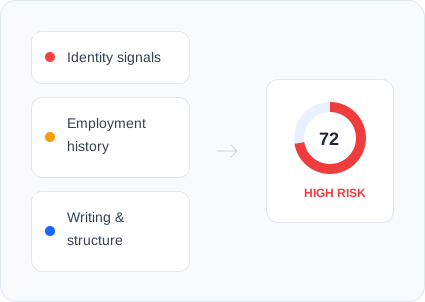
Turn CV Red Flags Into a
Documented Risk Score
A checklist tells you what to look for. CV Risk Checker scans any resume in seconds and shows you exactly where the fraud signals are — before you book the interview.
How CrossClassify Protects Hiring ROI
CrossClassify protects hiring ROI by scoring candidate and recruiter activity for fraud risk. Instead of measuring only how many applications a paid job post receives, platforms can measure how many trusted applications it receives. This changes the conversation from traffic quantity to hiring quality.
The system can detect fake applicants, bot generated applications, suspicious devices, repeated identities, abnormal behavior, and linked fraud patterns. These insights can reduce manual review, improve recruiter productivity, and help employers spend hiring budgets more effectively. Fraud aware metrics also make it easier to compare campaigns based on trusted outcomes.
The CrossClassify recruitment solution connects these capabilities to hiring workflows. The bot and abuse protection solution adds another layer when application fraud involves automation and high velocity abuse. Together, these solutions help platforms and employers protect the real value of recruitment advertising.
Better Metrics for Recruitment ROI
Trusted applicant rate measures the percentage of applications that appear genuine and low risk. This is more useful than total application count because it separates real candidate interest from suspicious activity. A campaign with fewer trusted applicants may be less valuable than a campaign with lower volume but higher trust.
CrossClassify can help calculate trusted applicant rate by scoring device, behavior, identity, and application signals. The recruitment fraud protection solution supports this shift from raw volume to trust based hiring metrics. This helps employers understand whether campaigns are producing candidates worth reviewing.
Suspicious application rate
Suspicious application rate measures how much of the pipeline may be fake, automated, duplicated, or low trust. This metric helps employers identify which campaigns, job types, or traffic sources need stronger controls. It also helps platforms demonstrate transparency around application quality.
CrossClassify can identify suspicious applications using bot signals, device reuse, resume similarity, behavioral anomalies, and network links. The bot and abuse protection solution helps detect automated and abusive activity that can distort campaign performance. This gives employers better visibility into recruitment advertising fraud.
Cost per trusted applicant
Cost per trusted applicant is more useful than cost per application. It shows how much the employer pays for applicants who are likely to be genuine and worth recruiter review. This metric can reveal that a cheap source of applications is actually expensive after fraud and low quality traffic are removed.
CrossClassify helps estimate this by filtering or scoring suspicious applications before ROI is calculated. The device fingerprinting solution supports this metric by detecting repeated or linked applicant identities. This helps employers make better decisions about where to spend job advertising budgets.
Fraud adjusted campaign ROI
Fraud adjusted campaign ROI measures performance after suspicious activity is removed or discounted. It gives a more realistic view of whether a paid job posting generated useful hiring outcomes. This metric is especially valuable for employers comparing platforms, job titles, locations, or sponsored campaigns.
CrossClassify can support fraud adjusted ROI by scoring every application and identifying suspicious patterns across campaigns. The CrossClassify recruitment solution helps connect fraud risk to recruitment performance. This allows teams to measure hiring value based on trusted outcomes rather than inflated activity.
Recruiter time saved
Recruiter time saved measures how much review effort is reduced by filtering suspicious applications earlier. This is a major hidden ROI factor because every fake applicant consumes human attention. Reducing low trust applications can improve recruiter focus, candidate experience, and hiring speed.
CrossClassify helps save recruiter time by prioritizing trusted applications and flagging risky ones. The behavioral biometrics solution helps detect unnatural candidate behavior that may waste recruiter effort. This makes fraud prevention part of operational efficiency, not only security.
Manual review reduction
Manual review reduction measures how much less time trust and safety teams spend reviewing obvious or repeated suspicious activity. A strong fraud detection layer can route high risk activity faster and let trusted activity move smoothly. This improves both platform efficiency and employer satisfaction.
CrossClassify helps reduce manual review by connecting risk signals into clear scores and alerts. The account takeover protection solution can also protect employer accounts from being misused in ways that create costly review work. This supports a healthier recruitment advertising ecosystem.
Conclusion
Job advertising ROI should be measured by trusted hiring outcomes, not just application volume. Employers asking “how much does Indeed cost” are really asking whether paid job traffic will produce real candidates and real hiring value. Raw metrics are not enough when fake applicants, bots, duplicate identities, and suspicious traffic can distort the funnel.
CrossClassify helps platforms and employers protect hiring ROI with fake applicant detection, bot and abuse protection, device fingerprinting, behavioral biometrics, and continuous monitoring. The CrossClassify recruitment solution gives recruitment platforms a trust layer for safer and more efficient hiring. This helps turn paid job posting performance into a fraud adjusted, trust based business metric.
See How CrossClassify Protects Recruitment Platforms
Detect fake recruiters, fraudulent resumes, and job scams instantly

Check a CV for Fraud Signals in 60 Seconds
Upload any resume and get an instant risk score, flagged signals, and a recruiter-ready action checklist.
Try the CV Risk CheckerNo credit card required
Share in
Related articles


Frequently asked questions
Let's Get Started
Create your free
account today
Discover how to secure your app against fraud using CrossClassify
No credit card required