Last Updated on 25 Jul 2026
Recruitment Messaging Trust: Preventing Hijacked Accounts, Spam, and Candidate Impersonation
Share in

Introduction
Messaging turns a recruitment platform from a directory into an active relationship channel. Recruiters invite candidates to consider opportunities, employers schedule conversations, and candidates share information about their experience and availability. These interactions often determine whether a person views the platform as credible and useful. Trust in the message is therefore closely connected with trust in the platform itself.
The recipient usually assumes that the account belongs to the person or organization displayed on the screen. A candidate may respond because the message appears to come from an established recruiter profile. An employer may trust a candidate because the account contains a complete application history. That inherited credibility can be exploited when an account is hijacked, fabricated, automated, or operated by an impersonator.
Message content controls are important, but they cannot fully explain who controls the account or whether the surrounding session remains trustworthy. An attacker can copy normal recruiter language, reuse a legitimate conversation, or generate varied messages that avoid simple spam rules. Dice has warned candidates about phishing messages that impersonate recruiters and has emphasized secure platform communication, privacy controls, personalized outreach, and the relationship between communication quality and candidate trust.
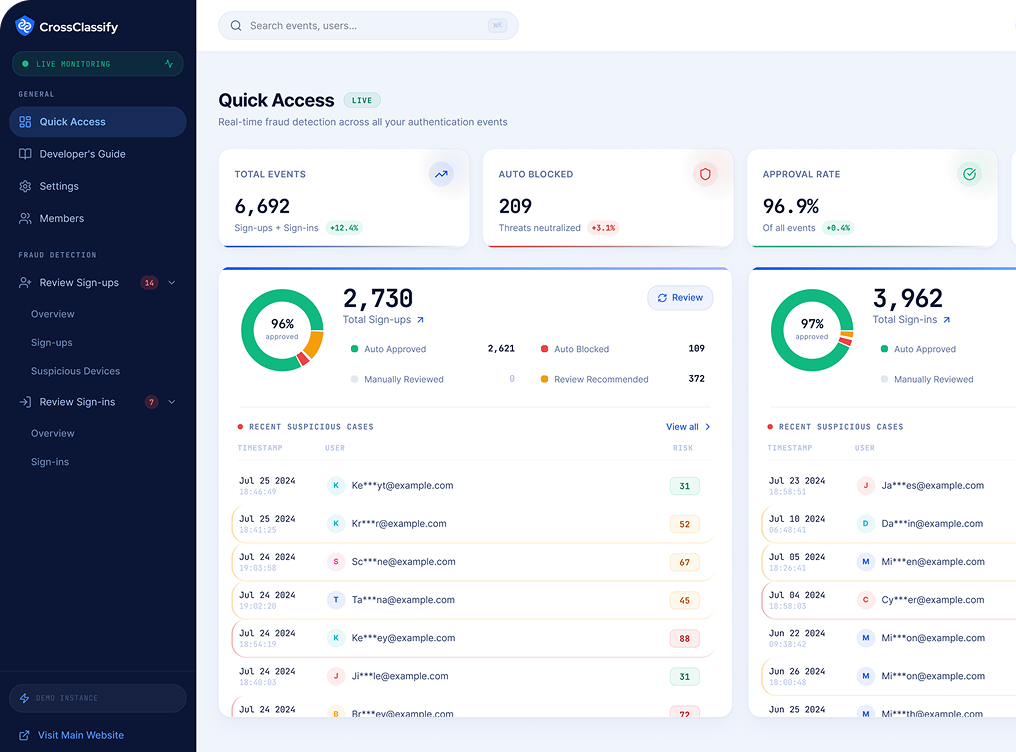
CrossClassify helps recruitment platforms evaluate messaging risk through account history, device intelligence, behavior analysis, network context, and relationships between accounts. These signals help teams understand whether the sender’s activity fits an expected account journey or deserves closer review. The platform remains responsible for content policy, candidate communication, account restrictions, and final decisions.
Messaging abuse is an identity and behavior problem
Traditional spam filters focus primarily on message content. They may detect repeated phrases, suspicious links, prohibited language, unusual formatting, or known scam terms. These controls can remove obvious abuse and remain an important part of communication safety. They are less effective when a malicious message uses normal language or comes from an established account.
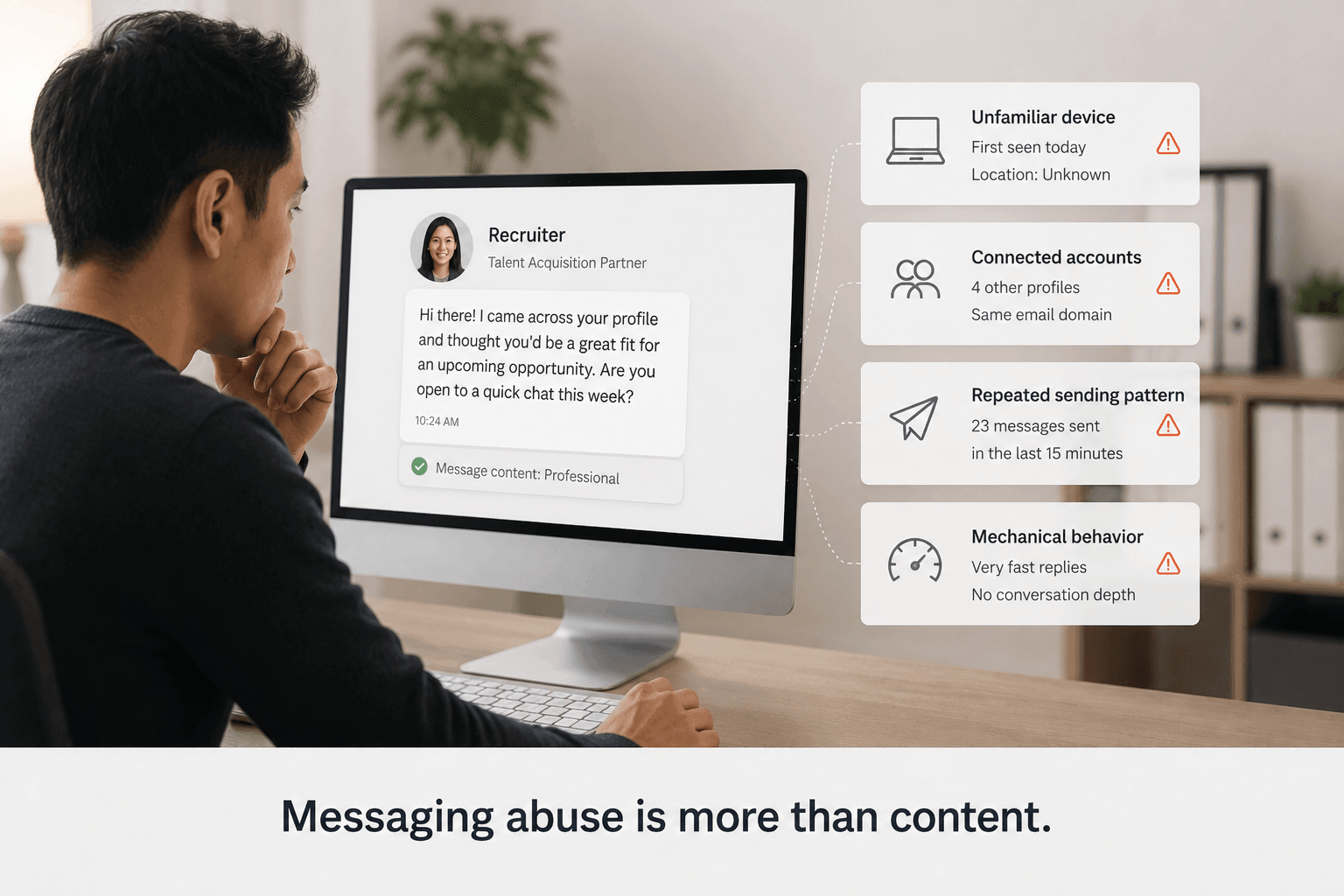
Messaging abuse frequently depends on identity and account context. A message may look professional while the sender account has just been accessed from an unfamiliar device. An attacker may copy earlier legitimate conversations, change only a few details, and contact new candidates through a trusted profile. A group of accounts may send varied messages from shared devices or infrastructure, making each message appear independent.
Behavior also reveals whether communication activity fits the expected workflow. A genuine recruiter may contact many candidates, but the session usually includes profile review, role comparison, and varied interaction. Automated or compromised activity may send messages at repeated intervals, contact unrelated recipients, and follow the same navigation sequence across accounts. These patterns add evidence that content analysis alone cannot provide.
Messaging trust therefore requires a combined view of content, account, device, session, and relationships. CrossClassify contributes the account and behavior layers, while platform moderation systems continue evaluating message text and links. Together, these controls can distinguish a suspicious message from a wider account incident and route the case to the right team.
How recruiter account takeover affects candidates
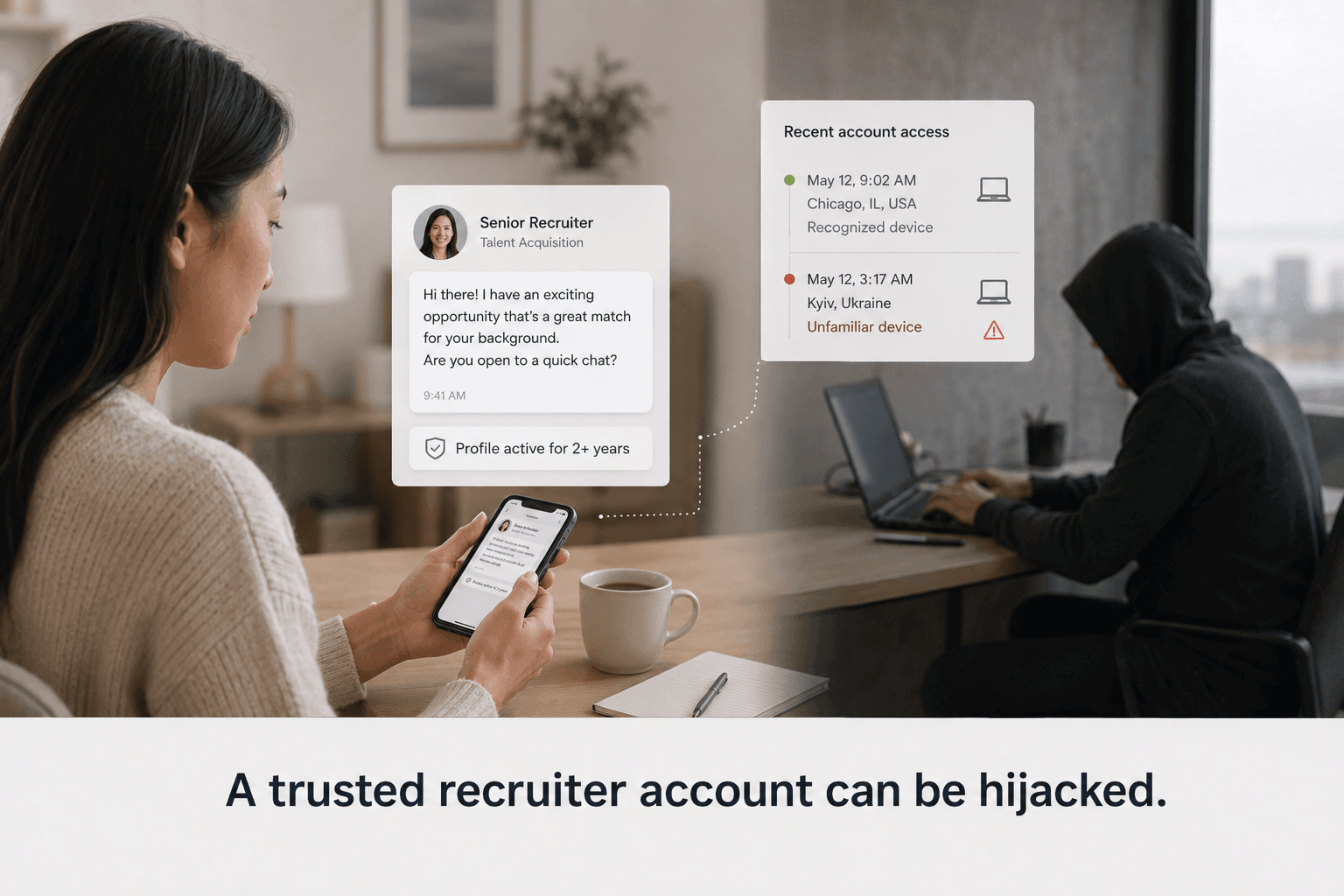
Recruiter and employer accounts can carry valuable permissions. They may view candidate profiles, send messages, create roles, manage company information, access applicant records, and invite team members. An established account also carries social credibility because candidates can see its history, profile, and connection with an employer. This makes recruiter accounts attractive targets.
When an attacker gains control of an established account, messages inherit the credibility of that account. Candidates may be more willing to respond, open links, move to another communication channel, or share personal information. The attacker does not need to build trust from the beginning because the platform and account history have already done part of that work. The resulting harm can affect candidates and the apparent employer.
Login controls alone may not identify the misuse. An attacker may use stolen credentials, a hijacked session, or a device that appears acceptable during authentication. The account may behave normally at first, then change profile details or increase message volume after trust has been granted. This is why messaging protection must include post login monitoring.
CrossClassify monitors access and session behavior through its account takeover protection solution. It combines device fingerprinting, behavioral baselines, session validation, and adaptive risk tracking to identify changes that static login controls may miss. Recruitment platforms can use this context to review suspicious messaging without assuming that every new device represents an attacker.
Candidate account misuse and impersonation
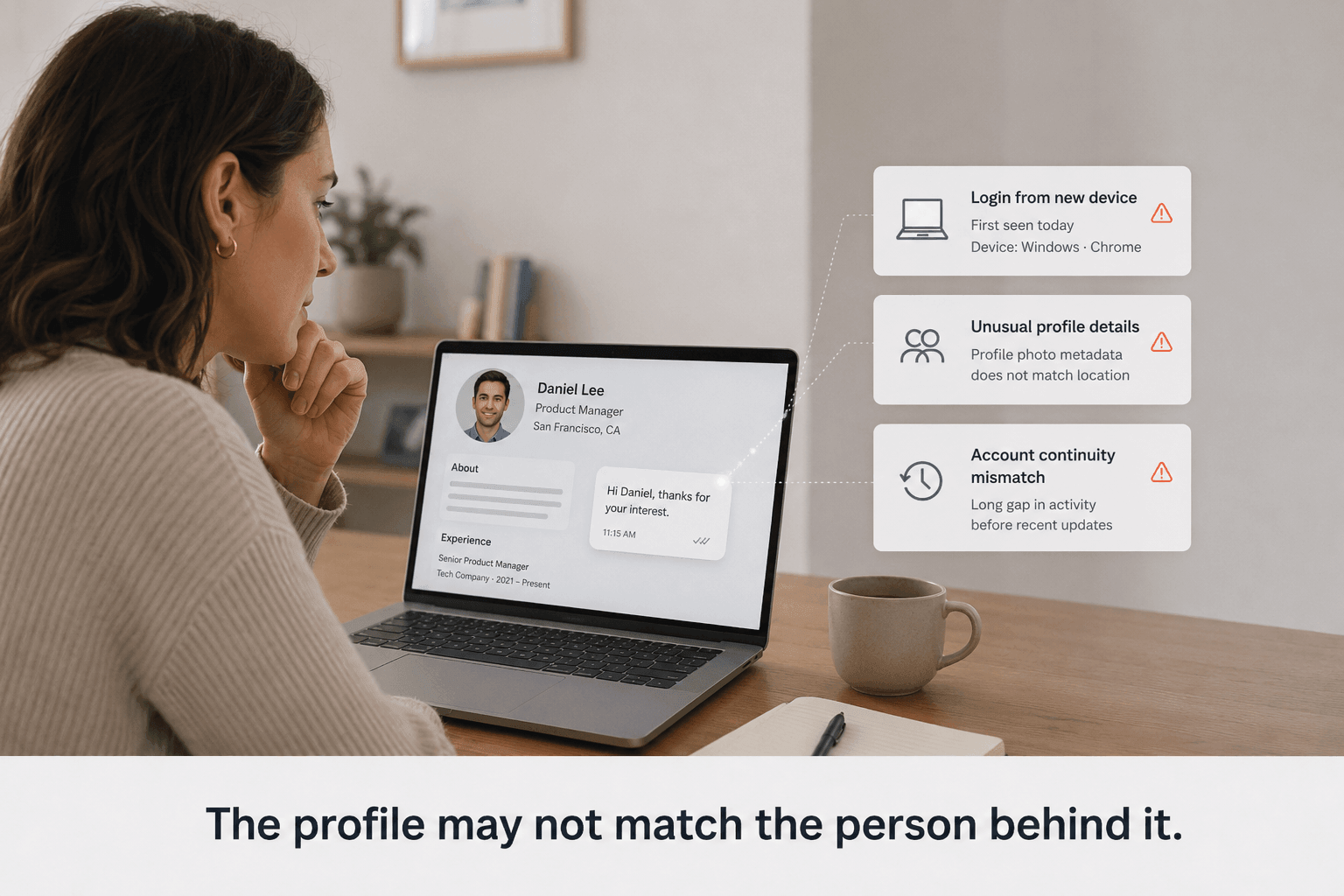
Messaging risk also exists on the candidate side. An account may be created with false identity information, shared between several people, or taken over after a genuine candidate stops using it. A malicious user may contact recruiters, request off platform communication, or submit information that does not match the profile history. The account can appear legitimate because it contains earlier activity.
Candidate impersonation can create operational and security concerns. Recruiters may spend time communicating with someone who does not control the original identity. Employers may receive misleading information, and the platform may connect the activity with a genuine person who is unaware of the account use. Messaging therefore becomes one part of a wider identity and account continuity problem.
The platform can evaluate whether the current sender resembles previous account activity. Device familiarity, behavior continuity, network changes, profile edits, and account recovery history can all provide context. A sudden change before messaging may deserve more attention than a new device used during ordinary browsing. The potential impact of the communication also matters.
CrossClassify can help detect unexpected changes in candidate account use through account takeover, device intelligence, and behavioral analysis. These signals support platform review but do not determine whether a candidate is suitable for a job. Recruiters continue evaluating professional content, while trust and security teams investigate account control.
Signals that improve messaging risk detection
Messaging risk should consider several categories of evidence. Sender account age, device familiarity, login changes, recipient volume, message timing, profile edits, network context, and relationships with other accounts can all influence risk. Content systems can add repeated wording, suspicious links, requests for payment, or attempts to move communication to unsafe channels. The combined picture is more useful than one isolated alert.
A high volume recruiter may be legitimate. Staffing agencies and internal talent teams often contact many candidates during a focused campaign. A repeated message template may also be part of an approved workflow, and a new device may belong to a real employee. Platforms should avoid rules that assume ordinary recruiter efficiency is abusive.
Risk becomes more credible when several conditions appear together. A new device that changes account details and sends many similar messages shortly after login deserves more review than any one event alone. The concern becomes stronger if the device is linked with other accounts or if the behavior follows a mechanical sequence. Review teams should see these relationships clearly.
CrossClassify combines account, device, behavior, velocity, network, and link evidence so platforms can respond according to context. The resulting indicators should describe what happened rather than accuse the account holder. This supports proportionate action and creates a clearer path for legitimate users to resolve unusual conditions.
Bot behavior inside communication workflows
Automation can support legitimate recruiter workflows. Approved systems may schedule outreach, populate message templates, or help recruiters manage follow ups. The platform may know which tools are authorized and how they should behave. The security problem begins when unapproved automation creates volume, impersonates users, or spreads suspicious messages outside normal controls.
Bots often produce mechanical timing, repeated navigation, unusual recipient velocity, and limited interaction variation. They may send messages immediately after login, skip profile review, and repeat the same flow across many accounts. Some systems introduce random delays or varied content, but device and relationship signals can still reveal that sessions are connected. This is why content variation alone does not defeat wider behavior analysis.
Platforms should distinguish approved automation from suspicious external behavior. Known internal services can use authenticated integrations, declared application identities, and controlled rate limits. Unknown automation may attempt to imitate browser activity through headless tools, emulators, or repeated devices. The policy should focus on authorization and impact rather than prohibiting automation as a category.
CrossClassify can identify automated interaction patterns through its bot and abuse protection solution. Its current bot protection positioning combines behavior analysis, device consistency, velocity, location, and continuous monitoring. The recruitment platform can then decide whether to monitor, limit, verify, or review the activity.
Device intelligence and sender trust
Device intelligence helps the platform understand whether the account is being used from an expected environment. A familiar device can support trust, while a new, manipulated, or connected device can add risk. The signal is particularly relevant when device change occurs near sensitive messaging activity. Device history can also reveal whether several sender accounts share the same environment.
A device should not become a direct identity decision. Recruiters may use several computers, mobile devices, or shared office systems. Staffing teams may legitimately operate from a common network and managed device fleet. The platform needs to compare device information with account role, organization context, behavior, and earlier activity.
Persistent device intelligence can also reveal attempts to evade controls. An operator may clear cookies, rotate IP addresses, or change visible browser details while retaining deeper configuration patterns. Several accounts may appear new to a simple session system but remain connected through persistent device evidence. This is useful when messaging abuse moves between profiles.
CrossClassify’s device fingerprinting solution is designed to identify returning devices, configuration anomalies, spoofing attempts, and connected activity across sessions. Recruitment platforms can combine this evidence with message velocity and account changes before choosing a response. This reduces dependence on static IP rules or browser cookies.
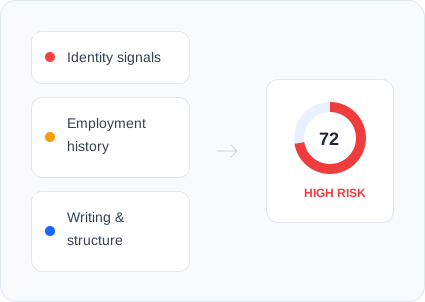
Turn CV Red Flags Into a
Documented Risk Score
A checklist tells you what to look for. CV Risk Checker scans any resume in seconds and shows you exactly where the fraud signals are — before you book the interview.
Protecting employer and platform reputation
Candidates often experience a recruitment platform through communication rather than through its technical features. A helpful and relevant message can create confidence, while a suspicious conversation can damage trust quickly. The candidate may associate the experience with the apparent employer, recruiter, and platform at the same time. One incident can therefore affect several reputations.
The operational effects include candidate complaints, support workload, account investigations, lower response rates, and reluctance to engage with future opportunities. Genuine recruiters may find their outreach treated with suspicion because candidates have encountered impersonation elsewhere. Employers may question whether the platform protects their brand and account permissions. Trust loss can persist after the original account is secured.
Dice’s hiring content emphasizes that candidate trust, secure communication, privacy controls, and personalized outreach can improve engagement. It also warns that impersonating recruiters is a known phishing technique and advises candidates to use official platform communication. These themes show why messaging security is part of product value rather than only a background security function.
CrossClassify’s recruitment fraud detection solution helps platforms evaluate risky communication within the broader account and application journey. Product, trust, fraud, and security teams can work from shared device, account, and behavior evidence. This makes it easier to protect candidates while preserving legitimate recruiter communication.
Risk based controls for messaging
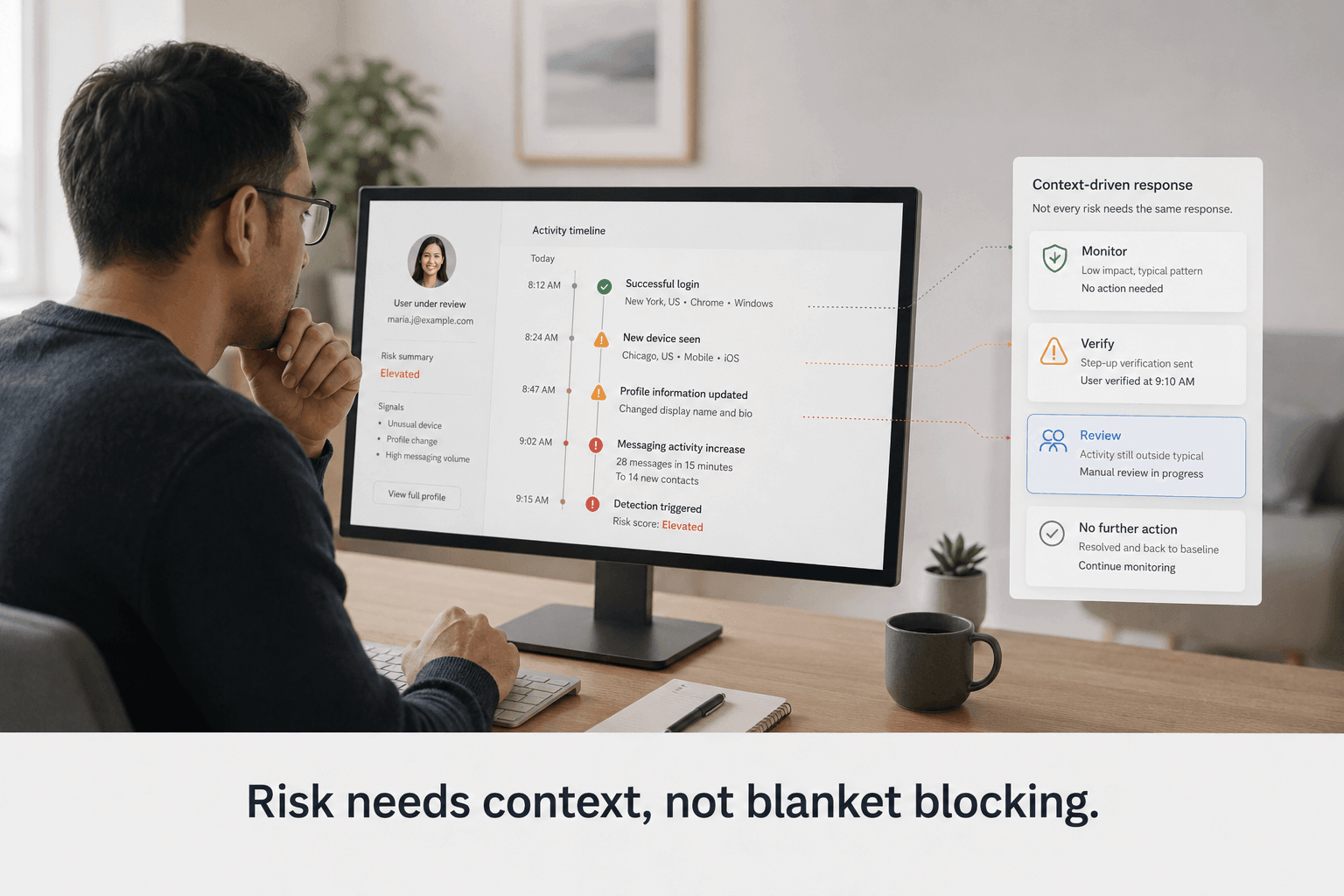
A proportional response model protects candidates without disrupting normal recruiter activity. Low risk sessions can continue normally, preserving the speed that makes direct messaging useful. Moderate risk may trigger continued monitoring, a temporary sending limit, account verification, or internal review. High risk activity may justify a temporary account hold or message restriction while the platform investigates.
The response should consider both confidence and potential impact. A profile edit may create one level of concern, while a message requesting payment or sensitive identity information may create another. An unfamiliar device sending one ordinary message is different from the same device contacting hundreds of candidates after changing account details. Policies should reflect these differences.
Controls should also provide a recovery path for genuine users. A real recruiter who changes devices or travels should be able to verify account control and continue. The platform should explain what is required without making an accusation. Reviewer outcomes should be recorded so the same legitimate condition does not create repeated restrictions.
CrossClassify provides the signal and reason context, while the recruitment platform defines the policy. The platform chooses thresholds, verification methods, sending limits, review ownership, and communication. This separation makes the risk layer adaptable to different marketplace models and recruiter workflows.
Giving review teams useful context
Review teams need a timeline that connects access and messaging activity. A series of separate alerts can hide the incident sequence and force analysts to reconstruct it manually. The case should show when the account logged in, whether the device was familiar, what profile changes occurred, and when message behavior changed. This helps reviewers understand cause and impact.
Useful context includes recipient volume, message timing, account role, device history, network changes, related accounts, and earlier review outcomes. Content moderation findings may add suspicious links or repeated themes. The reviewer should be able to see which evidence is strong and which is uncertain. A concise summary can support fast triage, with deeper technical details available when required.
Different teams need different views. A support agent may need to know that an account is under review and what the user must do next. A trust analyst may need connected account and messaging evidence. A security analyst may need session, network, and access details. Role based presentation prevents every team from receiving either too little or too much information.
CrossClassify can send risk events through APIs and application integrations. Teams can review the technical options on the integration overview. This allows risk information to appear inside existing account, support, review, and security workflows instead of requiring every team to use a separate tool.
Feedback loops for messaging protection
Messaging controls need feedback because legitimate communication patterns differ across platforms and recruiter types. A staffing agency may send more messages than an internal employer. A new product feature may change normal navigation or timing. Static thresholds can become noisy when workflow behavior changes. Reviewer outcomes help the platform understand these differences.
When analysts confirm abuse, the platform can record which evidence mattered. When they clear a legitimate recruiter, they can document the organization, device context, or workflow that explained the activity. This feedback can adjust thresholds and reduce repeated review. It also helps teams identify where policy, interface, or user education needs improvement.
Candidate reports provide another valuable signal. A recipient may flag irrelevant outreach, impersonation, suspicious links, or requests to move communication elsewhere. Reports should not automatically prove wrongdoing, but they add impact context to account and behavior evidence. Multiple independent reports connected to the same device or account cluster can strengthen an investigation.
CrossClassify can provide the technical risk context, while the platform combines it with moderation outcomes and user reports. This creates a learning system rather than a set of fixed rules. Over time, teams can improve precision and focus controls on the messaging patterns that create real harm.
Measuring messaging trust
Messaging security should be measured through outcomes rather than the number of messages blocked. Useful measures include confirmed account takeover cases, suspicious message recurrence, candidate report rate, review time, account recovery outcomes, and false restrictions. Platforms can also examine whether trusted recruiter response rates improve as suspicious communication decreases. These measures connect security with product value.
Teams should separate content incidents from account incidents. A prohibited message sent by a genuine account may require moderation, while normal language sent by a compromised account requires security response. Understanding the difference helps allocate cases to the right team and measure each control accurately. One universal abuse metric can hide these distinctions.
The platform should also review friction. Genuine recruiters may abandon outreach if controls interrupt ordinary work too often. Candidates may lose confidence if suspicious messages remain visible for too long. Measuring both protection and usability helps teams adjust thresholds. The best system reduces harmful communication while preserving timely, relevant conversations.
CrossClassify contributes account, device, behavior, and relationship evidence to this measurement model. The recruitment platform records moderation decisions, user reports, business outcomes, and support impact. Together, these data points show whether messaging protection strengthens trust without weakening the communication experience.
Conclusion
Recruitment messaging trust depends on more than filtering text. Platforms need to understand whether the sender account, device, session, network, and behavior remain trustworthy throughout the communication workflow. A professional message can still come from a compromised account, while a repetitive template can belong to a legitimate recruiter. Context determines the appropriate response.
Account takeover, fake account activity, automation, and impersonation can all exploit the credibility built into a recruitment platform. The effects reach candidates, employers, recruiters, support teams, and the platform brand. Protecting communication is therefore both a security responsibility and a core product requirement.
CrossClassify helps connect access, device, behavior, velocity, network, and account relationship signals. Recruitment platforms can use this evidence to monitor unusual activity, request verification, apply limits, or route incidents to human review. Content moderation and formal identity verification can remain separate but complementary controls.
The result is stronger candidate protection, clearer operational review, and more confidence in platform communication. Genuine recruiters can continue engaging candidates, while suspicious sessions receive proportionate attention. Messaging remains useful because trust is protected around the entire conversation journey.
See How CrossClassify Protects Recruitment Platforms
Detect fake recruiters, fraudulent resumes, and job scams instantly

Check a CV for Fraud Signals in 60 Seconds
Upload any resume and get an instant risk score, flagged signals, and a recruiter-ready action checklist.
Try the CV Risk CheckerNo credit card required
Share in
Related articles


Frequently asked questions
Let's Get Started
Create your free
account today
Discover how to secure your app against fraud using CrossClassify
No credit card required