Last Updated on 06 Oct 2026
When Lives Depend on Hiring: Put Patient Safety at the Heart of Healthcare Recruitment
Share in

Introduction
An urgent vacancy arrives on a hospital recruiter's desk. The team needs another colleague, and several applicants have relevant qualifications. Choosing among them means understanding what each person can safely contribute in the actual care setting, including the support they will need. The consequences reach patients, families, and the colleagues sharing responsibility for care.
Healthcare recruitment should connect workforce needs to evidence about competence and readiness. That requires clinical input before shortlisting, proportionate verification, and an appointment decision that explains why the candidate is suitable for the proposed responsibilities.
Translate patient needs into hiring requirements
Start with the care the service provides. A community nursing role and an acute hospital vacancy may share a professional title while requiring different experience, supervision, and working arrangements. A broad advertisement can obscure those differences and leave the selection panel comparing candidates against an incomplete description.
Ask the clinical lead to identify responsibilities that matter immediately, competencies that can develop after appointment, and the support the service can realistically provide. Make essential requirements distinguishable from preferences. A requirement should have a reason tied to the work, rather than appear because it was copied from an earlier advertisement.
This approach also makes the process fairer. Applicants can explain relevant experience, and recruiters can avoid rejecting someone because their previous employer used unfamiliar terminology.
For each essential criterion, specify the evidence that would satisfy it. Recent experience in a particular setting might be explored through examples and references; a registration requirement needs a separate authoritative check. This avoids a shortlist built around broad terms such as excellent communicator without agreement about what they mean. Where the service can offer development, explain the expected progression and who will assess readiness for additional responsibility.

Make staffing context part of the decision
Recruitment contributes to a wider staffing system. Patient needs, workload, skill mix, and available supervision affect what a team requires from a new colleague. An additional appointment can strengthen capacity, but filling a vacancy does not automatically establish that a service has appropriate staffing.
An AHRQ patient safety review describes associations between inadequate nurse staffing, missed care, and adverse patient outcomes. Its discussion supports assessing staffing needs in context. It does not establish that a particular hiring tool prevents clinical harm.
Before appointing someone, ask who will support their transition and whether that support is available on the relevant shifts. A newly qualified professional may be an excellent appointment where supervision is planned. The same appointment requires different preparation where an experienced colleague must work independently immediately.
The existing team also has limits. A department with several colleagues still learning local procedures may need experienced supervision more urgently than another person with the same entry level skills. Recruitment leaders should discuss this with the clinical manager before advertising. This is a service requirement to explain, rather than a reason to assume that early career applicants are unsuitable across healthcare. Match the appointment to an actual support plan.
Assess judgment through the work people will do
Qualifications and experience provide essential information, but interviews should also explore how applicants approach the responsibilities of the role. Use scenarios developed by an appropriate clinical reviewer, with clear assessment criteria and expectations suitable for the candidate's level.
For example, ask how someone would communicate a concern when information appears incomplete during a handover. Explore whom they would contact, how they would clarify the uncertainty, and how they would recognize the limits of their responsibility. Assess the reasoning rather than confidence or polished presentation alone.
AHRQ's TeamSTEPPS framework places communication and teamwork within patient safety practice. A recruitment process can reflect that importance through role relevant questions, while training and supervision continue after appointment. An interview remains a sample of evidence, rather than a complete demonstration of future performance.
Give assessors a simple recording method. Separate the action proposed by the candidate, the reasoning behind it, and any information they would seek before proceeding. Two panel members can then compare evidence instead of impressions. If the scenario depends on a local procedure an external applicant could not know, explain the relevant context. The exercise should assess judgment appropriate to the role, rather than reward prior access to the employer's internal systems.

Verify eligibility separately from document quality
A readable, convincing CV helps explain a career, but claims about registration and qualifications need an appropriate verification process. Keep eligibility checks separate from the panel's assessment of experience and suitability, with responsibility assigned to the relevant reviewers.
NHS Employers publishes distinct standards for identity and professional registration checks. These illustrate why document review cannot substitute for authoritative confirmation. Employers should use the requirements and sources applicable to their jurisdiction and profession.
When a date, title, or qualification description creates uncertainty, record a precise question. Invite clarification before drawing conclusions. Agency assignments, concurrent contracts, and changes in qualification terminology can explain apparent inconsistencies. The appointment record should distinguish an unresolved question from a verified discrepancy and a completed check.
A practical verification record identifies the person and claim being checked, the source, the date, the reviewer, and the result. If a source returns an ambiguous match, keep that ambiguity visible until it is resolved. Recruiters should not infer current status from an old document or assume that a certificate establishes permission to perform every proposed responsibility. The designated professional reviewer interprets what the confirmed evidence permits in the specific appointment.

Recruit for observable care values
Respect, compassion, and willingness to seek help matter in healthcare work. Assess them through behavior relevant to the role, using consistent questions and evidence criteria. A general impression that someone will fit in can reward similarity to existing staff without establishing their ability to contribute.
NHS Employers describes values based recruitment as a way to assess alignment between applicants' values and an organization's expectations. For a care provider, that can inform questions about responding to a patient's concern, working with colleagues, or recognizing when assistance is necessary.
Make the assessment accessible and appropriate to the candidate's experience. A support worker may draw on community or previous service work. A specialist practitioner should be able to discuss responsibilities at the relevant clinical level. Explain how each response supports the selection decision.
The organization should demonstrate the behavior it asks candidates to show. A panel that expects applicants to acknowledge uncertainty should make room for questions during assessment. Managers should explain how staff can raise concerns once employed and how those concerns are handled. Values based selection becomes more credible when applicants can see the connection between interview expectations and the working environment they are being invited to join.
Use screening support within its proper boundaries
Recruiters reviewing many applications need a way to locate relevant information consistently. CrossClassify's CV Checker provides job description Match Signals and CV risk findings with supporting evidence, helping a reviewer identify information to examine.
Consider an applicant whose CV appears relevant but contains conflicting employment dates. The recruiter can inspect the cited passages and ask for clarification while the clinical panel assesses suitability. A strong match does not confirm authenticity, and a risk finding does not establish dishonesty.
The employer still verifies credentials and evaluates clinical competence. Document analysis cannot observe bedside care, establish professional registration, or determine whether an applicant will practise safely. Using CV risk review within a defined process keeps the evidence connected to an accountable human decision.
Keep the original passage available when considering a finding. A date can be extracted incorrectly, and an abbreviated professional title can be misunderstood. Check the tool's explanation against the readable document before contacting the applicant. If the result is incomplete, route the CV to manual review. A practical workflow allows a reviewer to correct the interpretation and records the resolution, so an initial concern does not continue to follow a candidate after clarification.
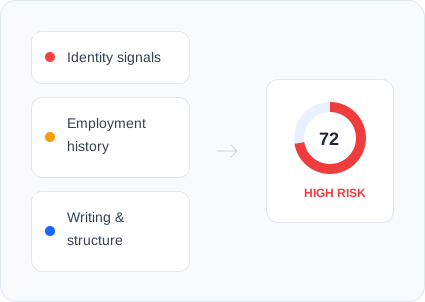
Turn CV Red Flags Into a
Documented Risk Score
A checklist tells you what to look for. CV Risk Checker scans any resume in seconds and shows you exactly where the fraud signals are — before you book the interview.
Connect appointment approval to safe onboarding
Before confirming the start arrangements, bring the evidence together. The responsible decision makers should know which requirements are satisfied, which checks are complete, and what supervision or training the new colleague needs. Resolve outstanding appointment conditions through the established policy.
Recruitment and the receiving team should agree on the handoff. Name the supervisor, confirm induction arrangements, and explain how the new starter can raise questions. A recruitment file can document a sound decision while the first shift still exposes gaps in practical preparation.
Review the process after the appointment. Ask whether the role description was accurate and whether the planned support was delivered. Use that feedback to improve future hiring requirements without attributing every clinical outcome to the recruitment decision.
The handoff should identify what needs to happen before the colleague works independently. For example, someone with relevant external experience may still need orientation to local escalation routes and documentation systems. Confirm that the receiving manager has accepted responsibility for those arrangements. Recruitment can close its administrative tasks while the service maintains a clear record of readiness and supervision. Completing one stage should not hide an outstanding action owned by another team.

Bring nonclinical roles into the patient safety discussion
Healthcare organizations also rely on administrative, technical, and operational staff. These colleagues may support appointment coordination, maintain information systems, or manage access to facilities and records. Their selection needs criteria tied to those responsibilities, even where clinical registration is irrelevant.
Consider a scheduling role serving patients who need coordinated appointments. The assessment can explore handling incomplete information, communicating changes clearly, and escalating uncertainty through the approved route. A technology role needs a different assessment, based on the systems and responsibilities involved. These examples show how recruitment can reflect the contribution of the role without pretending that every employee performs clinical work.
Ask the service owner to identify realistic consequences of mistakes and the controls that help colleagues recover. Use that information to shape assessment and induction. Avoid dramatic scenarios that exaggerate the employee's authority or overlook safeguards already in place.
Resolve disagreement with a documented review
A panel may agree that a candidate has strong relevant experience while disagreeing about one requirement. Identify the point of disagreement and what evidence could resolve it. Additional assessment should have a clear purpose, rather than expand until the panel reaches a preferred answer.
For example, a candidate may describe unfamiliar overseas responsibilities. The clinical reviewer can examine the actual work and the authoritative qualification evidence, while recruitment obtains clarification. Record whether the uncertainty concerns eligibility, experience, or the support required after appointment. Those questions can lead to different decisions.
When the available evidence is insufficient, follow the appointment policy and explain the next step through the appropriate communication process. Neither a senior manager's enthusiasm nor a software finding should substitute for resolving a material requirement. A documented decision also helps the organization review comparable cases consistently.
Review whether the hiring process supports the care team
Choose measures that describe the process employers can actually evaluate. Useful questions include whether essential requirements were defined before advertising, whether credential checks were completed, and whether new starters received the support agreed during selection. Record where reviewers repeatedly had to request missing information.
Recruitment and clinical managers can review a sample of appointments together. If the same role requirement is repeatedly misunderstood, improve the advertisement and assessment. If supervision was promised but unavailable, assign the issue to the service leaders responsible for delivery. The response should follow the evidence.
Clinical incident trends need interpretation through the organization's established quality processes. Changes in patient needs, staffing, workload, and care systems can affect outcomes. A hiring process review can identify practical improvements without claiming that a particular appointment or document tool explains every change in patient safety.
Conclusion
Patient safety belongs in healthcare recruitment from the first conversation about a vacancy to the new colleague's introduction to the team. Clear requirements, meaningful assessment, and independent checks help employers explain their choices. CrossClassify can support the document review stage through recruiter screening tools, while clinical judgment, appointment authority, and ongoing staff support remain with the healthcare organization.
See How CrossClassify Protects Recruitment Platforms
Detect fake recruiters, fraudulent resumes, and job scams instantly

Check a CV for Fraud Signals in 60 Seconds
Upload any resume and get an instant risk score, flagged signals, and a recruiter-ready action checklist.
Try the CV Risk CheckerNo credit card required
Share in
Related articles



Frequently asked questions
Let's Get Started
Create your free
account today
Discover how to secure your app against fraud using CrossClassify
No credit card required