Last Updated on 10 Oct 2026
How Healthcare Providers Can Hire Under Pressure Without Cutting Corners
Share in
Introduction
A clinic needs another practitioner before a colleague leaves. The vacancy is approved, applicants are waiting, and the service manager wants a start date. Yet the process stalls between screening, interview scheduling, and outstanding checks. The pressure grows while nobody can explain which step actually needs attention.
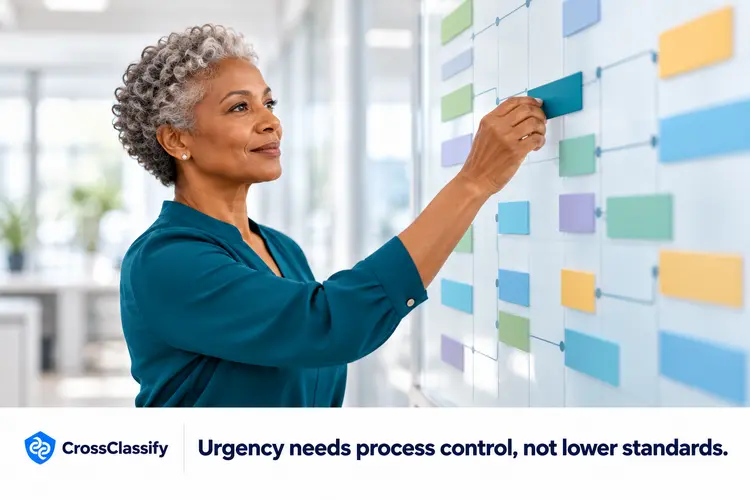
Hiring under pressure requires control over the process. Healthcare providers can remove duplicated administration, coordinate reviewers, and keep candidates informed while preserving the evidence needed for appointment. The practical goal is to reduce avoidable delay without treating urgency as a reason to accept unresolved requirements.
Locate the delay before changing the standard
A long recruitment process can contain several different problems. Applications may wait for review, interviewers may be unavailable, or a candidate may not know which document is missing. Each problem needs a different response. Describing all of them as slow hiring makes improvement difficult.
Review recent vacancies by stage. Record when an application arrived, when review began, and what happened before the next decision. Distinguish time spent doing necessary work from time spent waiting for ownership, an appointment, or clarification.
For example, repeated requests for the same information suggest a coordination problem. An unresolved professional registration question is an evidence problem. Give each a named owner and a clear next action, rather than applying a general instruction to accelerate everything.
Use a small set of recent appointments to test the explanation. A vacancy that attracted few suitable applicants needs a different intervention from one that produced a shortlist quickly but waited for an interview panel. Ask what the candidate was waiting for at each point and what the employer was waiting for. A process diagram helps only if it identifies the actual decision, the person responsible, and the information needed to move forward.

Agree on essentials before applications arrive
Urgent hiring becomes harder when the panel discovers that reviewers have different expectations. One person may prioritize specialist experience while another assumes that training is available. Recruiters then repeat screening or seek information that the advertisement never requested.
Before opening the vacancy, agree which requirements must be satisfied for appointment and which skills can develop with support. Confirm who can interpret unfamiliar qualifications and who approves any proposed changes to the role. Include clinical input where the responsibilities require it.
Make the advertisement reflect the actual working arrangement. Explain the location, schedule, expected responsibilities, and relevant supervision. Clear requirements help suitable applicants decide whether to proceed and give reviewers a stable basis for assessment when the service becomes impatient for a decision.
Challenge criteria that are convenient but unnecessary. Requiring experience in the employer's exact software or an identical organizational setting may exclude applicants who can learn with available support. Clinical leaders should decide which capabilities are essential immediately and which can develop safely. The recruiter should document that distinction before comparing CVs. Changing preferences during screening can otherwise create inconsistent judgments and repeat work without improving the evidence behind selection.
Coordinate checks through one accountable record
Recruitment, clinical assessment, and employment checks often involve different teams. Build a shared record of what needs to happen, who owns it, and what evidence is still missing. Use explicit statuses such as requested, received, awaiting clarification, and completed.
Where organizational policy permits, independent tasks can proceed together. A recruiter can arrange an interview while the designated team checks documents already supplied. Dependencies still matter, including which conditions must be satisfied before someone starts the relevant work.
NHS Employers maintains employment check standards covering distinct categories, including identity and professional registration. Use the applicable local requirements when designing the process. A CV review result should never be recorded as completion of an authoritative registration check, and a pending response should not quietly become an approval.
A status should say more than in progress. Record the outstanding item, the latest request, and the next action. If clarification is needed, identify who can provide it and who will interpret the response. Protect the record through approved access arrangements so coordination does not create unnecessary copies of candidate information. A shared process can be implemented through existing systems; it does not require attributing case management capabilities to a CV analysis tool.

Make candidate communication part of the workflow
A candidate who receives no update may not understand whether the employer is interested or whether something is missing. Set a communication schedule that explains the next step and identifies a person who can answer questions. Avoid promising a decision date that reviewers cannot meet.
Consider a practitioner waiting for an interview invitation while two managers assume the other is arranging it. A named scheduling owner and a brief update can resolve the problem without changing any clinical assessment requirement.
Provide a clear route for submitting requested information and explain why it is needed. CrossClassify's CV contact extraction can organize contact details present in a readable CV, but recruiters should confirm the appropriate channel and manage communication through their approved process.
Give applicants practical information about interview format, assessment expectations, and the route for requesting an adjustment. If a step is delayed, explain what happens next rather than send a generic message saying the application is being reviewed. Recruiters can maintain contact without disclosing internal deliberations. Candidates who understand the process can respond to focused requests, and the employer can distinguish missing information from a message that never reached the intended person.
Use document analysis to focus recruiter attention
When applications accumulate, recruiters need to find relevant evidence and unanswered questions. CrossClassify's CV Checker compares a CV with an entered job description and surfaces Match Signals, alongside separate document risk findings. These outputs provide starting points for review.
For example, a CV may describe related experience without explaining whether it involved the service's required responsibilities. The recruiter can check the relevant passage and ask a focused question. That is more useful than requesting a complete career history again.
Keep role suitability separate from document concerns. Missing detail does not establish fraud. An unreadable document needs an alternative review route, while a flagged inconsistency needs examination. The employer's reviewers still determine whether the evidence supports progression or appointment.
A screening pilot should include ordinary applications as well as difficult documents. Review whether the entered job description is accurate, whether cited evidence can be found in the CV, and whether the questions generated help the reviewer. Check a sample of applications that appear straightforward, too. Prioritizing review does not justify treating an unflagged application as verified. Keep the organization's essential checks and assessment steps in place for everyone to whom they apply.
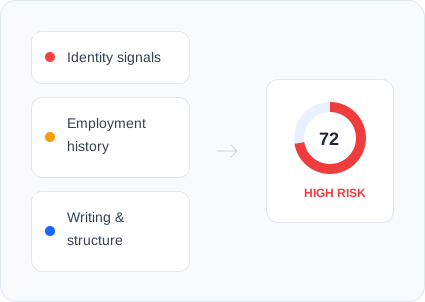
Turn CV Red Flags Into a
Documented Risk Score
A checklist tells you what to look for. CV Risk Checker scans any resume in seconds and shows you exactly where the fraud signals are — before you book the interview.
Plan temporary coverage alongside permanent recruitment
Recruitment cannot immediately resolve every capacity gap. Service leaders should manage interim arrangements through their staffing and clinical governance processes while recruiters work toward a sustainable appointment. This separates the immediate care decision from the selection decision.
Temporary professionals can contribute valuable experience. The relevant questions include familiarity with the setting, available support, required checks, and orientation. The evidence reviewed by AHRQ does not support assuming that agency status alone makes care unsafe.
Coordinate with the receiving team so every new colleague knows how to obtain help and use local procedures. If safe coverage remains uncertain, escalate it to the responsible service leaders. Pressuring a recruiter to produce a start date cannot resolve a staffing decision that needs clinical oversight.
The service should also know when an interim arrangement will be reviewed. A short gap can become an ongoing dependency if permanent recruitment repeatedly stalls. Ask whether the proposed cover creates additional supervision work and whether the team can provide it. Recruitment can report the realistic status of the vacancy while service leaders evaluate capacity. Keeping those responsibilities connected helps prevent an optimistic hiring forecast from becoming an unsupported staffing assumption.

Measure progress without rewarding rushed appointments
Time to hire is useful, but it should be considered alongside where delays occur and whether required steps were completed. A shorter timeline can conceal omitted checks or an appointment that leaves the team unprepared for onboarding.
Track waiting time at each stage, repeated information requests, candidate withdrawals, and unresolved conditions. Review a sample of completed appointments to confirm that decisions and checks are documented. Ask new starters whether the process accurately described the role.
Start improvements with one recurring bottleneck, such as scheduling or clarification requests. Compare the process before and after the change. Treat any improvement as a local finding, rather than claiming that a screening tool will deliver the same result across every healthcare employer.
Review variation between similar vacancies instead of relying only on an overall average. One department may wait longer for clinical interviews while another repeatedly requests incomplete documents. Compare the reasons before setting a universal timeline. Discuss candidate withdrawals using recorded stages and feedback, rather than assume that every departure reflects a slow process. The aim is a process the team can explain and improve, with assurance visible alongside speed.

Separate workforce supply problems from process problems
Healthcare vacancies exist within broader workforce constraints.WHO identifies difficulties in education, deployment, employment, and retention, including challenges serving rural and underserved areas. A more efficient screening process cannot create specialist professionals who are unavailable or make an unattractive working arrangement sustainable.
If suitable applications remain scarce, examine the vacancy itself. Confirm that responsibilities, pay arrangements, location, and support are described accurately. Ask clinical leaders whether the role can be redesigned or supported through an appropriate development pathway. Any change should follow the service's governance and appointment requirements.
Recruitment and service leaders should agree which problem they are trying to solve. Removing a scheduling delay may improve an existing candidate's experience. Building a future workforce pathway requires a longer commitment. Treating both as a demand for faster CV review can distract the team from the action that would actually help.
Broaden sourcing without weakening the role requirements
Expand the search around relevant experience rather than simply increase application volume. A specialist vacancy may benefit from professional networks or conversations with candidates who have related responsibilities. Employers can also consider returners or development routes where the service can provide the required support.
Define what needs clarification for each route. An applicant returning to practice may need an assessment and transition plan that differs from a currently practising specialist. Someone with international experience may describe comparable work using different terminology. Review the evidence with the appropriate professional input instead of relying on a familiar job title.
International recruitment also needs attention to ethical recruitment and the requirements applicable to the employer and source country. WHO's workforce guidance recognizes this responsibility. A broader search should not become a shortcut around qualification recognition, employment checks, or realistic support for the person relocating.
Set a practical escalation route for blocked appointments
An urgent vacancy needs a clear way to resolve uncertainty. Agree who receives a blocked case, what information the escalation includes, and who has authority to decide the next step. The record should explain the unresolved requirement and the effect on the proposed start arrangements.
For example, interview evidence may be complete while a required verification remains outstanding. Recruitment can summarize what has been obtained and what response is awaited. The designated reviewer determines whether further evidence or another approved route is appropriate. The decision should not disappear into an informal conversation between managers.
Keep candidates informed about the procedural next step and avoid promising that an exception will be granted. If the service cannot safely rely on the projected start date, route the capacity issue to its staffing leaders. Effective escalation speeds up ownership and clarification; it does not convert a missing requirement into a completed one.
Conclusion
Healthcare hiring can become more responsive when teams remove unnecessary waiting, clarify responsibilities, and ask focused questions. Essential assessment should remain visible throughout the process. Explore CrossClassify's recruiter review workflow as one source of document support, with appointment standards, clinical oversight, and interim staffing decisions controlled by the employer.
See How CrossClassify Protects Recruitment Platforms
Detect fake recruiters, fraudulent resumes, and job scams instantly

Check a CV for Fraud Signals in 60 Seconds
Upload any resume and get an instant risk score, flagged signals, and a recruiter-ready action checklist.
Try the CV Risk CheckerNo credit card required
Share in
Related articles



Frequently asked questions
Let's Get Started
Create your free
account today
Discover how to secure your app against fraud using CrossClassify
No credit card required