Last Updated on 04 Dec 2025
CV Screening in the Age of AI: How to Detect Fake Resumes and Stop Recruitment Fraud
Share in
Introduction
The hiring landscape has changed dramatically in recent years. With the ease of submitting online applications and the growing pressure to stand out, many candidates have turned to embellishing or even fabricating parts of their CVs. At the same time, AI writing tools have made it easier than ever to generate polished, professional-looking resumes within minutes. As a result, CV fraud is rising quickly, making it increasingly difficult for businesses to distinguish genuine talent from artificially enhanced applications. To protect themselves, organizations must adopt more scalable and intelligent methods of identifying resume fraud and verifying candidate authenticity. Read more about Fraud Prevention and Cybersecurity in the Recruitment Industry here.
CV Frauds and Their Effects
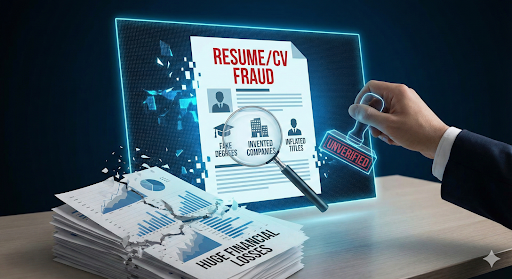
Resume fraud has evolved far beyond harmless exaggeration. Today, candidates inflate job titles, invent companies, fabricate degrees, or list skills they do not actually possess. These inaccuracies can have serious consequences. For example, one Australian public agency unknowingly hired a candidate with a history of resume fraud for a senior financial position. The decision resulted in losses of A$16.69 million due to misconduct and mismanagement.
Research shows the problem is widespread. Studies indicate that up to 25 percent of applicants admit to lying on their CVs . In the United States, the cost of resume fraud to employers is estimated at roughly 600 billion dollars per year . In the United Kingdom, recruitment fraud which includes fake credentials and fabricated references costs businesses about 23.9 billion pounds annually.
These figures illustrate that hiring a fraudulent candidate is not just a hiring mistake. It is a business risk with real financial consequences.
How to Detect Fake CVs and What to Look For
Employment History Red Flags
Employment history is one of the most common areas where fraud occurs. Candidates sometimes inflate roles, exaggerate achievements, or invent companies to appear more experienced.

This includes claims that do not align with what a company could realistically support. Examples include leading teams significantly larger than the company's actual staff size or claiming to have built a large-scale social media platform entirely alone. These statements suggest the candidate is presenting fantasy rather than fact.
Unverifiable companies or references
Some candidates list employers that have no digital footprint or provide references using personal email accounts. Others include a pattern of very short self-employed roles that appear to be gap-fillers. When a company cannot be found anywhere or when references cannot be validated, the credibility of the experience becomes questionable.
Timeline inconsistencies
Overlapping full-time roles without explanation, odd transitions between jobs, or clusters of unusually short positions may indicate attempts to hide gaps or exaggerate experience.
Unrealistic promotions
Rapid jumps in seniority that do not match industry norms such as moving from intern to senior-level positions in a few months or claiming executive roles at a very early age often suggest fabrication.
Suspicious company details
Missing information about company size, industry, or location raises concerns. Listing employment at well-known companies but placing them in the wrong location or mentioning defunct companies without proof also suggests possible fraud.
Skills and Qualifications Red Flags
Fraud also appears in the skills and education sections where candidates try to impress by listing an unrealistic number of abilities or altering academic achievements.
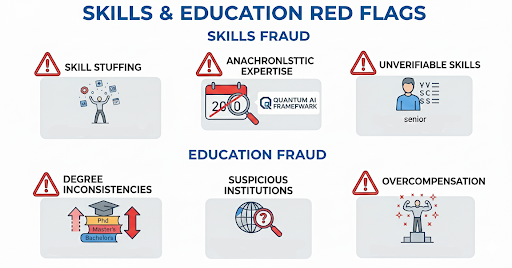
Some candidates list an excessive number of unrelated technologies or claim senior-level expertise across too many fields at once. Fraud becomes even more clear when a candidate claims experience with tools that did not exist during the period they mention. For example, stating more than ten years of experience in FastAPI, a framework that is significantly younger, is an obvious red flag.
Degree inconsistencies
Unusually fast degree completion or illogical academic sequences such as listing a PhD before a Bachelor's degree raise concerns about accuracy.
Suspicious institutions
Some applicants mention universities that cannot be found online or list institutions in locations that contradict their work history. For example, stating full-time work in Paris while simultaneously pursuing an on-campus degree in India is highly unlikely.
Overcompensation
Excessive self-promotion, repeated inflated claims, and achievements with no measurable detail often indicate that the candidate is trying to overstate their abilities.
Identity Red Flags
Identity information can reveal discrepancies that point to fabricated profiles.
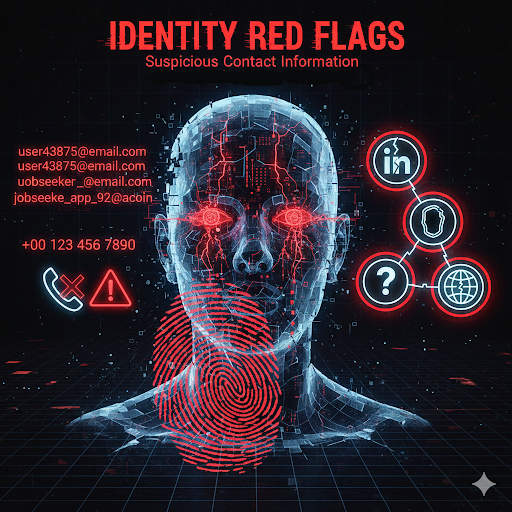
Email addresses that look auto-generated, such as those containing random digits or job-related words, are often newly created accounts used only for job applications. Phone numbers that do not match the country where the candidate claims to live are another sign of potential misrepresentation.
Unverifiable online presence
If a candidate's LinkedIn profile, portfolio link, or personal website leads to an empty page or does not exist, this raises immediate concerns. A lack of digital footprint for a supposedly experienced professional is often a strong indicator of a fabricated identity.
Writing and Structure Red Flags
The writing style of a CV can reveal whether it was authored by a real person or generated or pieced together using AI or other sources.
AI-generated signalsThese include overly generic and perfectly polished language, repetitive sentence structures, and unnatural punctuation choices. Resumes that read like templates with no personal nuance are often machine-generated.
A CV that shifts abruptly in tone or quality, such as a flawless summary paired with poorly written experience descriptions, suggests multiple authors or the use of AI tools. This inconsistency often reveals that the document was assembled from various sources rather than written by the candidate.
JOB DESCRIPTION–BASED RED FLAGS
Another important source of fraud indicators comes from comparing the resume directly with the job description. Many fraudulent candidates tailor their applications specifically to fool the first layer of screening, which is often handled by an AI system that compares the job description with the resume. By mimicking the language of the job posting, they attempt to bypass automated matching algorithms and move to the next stage of the hiring process despite not having the real experience.
Copy and paste or mimicry of the job description
A common tactic is to copy entire sections of the job description directly into the resume. Responsibilities in the CV may appear almost identical to the posting, with little original detail or real context behind them. In the same way, the skills section might replicate the job requirements list word-for-word, suggesting the candidate simply pasted the criteria into their resume to trigger a high AI match score, rather than listing genuine capabilities.
Claims that match the JD but lack supporting evidence
Another red flag appears when candidates claim expert-level proficiency in every skill listed in the job description, but their work history includes no projects or responsibilities that demonstrate those abilities. In some cases, the candidate's headline or summary matches the job title and keywords from the posting exactly. However, their actual background is in different roles or domains, revealing that the alignment is superficial and intended primarily to pass automated screening filters.
Seniority or domain mismatch relative to the JD
Some candidates inflate their title in the resume header to match the seniority level in the job description, such as calling themselves a Senior Architect despite listing only junior or internship-level experience. Domain mismatches are also common. For instance, the job description may target data engineering, while the candidate's career has been almost entirely in unrelated fields. The only "matching" elements appear suddenly in the headline or skills section, with no real history to support those claims.
Professional Networking Red Flags
A candidate's presence on professional networking platforms, especially LinkedIn, can reveal critical information about the authenticity of their profile. Fraudulent applicants often create or alter their online presence to support fabricated resumes, but inconsistencies in their digital footprint can expose the deception. Evaluating LinkedIn profiles is an essential part of detecting identity and experience fraud.
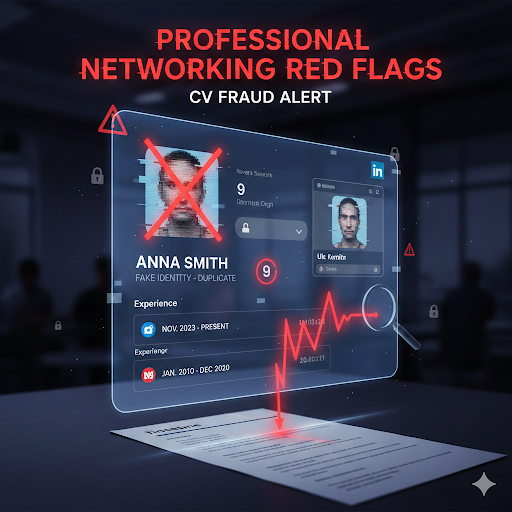
A genuine LinkedIn profile typically includes profile verification. Red flags appear when the profile has a very recent creation date, limited activity, or almost no professional engagements. Profiles created only days or weeks before an application may indicate an artificial identity constructed specifically for job hunting.
Connection count and network depth
Fraudulent profiles often have very few connections. While connection count alone is not definitive, profiles with only a handful of contacts despite claiming years of professional experience raise questions. Experienced professionals usually accumulate a network over time, and a lack of it suggests a newly fabricated presence.
Lack of recommendations or endorsements
Authentic professionals often receive endorsements or recommendations from colleagues, clients, or former employers. A total absence of recommendations is not necessarily proof of fraud, but when combined with other suspicious signals, it increases concern. Fraudulent candidates rarely have credible individuals who can vouch for their experience.
Profile mismatch with the CV
One of the strongest indicators of fraud is when the LinkedIn profile does not match the resume. This may include different dates, different job titles, missing companies, or inconsistent skill sets. In some cases, the LinkedIn profile shows a completely different career path than the one presented in the CV, revealing attempts to manipulate information for specific job applications.
Profile image inconsistencies or duplication
Another important check is verifying whether the profile photo is unique. Fraudsters often use stock photos, AI-generated faces, or images stolen from other profiles. A simple reverse image search can reveal if the same profile picture appears on multiple LinkedIn accounts or unrelated websites. If another LinkedIn profile uses the same image, or if the photo is found on stock image databases, it strongly indicates a fake or compromised identity.
Manual Screening Is No Longer Enough
Recruiters today face massive volumes of applications. It is not uncommon for a single job posting to receive hundreds or thousands of CVs. Verifying each one manually takes time and is extremely difficult to scale.
A recent survey found that only 19 percent of hiring managers believe their current processes can reliably identify fraudulent applicants . Nearly two thirds said AI now helps candidates deceive them more effectively. In the same study, one in four reported financial losses of more than 50,000 dollars per year due to fraudulent hires , and one in ten reported losses above 100,000 dollars.
Given these pressures, manual screening alone is no longer capable of detecting sophisticated fraud.
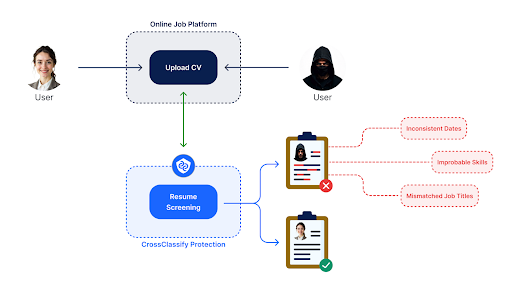
How CrossClassify Helps Recruitment Teams Stop CV Fraud at Scale
CrossClassify provides an AI-powered system that automatically analyzes resumes for fraud indicators we provided. Instead of requiring recruiters to manually inspect every detail, CrossClassify reviews each application with consistent and unbiased accuracy.
The system verifies company legitimacy, checks date consistency, analyzes skill credibility, evaluates education history, evaluates contact information, and identifies writing patterns associated with AI-generated or manipulated content. It compares thousands of data points to real-world information and assigns a risk score to each CV. Recruiters receive clear red flag categories, detailed explanations, and prioritized insights, allowing them to focus on genuine talent while significantly reducing verification time.
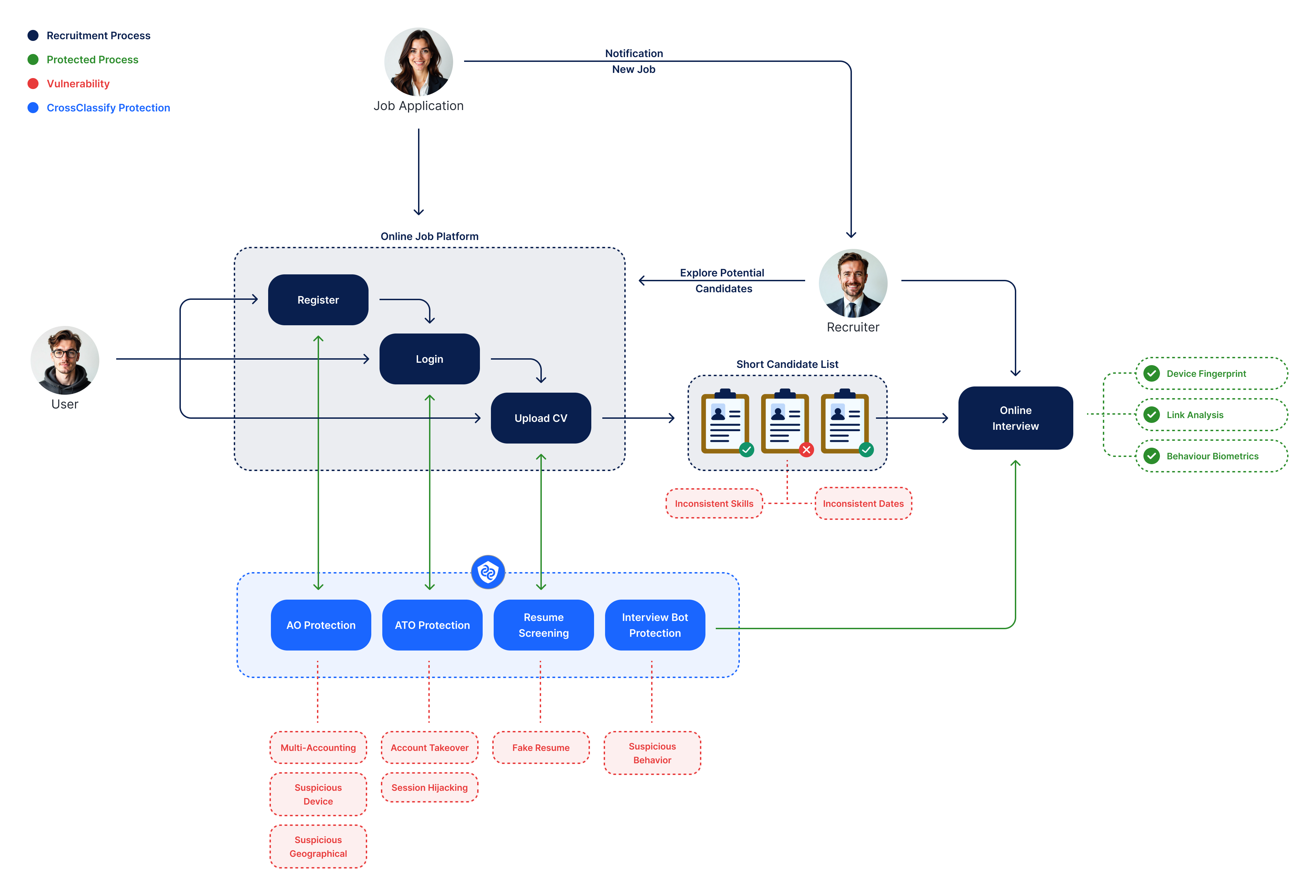
Resume screening and fake CV detection is only one part of CrossClassify's Real-Time Recruitment Fraud Detection service. The platform is built to protect the entire recruitment lifecycle, not just the application stage.
Account opening protection
CrossClassify prevents multi-accounting by detecting users who create several accounts to bypass restrictions or reapply under different identities. It blocks suspicious devices, device farms, and unusual geographical patterns, ensuring that only legitimate applicants can create profiles. This stops fraud early, before a single resume is even submitted.
Account takeover (ATO) protection
The system detects and prevents account takeovers and session hijacking. By monitoring live behavioral patterns and device fingerprints, CrossClassify can identify when an unauthorized user attempts to access an applicant or employer account, preventing malicious actors from exploiting the recruitment platform.
Interview bot and agent protection
During live interviews, CrossClassify uses link analysis, behavioral biometrics, and real-time device fingerprinting to identify bots, deepfakes, remote controlled sessions, and impersonation attempts. This ensures that the candidate participating in the interview is the real individual behind the application and not a proxy or automated system.
Together, these capabilities provide end-to-end protection across the entire hiring workflow. CrossClassify is designed not just to detect fraudulent CVs but to secure every touchpoint in the recruitment process, from account creation to the final interview. You can access the CrossClassify Recruitment Solution white paper here.
Conclusion
CV fraud is growing rapidly and is increasingly powered by modern AI tools. Traditional CV screening methods are no longer enough to protect organizations from sophisticated deception. Companies need automated and intelligent systems that can verify candidate authenticity at scale. CrossClassify delivers this capability using smart CV screening and empowers hiring teams to make confident and fraud-resistant hiring decisions.
Explore CrossClassify today
Detect and prevent fraud in real time
Protect your accounts with AI-driven security
Try CrossClassify for FREE—3 months
Share in
Frequently asked questions
- Overlapping or inconsistent employment dates
- Unrealistic job titles or rapid promotions
- Companies with no online footprint
- Skills that don't match real project experience
- Claims of expertise in technologies that didn't exist at the stated time
- Perfectly polished or overly generic writing (often AI-generated)
- LinkedIn profiles that contradict the resume

Let's Get Started
Discover how to secure your app against fraud using CrossClassify
No credit card required