
01 · About the customer
About Roast My IVR
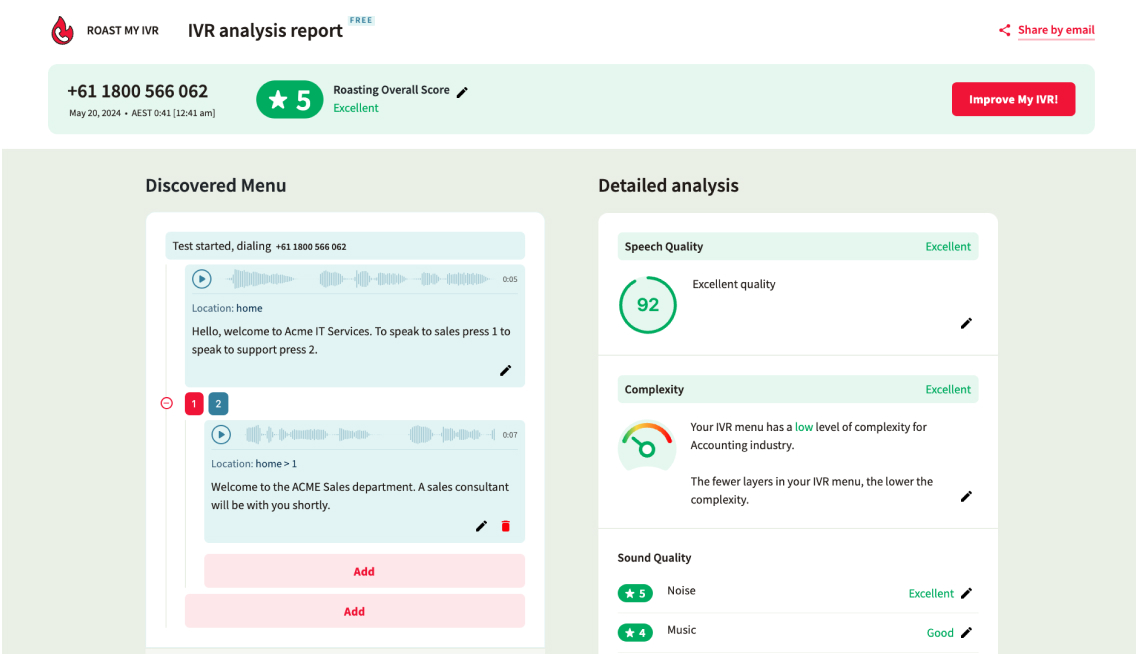
Roast My IVR gives businesses an automated report on their interactive voice response experience. A visitor submits a phone number and the service maps the call flow, hidden menus, wait-time issues and other friction in the customer journey.
The free first report is designed to make the product immediately useful. Behind that simple form, however, every accepted request can initiate real telephony and processing work.
02 · The challenge
Every submitted number could trigger real work—and automation could exploit that
Roast My IVR turns a phone number into an automated analysis of a company’s call flow, including hidden menus, wait-time issues and structural problems. The free report removes sales friction, but the public form also creates a direct path to resource-intensive testing.
Static validation or a challenge shown to everyone would punish genuine prospects. Yet treating every well-formed submission as human could invite scripted requests, repeated targets, disposable identities and avoidable telephony or processing costs.
Before CrossClassify
With CrossClassify
03 · The solution
Decide whether to trust the session before triggering the roast
CrossClassify added real-time bot, device, velocity and behavioral signals around the report request. The decision could account for how the visitor arrived, interacted and submitted—not only whether the fields passed validation.
Low-risk visitors kept the fast path. Suspicious automation, repeated device patterns or abnormal submission behavior could be challenged, rate-limited or held for review before expensive downstream work began.
How it works
One continuous loop replaced the one-time trust decision.
04 · The results
The free report stayed open without making the testing engine an open tab
Roast My IVR can preserve the no-sign-up experience that makes the product easy to try while adding a risk decision in front of the costly action behind the form.
The result is a cleaner testing queue, stronger control of automated abuse and a better conversion path for real prospects—because protection appears when risk rises, not by default.