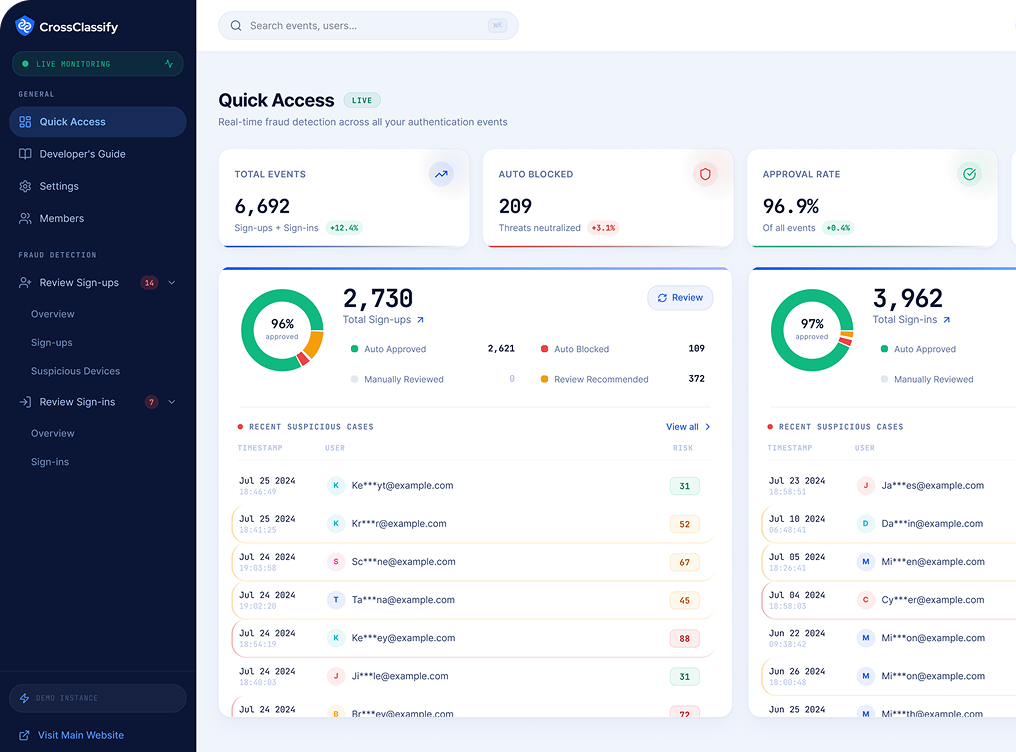
Last Updated on 25 Apr 2026
The Smart Job Scam Detection Layer for Indeed Style Hiring Platforms
Share in

Introduction
Many job seekers search for phrases such as “Indeed job scams,” “are there scams on Indeed,” “are Indeed jobs legit,” and “how to spot fake job postings on Indeed” because online hiring now depends on trust as much as visibility. This article discusses Indeed related search behavior and similar large job board experiences, not a partnership with Indeed. The bigger point is that recruitment marketplaces need a smart job scam protection layer that can detect fake job postings, fake recruiter behavior, suspicious devices, repeated scam patterns, and abnormal account activity before job seekers are harmed.
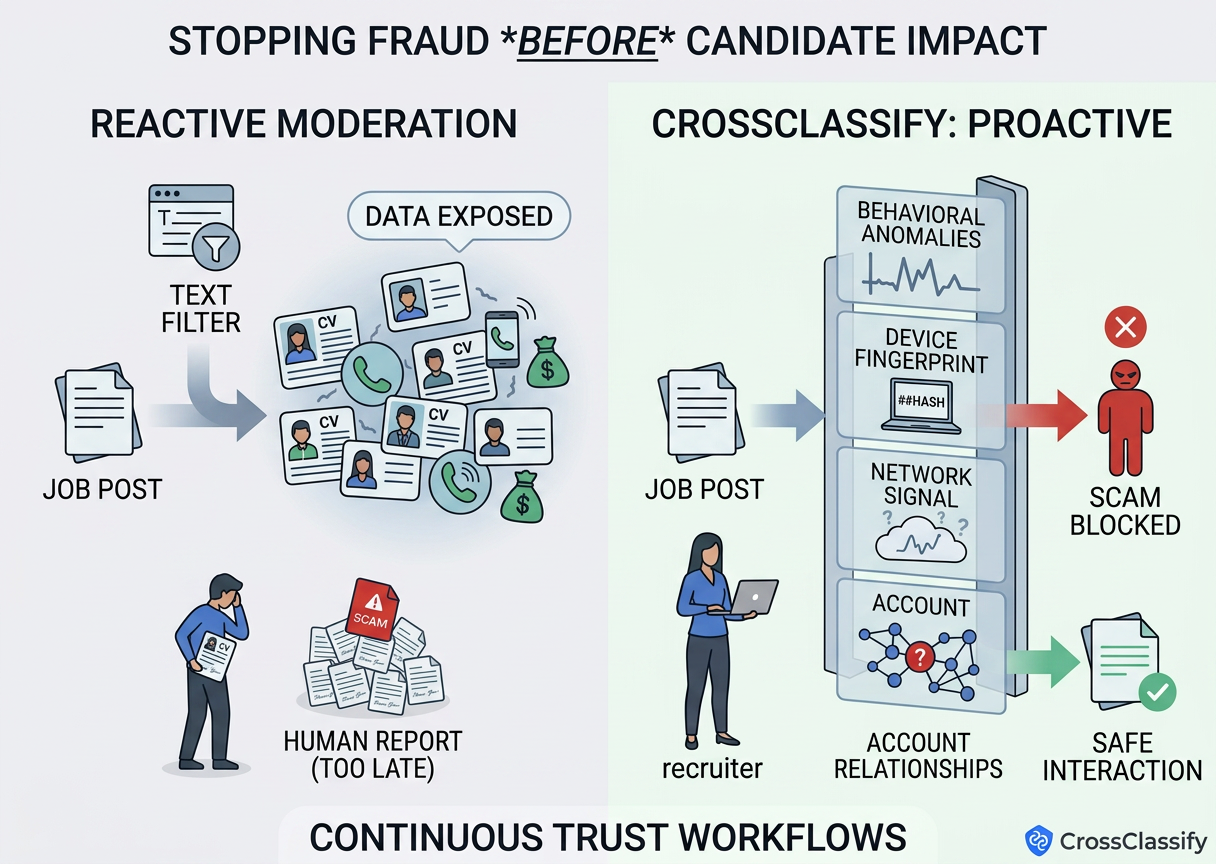
For platforms, the trust issue is not only about removing bad content after users report it. A fake job post can collect resumes, phone numbers, addresses, identity documents, and salary expectations before moderation teams notice anything unusual. This is why recruitment fraud detection software must look beyond job description text and analyze the behavior, device, network, and account relationships behind each posting.
CrossClassify helps recruitment platforms turn scam detection into a continuous trust workflow. The CrossClassify recruitment fraud protection solution is designed for recruitment environments where fake recruiter detection, candidate safety, and job scam protection must work together. This makes it useful for job boards, staffing marketplaces, hiring portals, and employer account systems that want to reduce fake job posting risk at scale.
Why People Search “Are There Scams on Indeed?”
Searches like “are there scams on Indeed,” “are all jobs on Indeed legit,” and “how to spot fake job postings on Indeed” show a clear trust gap in online recruitment. Job seekers want access to more opportunities, but they also want confidence that the recruiter is real, the company exists, and the job post is not a phishing trap. This type of search intent is especially important because it appears before the user takes action, such as uploading a resume, clicking an external link, or replying to a recruiter.
For hiring platforms, these searches reveal a commercial and reputational problem. If users repeatedly ask whether jobs are real, the platform is not only managing content quality, it is managing trust in the entire hiring journey. A smart recruitment fraud detection layer can help platforms answer this concern with stronger prevention, faster review, and better risk scoring.
CrossClassify addresses this trust gap by checking account behavior, device reputation, identity signals, IP and geo risk, and linked scam patterns. The recruitment protection page explains how fraud signals can be used to protect hiring workflows from fake recruiters and suspicious applicants. This gives platforms a stronger foundation than relying only on user reports or manual review queues.
Common Scam Patterns on Job Boards Like Indeed
Fake recruiters are one of the most damaging job scam patterns because they appear to be legitimate hiring contacts. They may use copied company branding, vague job titles, and professional language to gain a candidate’s trust. Once contact begins, they can move the candidate to email, chat apps, or external forms where identity harvesting becomes easier.
Fake job postings often use vague job descriptions, unrealistic salaries, flexible remote work promises, and urgent hiring language. These posts are designed to attract a high number of applicants quickly, especially people who are actively looking for work. The goal is usually not to hire, but to collect personal information, push payment scams, or redirect users to malicious links.
Upfront payment requests are another warning sign in job scam protection. A fake recruiter may ask candidates to pay for equipment, training, background checks, software access, or visa processing. A hiring platform that only checks job text may miss the wider pattern, but a fraud detection system can connect repeated payment language, device reuse, linked recruiter accounts, and suspicious contact behavior.
Identity harvesting scams are especially risky because resumes contain sensitive personal information. A resume may include name, phone number, email address, location, employment history, education history, and sometimes identity details. The CrossClassify device fingerprinting solution can support this type of protection by identifying repeated suspicious actors who create many recruiter or employer accounts from the same device environment.
Why Manual Moderation Is Not Enough
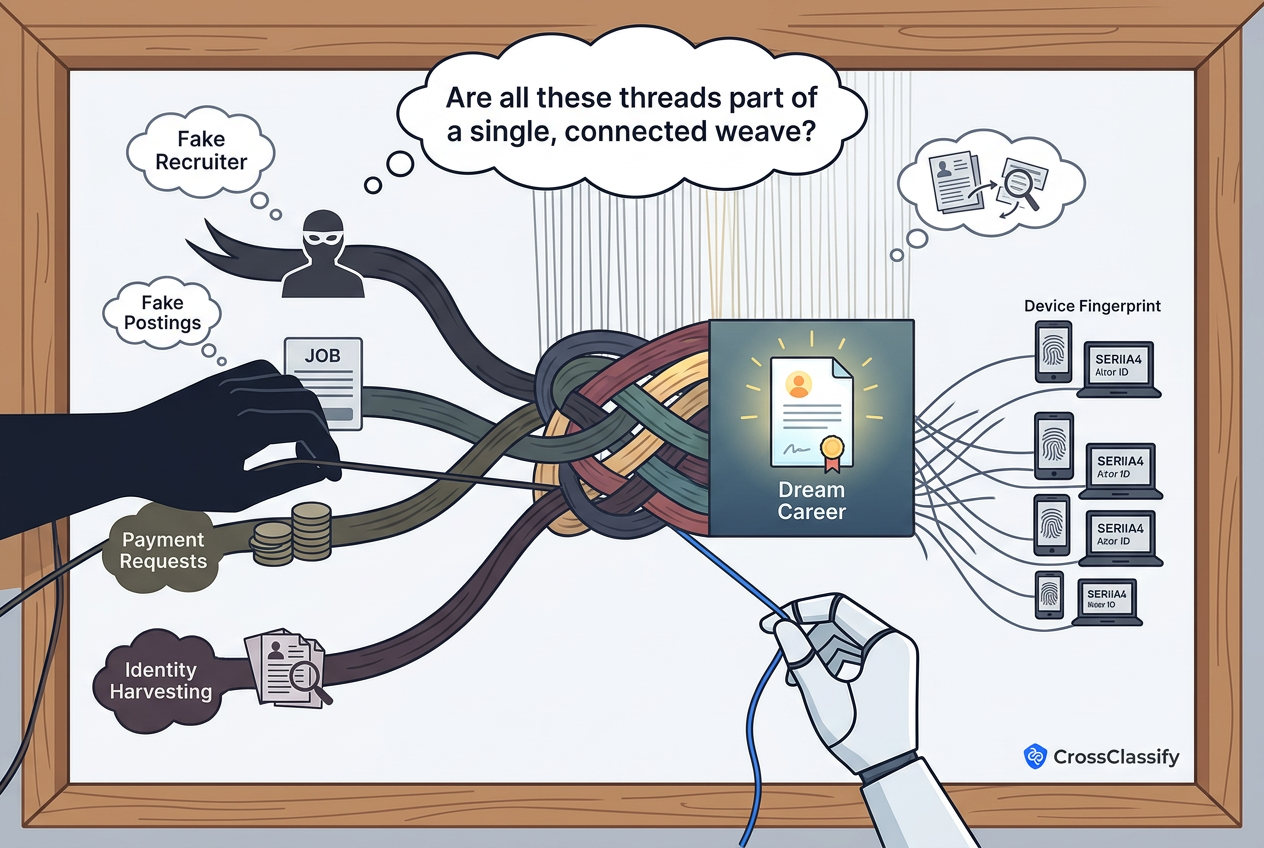
Manual moderation is important, but recruitment scams move faster than human review teams can handle. Fraudsters can reuse account patterns, posting templates, device profiles, IP ranges, contact details, and external links across many fake job posts. By the time a reported scam is reviewed, many candidates may already have shared personal data.
Recruitment fraud detection software must detect patterns before the damage spreads. A fake recruiter may slightly change job titles, company names, salary ranges, and contact messages while keeping the same underlying device, behavior, or network relationship. A smart detection layer can connect these hidden signals even when each post looks different on the surface.
CrossClassify gives review teams a better way to prioritize suspicious activity. Instead of treating every job post equally, the system can assign a risk score based on device fingerprinting, behavioral biometrics, link analysis, geo analysis, and suspicious account relationships. The bot and abuse protection solution can also help when scam campaigns involve automation, mass posting, or scripted recruiter actions.
Turn CV Red Flags Into a
Documented Risk Score
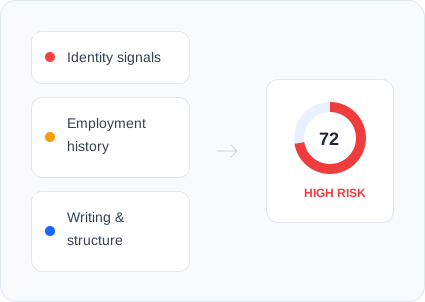
A checklist tells you what to look for. CV Risk Checker scans any resume in seconds and shows you exactly where the fraud signals are — before you book the interview.
How CrossClassify Detects Job Scam Signals
CrossClassify detects job scam signals by combining multiple layers of recruitment fraud intelligence. It does not rely only on the content of a job description because scammers can rewrite text easily. It looks at how accounts behave, where they connect from, what devices they use, which entities they share, and whether their activity resembles known fake recruiter detection patterns.
Device fingerprinting helps identify repeated scam accounts even when the fraudster uses different emails or company names. Behavioral biometrics can flag abnormal recruiter behavior, such as unusually fast posting, repeated copy and paste actions, or scripted interaction patterns. Link analysis can connect fake recruiter accounts, repeated contact details, similar external URLs, shared devices, and suspicious job templates.
The CrossClassify behavioral biometrics solution supports this approach by focusing on how users behave during digital interactions. This is important because legitimate recruiters and scam operators often behave differently when creating accounts, posting jobs, messaging candidates, and changing profile details. When combined with the recruitment solution, these signals help platforms detect fake recruiter behavior earlier.

Key Detection Signals
Device fingerprinting helps detect repeated scam accounts that come from the same browser, device, or technical environment. A fraudster may create many employer accounts with different names, emails, and company details, but the device pattern may still reveal a connection. This is a strong signal for fake job posting detection because it helps expose coordinated recruiter abuse instead of treating every account as separate.
CrossClassify can use device level intelligence to identify suspicious device reuse across employer signups, job posts, and recruiter messages. The device fingerprinting solution supports platforms that want to detect risky devices before those devices create more fake accounts. This helps recruitment platforms reduce job scam protection gaps caused by repeated account creation.
Behavioral biometrics
Behavioral biometrics can detect abnormal recruiter behavior that content filters may miss. A legitimate recruiter usually has a natural pattern when creating a company profile, filling job details, reviewing applicants, and messaging candidates. A scam operator may move too quickly, reuse text, skip normal profile steps, or repeat the same actions across many accounts.
CrossClassify can score these behavioral patterns and help review teams focus on high risk recruiter accounts. The behavioral biometrics solution is useful because behavior is harder to fake consistently than a job description. When behavior signals are connected to recruitment fraud detection software, platforms gain a deeper way to spot fake recruiters.
Link analysis
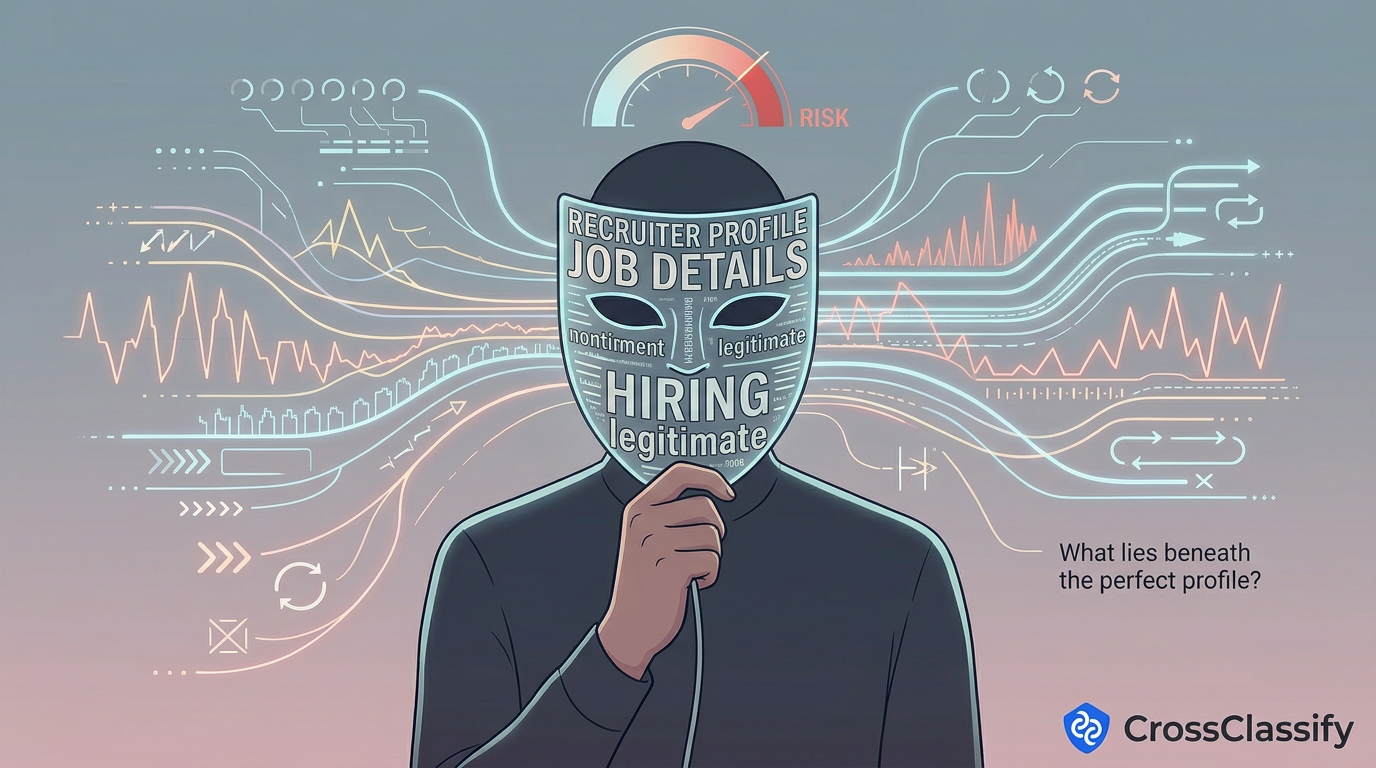
Link analysis connects accounts, devices, IPs, emails, phone numbers, company names, external links, and repeated job templates. This matters because many fake job scams are not isolated events, but campaigns that reuse infrastructure across multiple postings. A single suspicious employer account may be part of a larger network of fake recruiters and fake job listings.
CrossClassify can identify these relationships and give fraud teams a clearer picture of coordinated abuse. The recruitment fraud protection solution supports this type of platform level visibility for fake recruiter detection. This helps hiring marketplaces reduce repeated scam patterns rather than only removing one fake post at a time.
IP and geo risk
IP and geo risk signals can reveal suspicious access behavior behind recruiter accounts. A job post may claim to represent a local company, but the account may be created or managed from risky locations, anonymized networks, or inconsistent access points. These signals do not prove fraud alone, but they add important context to the overall risk score.
CrossClassify can combine IP reputation, geo mismatch, device changes, and login patterns to flag suspicious recruiter activity. The account takeover protection solution can also help when a real employer account is accessed from an unusual location and then used to post fake jobs. This gives recruitment platforms a stronger way to detect both fake accounts and compromised accounts.
Risk scoring
Risk scoring helps platforms prioritize the most suspicious job posts for review. Instead of asking moderators to manually inspect every posting with the same urgency, a smart fraud detection layer ranks job posts by combined risk. This can include device reuse, abnormal behavior, suspicious links, geo mismatch, account age, posting velocity, and repeated scam language.
CrossClassify can provide risk scores that help recruitment teams decide whether to approve, review, block, or escalate a job post. The CrossClassify recruitment solution is especially relevant because it applies these signals to hiring fraud and fake recruiter protection. This turns job scam detection from a reactive process into a proactive trust workflow.
Conclusion
Job boards and recruitment marketplaces need more than content moderation to protect users from fake job postings. Scammers can change words, create new accounts, reuse devices, copy company identities, and move quickly across platforms. A smart job scam detection layer can connect behavior, device, link, IP, geo, and risk signals before candidates are exposed to serious harm.
CrossClassify helps recruitment platforms detect fake recruiters, suspicious employer accounts, risky devices, and coordinated scam patterns. The recruitment fraud protection solution gives hiring platforms a focused way to strengthen trust across job posts, accounts, and candidate interactions. For platforms facing searches like “are there scams on Indeed” and “how to know if an Indeed job is real,” this kind of protection becomes a core part of user safety.
See How CrossClassify Protects Recruitment Platforms
Detect fake recruiters, fraudulent resumes, and job scams instantly

Check a CV for Fraud Signals in 60 Seconds
Upload any resume and get an instant risk score, flagged signals, and a recruiter-ready action checklist.
Try the CV Risk CheckerNo credit card required
Share in
Related articles


Frequently asked questions
Let's Get Started
Create your free
account today
Discover how to secure your app against fraud using CrossClassify
No credit card required