Last Updated on 03 Jul 2024
Legal cybersecurity
Share in

Law practices and startups in the lawtech space face an elevated onus when it comes to protecting extremely valuable and sensitive data.
Proofs and records are at the heart of all legal processes, and frequently the attack of online bad agents trying to steal, copy, destroy or falsify them.
Lawtech and legal practices have grown reliant on SaaS applications for their BAU operations, for different specialist processes from eDiscovery, to case management.
This move has however expounded their cybersecurity vulnerability as cyber criminals can now “come in” to their data from any one of the different SaaS/API integrations/Plug-ins they use for BAU.
With stolen security tokens available for purchase on the dark web for as little as $10, and the dark web itself having grown an estimated 300% since 2017 , times are fast changing for lawtech cybersecurity.
DoS attacks can disrupt BAU operations for a legal practice or a lawtech startup, inflicting quick, substantial damage in the short term (lost cases, direct legal risk) and long term (reputational damage, indirect legal risk).
A higher bar for lawtech: Legal data protection in 2024
Simply put, highly sensitive data must follow highly privileged access and security protocols, in how it is shared, accessed, viewed, recorded and encrypted.
Law practices are well aware of the general explosion of cybercrime online, being routinely involved in cybercriminal litigation on behalf of their clients. And business shows no sign of abating: A 2023 FBI report found that investment fraud grew from $3.31 billion in 2022 to $4.57 billion in 2023 (38% increase).
However, legal practices and lawtech startups face a conundrum: As SME’s with limited IT or financial resources they rely typically on SaaS application type, keywords and 2FA or MFA.
They also provide a false sense of security in this context, which can be an extremely high cyber risk posture for the lawtech / legal practices involved, considering the catastrophic risk specific to their trade.
Smart MFA in lawtech
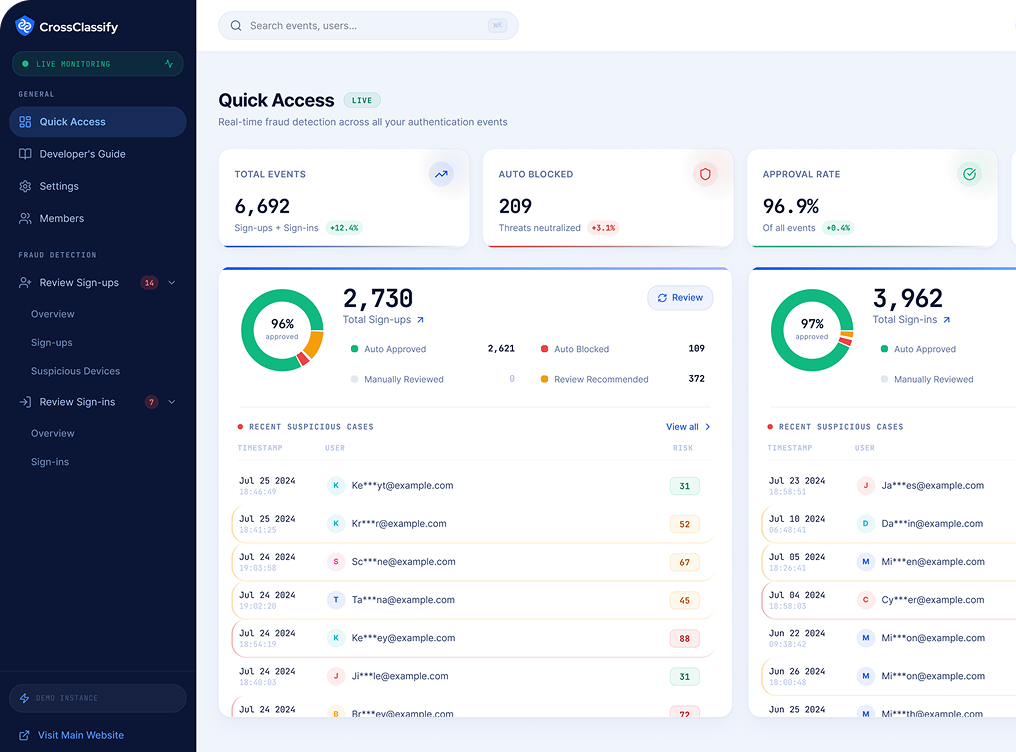
Smart MFA is an evolving cybersecurity protocol leveraging AI, that is particularly relevant to lawtech cybersecurity. By monitoring key behavioral biometrics, the AI cybersecurity solution can identify fraudulent accounts, or fraudulent usage of existing accounts very early.
Behavioral biometrics are also virtually impossible to emulate, which means that AI estimate is probably quite accurate, and can be broken down into different risk and associated mitigation thresholds.
Smart MFA in lawtech can be simply, to configure the AI cybersecurity monitoring so that an account with low risk estimate might have to authenticate for a medium value access or transaction.
A higher usage risk profile may require more MFA authentication triggers, for even lower transaction levels.
An extreme account risk profile may be configured to trigger immediate account freezing until manual review.
Smart MFA provides both more opportunities for a more nuanced cyber risk management, but it also provides on a normal day a higher cybersecurity as well as higher user UX.

Behavioral biometrics, account fraud and legal cybersecurity
In few words, the legal industry at large is expected to a reasonable degree to apply best practice when it comes to cybersecurity.
This is not just a cultural expectation, it is also a reasonably legal one. Should any legal organization be found negligent in the protection of their customers' data after a breach, they would most likely be sued, and possibly into oblivion.
Direct litigation (from their clients who may have lost a legal battle) as well as indirect litigation (from users who saw their private data breached)
Immediate alerting of fraudulent behavior
Another great advantage of AI cybersecurity based on behavioral biometrics is that often the alert is immediate and very clear in the case of a real life bad agent trying to penetrate an application.
Such responsiveness can be found in some existing software solutions that already track live cyber attacks against applications.
However these tend to track objective factors only (SQL injections, XSS attacks, MitM attacks) thereby missing outright a whole class of fraud around account hacking, session jacking, new account fraud, etc.
Preventing fraudulent access to accounts and data is central in law tech Law tech is famously a “high value target” for cybercriminals online. Stakes are high, information is absolutely central to massive outcomes in civil or criminal litigations.
Cyber criminals have long tried to influence due legal recourse by stealing, falsifying or destroying evidence, records, depositions and other digital proof.
Configurable cybersecurity policies Legal practices and lawtech startups are also more likely to need to be able to change and adapt their cybersecurity posture, in time as policy changes or in the case of a particularly high profile case.
Cybersecurity excellence in a digital world is becoming a core business expectation from clients, for any organization operating in high-regulatory, highly-sensitive data.
An AI powered cybersecurity monitoring, allows for a nuanced and highly configurable, higher effectiveness cybersecurity posture.
Higher cyber security regulatory standard Law practices are subject to some of the most stringent data protection standards in business terms, and using an AI-powered behavioral biometrics solution can help meet regulatory requirements and frameworks (GDPR, HIPAA).
The system data is a great source of insights and real time protection raising the whole cybersecurity profile, and providing more useful data in case of an incident.
Reputational and commercial gain / risk mitigation Increasingly for legal tech, cybersecurity excellence is becoming a critical expectation from clients across any jurisdiction. More and more, providing a safe service online and ensuring best practice for data protection is becoming a central, non-negotiable demand from most clients.
Failing the test and incurring a major data breach can be business-ending for a medium sized law practice, through direct litigation or long-term reputational damage.
Implementing modern cybersecurity protocols and communicating that best practice approach, is conversely, gradually becoming a strategic commercial leverage for lawtech companies as well as a source of higher customer satisfaction.
See How Protecting Customers from the Growing Threat of Account Takeover
Ensure Continuous Security with Real-Time Account Monitoring
Explore CrossClassify today
Detect and prevent fraud in real time
Protect your accounts with AI-driven security
Try CrossClassify for FREE—3 months
Share in
Related articles


Frequently asked questions
Let's Get Started
Create your free
account today
Discover how to secure your app against fraud using CrossClassify
No credit card required