02 Apr 2026
Your next breach will arrive as an approved update.
If you lead security or fraud for a fintech, SaaS, or crypto platform, you already know the nightmare pattern:
You did vendor reviews.
You enabled MFA.
You locked down access control.
You scan dependencies.
And still, something trusted ships to production and turns your own release pipeline into the attack path.
OWASP Top 10 2025 ranked Software Supply Chain Failures as the third biggest application risk, and it was the top concern in the community survey.
The message is simple: modern applications are ecosystems, and trust multiplies blast radius.
Two stories that changed how I explain this risk:
• SolarWinds showed how one poisoned update can expose roughly 18,000 organizations at once.
• The 2025 Bybit theft showed the more dangerous pattern: a trusted wallet interface that looked normal until a specific condition was met, then $1.5B moved.
Here is the fresh take most teams miss:
Software supply chain security is not only a governance problem.
It is an identity continuity problem.
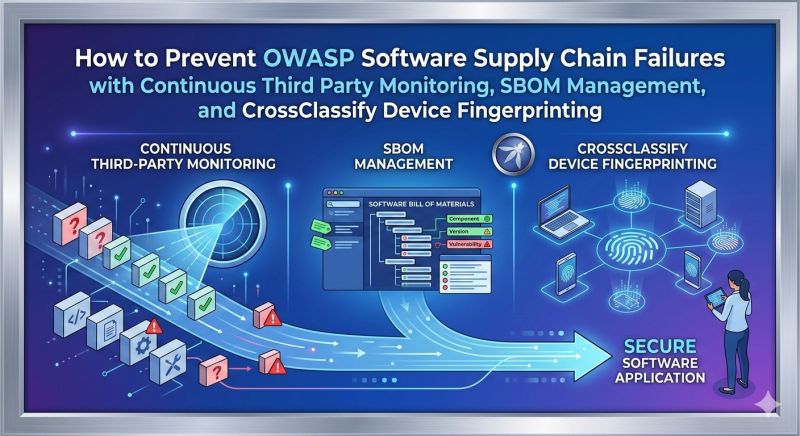
SBOM management, software composition analysis tools, transitive dependency tracking, and canary deployments reduce exposure.
But when an attack is conditional, or the compromise is already inside a trusted path, the winning question becomes:
Do our sessions still look like the same human using the same device, or did a trusted change just enable takeover at scale?
This is where CrossClassify fits as a continuous third party risk monitoring layer in production:
• Device fingerprinting fraud prevention to detect abnormal device continuity, device reuse, and session anomalies after a trusted change
• Behavioral biometrics continuous authentication to spot scripted behavior, mule activity, and silent account takeover even when credentials are valid
• Bot and abuse protection to catch automation spikes that often follow supply chain compromise and credential theft
SBOM tells you what you shipped.
CrossClassify helps you see what that shipment is causing right now, in real user flows, before the blast radius becomes a headline.
If you are building a software supply chain security platform strategy for 2026, combine prevention plus continuous monitoring, not one or the other.