16 Apr 2026
OWASP A08: Signed, Approved, and Still Dangerous
The most dangerous software integrity failure does not start with obviously malicious code.
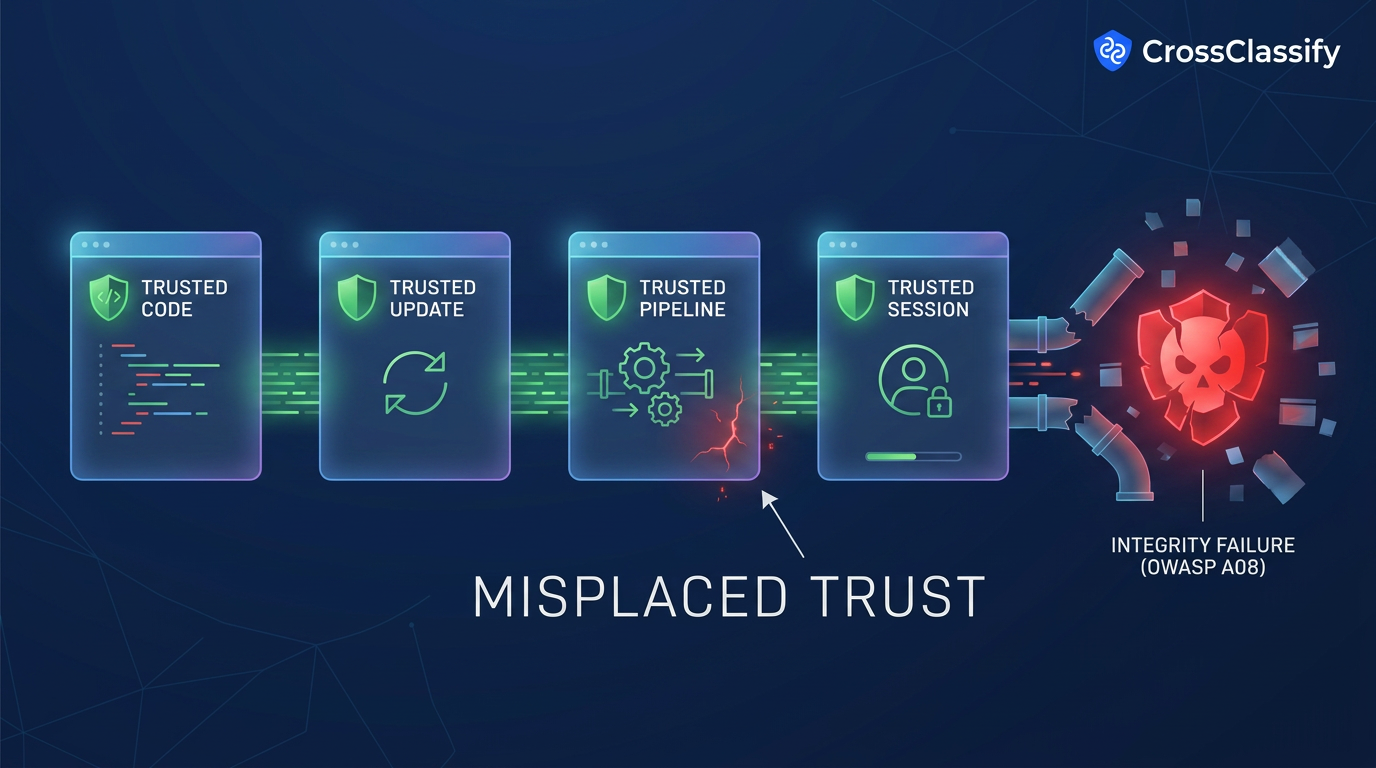
It starts with trusted code, trusted updates, trusted pipelines, and trusted sessions.
That is exactly why OWASP A08:2025 Software or Data Integrity Failures is so uncomfortable.
Because the problem is not only bad software.
The problem is misplaced trust.
A team signs the build.
The release looks clean.
The update comes from the expected source.
The user passes authentication.
Everything looks normal.
Then the damage starts.
We have seen this movie before.
SolarWinds showed the world what happens when a trusted build pipeline becomes the delivery channel for tampered code.
Kaseya showed how trusted administrative and update paths can push damage downstream at scale.
NotPetya showed that one poisoned update can become a global business crisis.
Here is the fresh take most teams still miss:
Software or Data Integrity Failures are not only a software supply chain problem.
They are a live trust problem.
A signed artifact can still come from a compromised process.
A valid session can still be driven by the wrong actor.
A normal login can still become account takeover, fake account creation, bot abuse, or silent workflow manipulation a few minutes later.
That is why "verify integrity once" is no longer enough.
The stronger model is:
Never trust by default, even your most trusted channels.
That means Zero Trust Architecture for application security.
That means Continuous Adaptive Risk and Trust Assessment.
That means continuous software integrity monitoring, secure CI CD pipeline protection, software update integrity verification, device fingerprinting for fraud detection, and behavioral biometrics for account takeover prevention.
This is where CrossClassify becomes powerful.
Not because it replaces code signing, trusted repositories, or secure deployment review.
But because it helps answer the question those controls cannot fully answer:
Is this still the same trusted actor, on the same trusted device, behaving in the same trusted way?
If the answer starts changing, CrossClassify can help surface the risk early through device fingerprinting, behavioral biometrics, continuous monitoring, and adaptive trust decisions.
That is the real gap in OWASP A08.
Not only how code gets in.
But what happens after trust is broken.
If your application still assumes that signed, familiar, or previously approved means safe, this is the conversation worth having.