02 Apr 2026
Most teams still talk about OWASP Injection like it is only a coding problem. It is not.
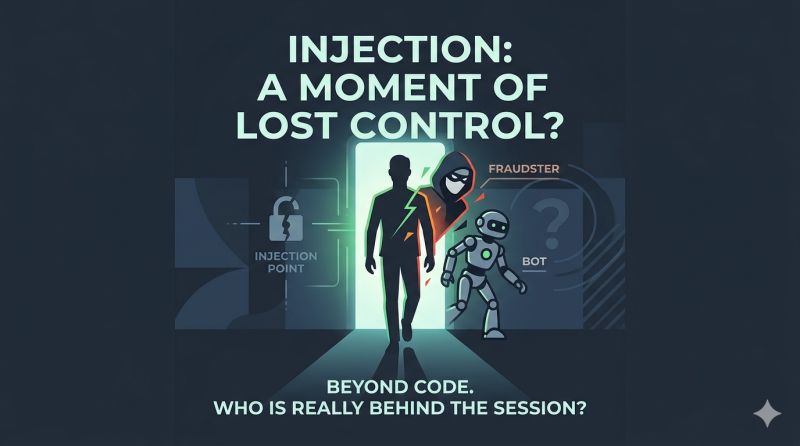
It is often the moment your application loses the ability to tell whether the person behind the session is the real user, a fraudster, or a bot quietly abusing trust.
That is why Injection keeps hurting businesses even after the team says:
"We use parameterized queries."
"We validate input."
"We ran the scans."
I keep seeing the same pattern.
A team fixes the obvious SQL injection risks.
They clean up input validation.
They pass their security checks.
Everyone feels safer.
Then one overlooked endpoint, one legacy report builder, one client side script issue, or one hidden dynamic query turns into something much bigger.
Not just a vulnerability.
A live fraud problem.
Now the attacker is not only querying data.
They are hijacking sessions.
Testing stolen identities.
Abusing customer accounts.
Automating actions that look normal enough to slip through.
Turning an application security issue into account takeover, account opening abuse, and bot driven fraud.
That is the part many teams miss.
The real damage from OWASP A05 Injection often starts after the technical exploit succeeds.
So the smarter question is not only:
"How do we prevent injection?"
It is also:
"How do we know, in real time, when an injected path is being used to abuse trust inside the application?"
That is where the strategy changes.
Secure coding still matters.
Parameterized queries still matter.
DAST still matters.
Server side validation still matters.
But if you stop there, you are still betting that your team caught everything.
A stronger approach is to combine prevention with continuous monitoring.
That is exactly where CrossClassify fits.
CrossClassify helps teams strengthen protection against downstream risks of OWASP Injection by combining device fingerprinting and behavioral biometrics into a continuous monitoring layer for modern applications.
If your team is thinking about application fraud prevention, OWASP Injection should not be treated as a developer only issue anymore.
It should be treated as a business risk that needs runtime visibility.